Why you should stop using 'Cloze Deletion' for complex concepts
Cloze deletion is fast to create but often leads to pattern matching. Learn why Q&A encoding is better for understanding logic and engineering principles.
Cloze deletion is a flashcard type where you hide a specific word in a sentence and try to fill it in later. It is the fastest way to turn a textbook into a deck. But if you are using it for complex logic or engineering, you are likely falling into a pattern matching trap.
Hello there! My name is Daniel. I am a third year engineering science student at the University of Toronto, specializing in machine intelligence. I also work on Nebulearn. Because I built a study tool, I have a clear conflict of interest here, but I also spend my life looking at how students encode information.
The problem with cloze deletion is that your brain is incredibly efficient at finding shortcuts. When you see a sentence with a hole in it, your brain does not always retrieve the underlying concept. Often, it just learns the shape of the sentence.
What is cloze deletion
Before we look at why it fails, we need to define what it is. In apps like Anki, a cloze deletion looks like this:
The {{c1::mitochondria}} is the powerhouse of the cell.
When you study, you see "The [...] is the powerhouse of the cell." You provide the missing word. It is popular because you can copy a sentence from a PDF, hit a keyboard shortcut, and have a card in three seconds. This speed is a double edged sword. Because it is so easy to make, you end up making hundreds of them without ever truly encoding the information effectively.
The Sentence Shape fallacy
The Sentence Shape fallacy happens when you start recognizing a card by its length, its first three words, or a specific preposition rather than the logic it contains.
I hit this hard in my second year circuits course. I had dozens of cloze cards for different theorems. After a month, I wasn't thinking about Kirchhoff's Voltage Law anymore. I just knew that when I saw a sentence starting with "The algebraic sum of..." the answer was "zero."
My brain had mapped a visual trigger to a string of text. On the exam, when the question was phrased differently, that trigger never fired. I knew the sentence, but I didn't know the law.
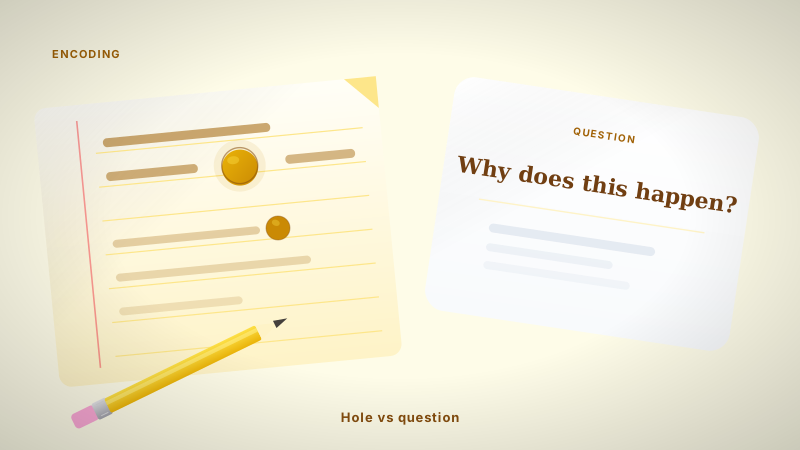
Comparison: Cloze vs. Q&A
To see the difference, look at how we can encode the same concept using two different methods.
Concept: In a steady state inductor, the voltage across it is zero because the current is constant.
The Cloze Version:
- Front:
In a steady state inductor, the voltage across it is {{c1::zero}} because the current is {{c2::constant}}. - The Trap: You quickly learn the "zero because constant" rhythm. You aren't thinking about $V = L(di/dt)$.
The Q&A Version:
- Front: Why is the voltage across a steady state inductor zero?
- Back: Because current is constant, and voltage depends on the rate of change of current ($di/dt = 0$).
The Q&A version forces you to explain the "why." It requires a deeper level of encoding because you cannot hide behind the structure of a pre-written sentence. You have to generate the answer from scratch. That is the same bar as how to use flashcards effectively.
The 2-second rule for card answers
One way to tell if your cards are working is the 2-second rule. A good flashcard should take you less than two seconds to answer once you have finished reading it.
If a cloze card takes longer, it is usually because the sentence is too long and you are busy re-reading the context to find your place. If a Q&A card takes longer, it usually means the question is too broad.
Cloze deletion feels fast during creation, but it leads to "leaky" cards that you get right in your app but wrong in the real world. Q&A cards take longer to write, but they ensure that the time you spend in your due queue actually builds intuition.
| Feature | Cloze Deletion | Q&A (Basic) |
|---|---|---|
| Creation Speed | Extremely High | Moderate |
| Cognitive Load | Low (Recognition) | High (Retrieval) |
| Risk of Pattern Matching | High | Low |
| Best For | Vocabulary, simple facts | Logic, "Why" questions, Engineering |
When to use cloze deletion in Anki
I am not saying cloze deletion is useless. If you are using Anki for medical school or language learning, cloze is often the only way to handle the sheer volume of terminology. If you have 10,000 cards to make, you cannot spend three minutes on each one.
Anki is great for this because of its massive ecosystem of shared decks. If you are an iPhone user, AnkiMobile is about $25 one-time, while the desktop version is free. For those types of high-volume, fact-based subjects, cloze is a powerful tool.
However, if you are studying a subject where you need to apply principles to new problems, cloze deletion can be a crutch. It gives you a false sense of security. You feel like you are "mastering" the deck, but you are actually just mastering the sentences.
Why Q&A is the default I actually use
When I started building the editor, I made a conscious choice to focus on Q&A pairs. I wanted to move away from the "fill in the blank" style of learning that dominates apps like Quizlet.
On Quizlet, the free "Learn" mode is session-scoped. It helps you master a list for a test tomorrow, but it doesn't provide a long-term due calendar unless you pay for their Plus tier. Even then, their "Memory Score" is a proprietary spacing system, not the open FSRS algorithm we use.
I wrote a guide on how to write flashcards that stick. The same idea shows up in how to use flashcards effectively: one fact, one prompt.
We also default to FSRS (Free Spaced Repetition Scheduler), which is the most accurate way to predict when you are about to forget a card. If you want to see the math behind it, you can check out the FSRS Github.
Making the switch
If you have a deck full of cloze deletions and you find yourself "cheating" by recognizing the cards, try converting the most important ones to Q&A.
Ask yourself: "If I didn't see this sentence, would I still know the answer?"
If the answer is no, your encoding is failing. Start by writing cards that ask "Why" or "How" rather than "What is the missing word." It will be harder at first, and your daily review might take a bit longer, but the knowledge will actually stick when the exam paper looks nothing like your flashcards.