Encoding complex diagrams without Image Occlusion
Image occlusion is great for anatomy, but it can fail for logic. Learn why describing diagrams in text leads to better long-term retention.
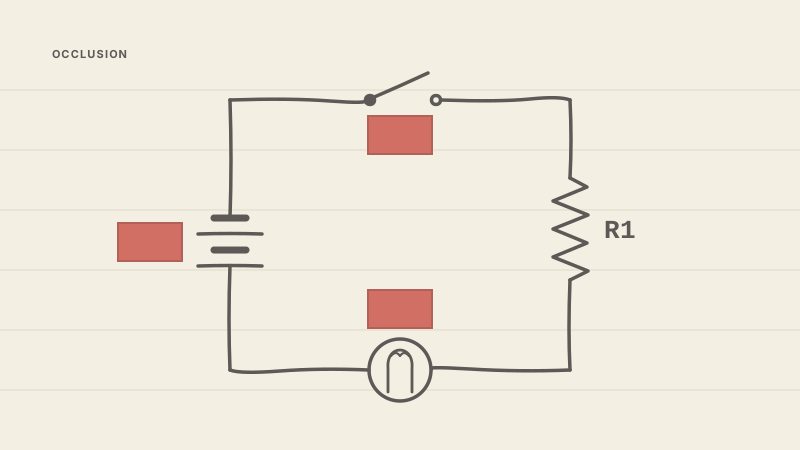
Most students treat diagrams like a game of "hide the label." You take a screenshot of a heart or a circuit, put a red box over the word "Aorta," and call it a day. This is called Image Occlusion (IO), and it is the fastest way to feel like you are learning without actually understanding a single thing on the screen.
I work on Nebulearn. I built image occlusion into the app because it is essential for specific subjects. But for my own Engineering Science courses at UofT, I rarely use it. If you have ever aced your flashcard deck only to blank when the professor shows the same diagram from a different angle, you have experienced the "spatial recognition" trap.
To memorize a diagram effectively, you have to decide if you are learning where things are or how things work. If you choose the wrong one, you fall into a pattern where you recognize the card but fail the exam.
The spatial recognition trap
The problem with Image Occlusion is that your brain is incredibly lazy. If you show it a picture with a box, it won't try to understand the logic of the system. Instead, it will memorize the pixels. You start to remember that "the label in the top right corner is the resistor," not because you understand the circuit, but because you recognize the shape of the image.
This is spatial encoding. It is why you can recognize your house from the street but might struggle to draw a floor plan from memory. When the context changes slightly, the memory collapses.
If you are studying computer science, a diagram of a database architecture isn't about geography. This is why it's often the study app that saves the most time is the one that forces you to encode logic rather than pixels. It is about flow. By occluding the labels, you are testing your ability to name a box, not your ability to explain why that box exists.
When Image Occlusion is actually the right tool
I am not saying Image Occlusion is bad. It is a specialized tool for a specific type of knowledge: brute-force anatomy.
If you are a med student and you need to know the names of twenty different bumps on a femur, you cannot "logic" your way through that. There is no functional reason why one bump is named one thing and not another. It is arbitrary geography. In that case, spatial recognition is exactly what you want.
| Subject | Best Method | Why |
|---|---|---|
| Gross Anatomy | Image Occlusion | Purely spatial; location is the primary data. |
| Physiology | Functional Description | Understanding the process matters more than the label. |
| Circuit Design | Logic Cards | The relative position changes; the component roles don't. |
| Organic Chemistry | Mixed | IO for reagents; Functional for mechanisms. |
If the diagram represents a sequence or a logic chain, hiding the labels is a stand-in for learning that usually fails during the exam. However, there are cases where the 'where' is the only thing that matters.
The Functional Description technique
Encoding a diagram as a set of logical propositions is more durable than memorizing a coordinate. Instead of hiding a label, try to describe the diagram's logic in text. This forces a process called "dual coding." You are taking a visual concept and translating it into a logical proposition.
For a diagram of a kidney nephron, a bad IO card asks: "What is this tube?" (Points to the Loop of Henle).
A good Functional Description card asks: "In the nephron, which structure creates the osmotic gradient in the medulla, and what is its primary mechanism?"
By writing the text card, you have to mentally traverse the diagram. You aren't just looking at a pipe; you are thinking about sodium pumps and water permeability. You can still include the image on the back of the card for reference, but the "question" should live in your head, not in the pixels.
Breaking diagrams into Logic Cards
When I have a complex process flow, I break it into "If/Then" or "Input/Output" cards. This is how I handle image occlusion without Anki when the diagrams get too messy to box up.
If you have a diagram of a software microservices mesh, don't occlude the "Load Balancer" label. Ask yourself:
- "What is the entry point for a request in this diagram?"
- "If Service A fails, which component in the diagram handles the retry logic?"
This forces you to "run" the diagram in your mind. If you can answer those questions, you have encoded the diagram. If you can only point to the box in the middle, you have just memorized a picture.
How to transition from pictures to logic
If you already have a massive deck of image occlusion cards, don't delete them. That is a waste of time. Instead, start adding "Why" questions to the extra fields.
When a card comes up, don't just click "Good" because you remembered the word. Force yourself to say out loud what that component does before you flip the card. If you can't say it, mark it as "Again," even if you got the label right.
I built Nebulearn to handle both. You can snip an image from your lecture slides using the Chrome extension and immediately decide: do I want to hide a label, or do I want to use the AI to generate a functional question based on the text next to that image?
Most of the time, the text question wins because it survives the exam room.