New vs Due Cards: What's the Difference, and Which Should You Study First?
A simple guide to new and due flashcards, how spaced repetition moves cards into your review cycle, and when to study each pile.
The first time I opened up Nebulearn and Anki, I was very confused about the difference between new and due cards.
Well, the actual meaning of new versus due made sense. I understood that a new card was new. What confused me was when I was supposed to study from each pile.
There seemed to be no hard-set rule, nothing obvious to follow, and it was just terribly confusing. Should I finish every new card first? Should I only study due cards? Was I doing something wrong if I left fifty new cards sitting there?
If you're anything like me, fear not. Here is my guide to what new and due cards are, how they fit into spaced repetition, and when you should study each one.
First, how does spaced repetition work with flashcards?
Before the difference between new and due cards really makes sense, you need to understand the basic cycle behind spaced repetition.
When you study a flashcard, you rate how well you remembered it. In Nebulearn, for example, you can rate a card from No Idea to Mastered. The spaced repetition algorithm uses that rating to decide when you should see the card again.
If you did not know the answer, the card comes back sooner. If you knew it well, the card is scheduled farther into the future. The better you continue to remember it, the longer the gaps between reviews can become.
The goal is to review each card around the time you might otherwise forget it. Instead of studying every card every day, you spend more time on the material you are in danger of forgetting and less time on the material you already know.
That scheduled day is the card's due date.
So the basic cycle looks like this:
- You study a new card for the first time.
- You rate how well you remembered it.
- The spaced repetition algorithm schedules it for a future review.
- When that day arrives, the card becomes due.
- You study it again, rate it again, and receive a new due date.
Once I understood that cycle, the two piles made much more sense.
Due cards
Due cards are cards you have studied before and that the spaced repetition algorithm has scheduled for review.
In simple terms, the app is saying, "This is probably a good time to test your memory on this card again."
The card might be due because you struggled with it yesterday. It might also be a card you have remembered correctly many times and have not seen for a month. Every card follows its own schedule based on your previous reviews.
This is why I generally recommend studying your due cards first. They are appearing now for a reason. You already introduced them into your review cycle, and keeping up with them is how you avoid forgetting material you previously learned.
That does not mean missing one due card for one day will destroy your progress. It just means that due cards should usually be your default when you open the app and wonder what to study.
New cards
New cards are cards you have not studied yet.
They are not part of your spaced repetition cycle because the algorithm does not have a review from you yet. Until you study a new card for the first time, it can simply sit in the new pile. You are not behind, and the card is not overdue. It is just waiting to be introduced.
The moment you study and rate it, that changes. The card receives its first due date and becomes part of your future review load.
This is the most important thing to understand about new cards: studying a new card creates more work later.
That is not a bad thing. Learning more material is the entire point. But every new card you introduce will eventually return as a due card, and usually more than once. If you study a huge number of new cards in one sitting, you may suddenly have a huge number of reviews waiting for you over the next few days.
You do not need to study all your new cards at once. In fact, I generally would not. Add them little by little so you do not flood your future reviews.
For example, imagine you already have 500 due cards and you just added a couple of enormous decks containing 10,000 new cards. Do not sit down and try to study all 10,000 new cards in that moment. Study a handful each day instead.
Remember, the more new cards you study now, the more due cards you will have later. If you introduce all 10,000 cards at once, you are not clearing your workload. You are scheduling an avalanche of future reviews. Those cards will start returning over the following days and weeks, on top of the 500 cards you already had due.
Introducing a manageable number each day gives you time to learn the material without suddenly flooding your review cycle.
So, should you study new or due cards first?
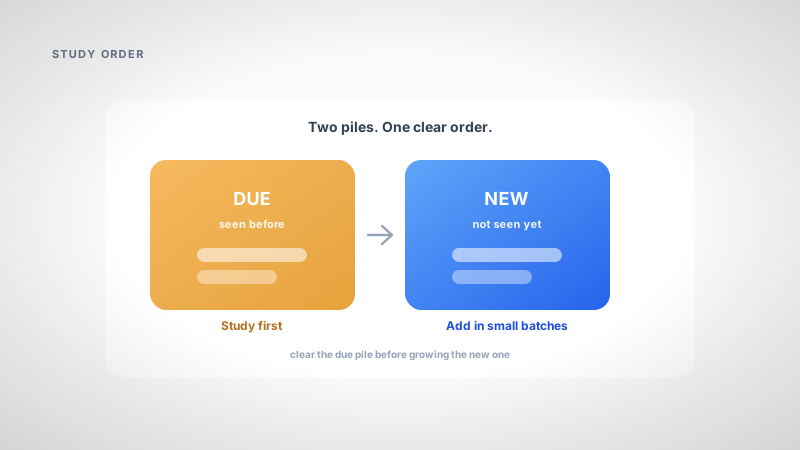
My general advice is simple: try to study your due cards first. Then study some new cards whenever you feel ready to add more material to your rotation.
Due cards maintain what you have already learned. New cards expand what you are learning.
If you only have a few minutes, study your due cards.
If you finish your due cards and still want to keep going, study some new cards.
If you have a large new deck, do not feel like you need to finish the whole thing. Study a small batch, let those cards enter your review cycle, and add more when the extra reviews still feel manageable.
There is no perfect number of new cards that works for everyone. Ten easy vocabulary cards and ten dense medical cards can create completely different workloads. Your available time, the difficulty of the material, and the number of reviews you already have all matter.
The better question is: Do I have room to add more cards right now?
If your due pile already feels overwhelming, focus on catching up before adding much more. If your reviews feel manageable and you want to learn more, bring in a few new cards.
You are allowed to leave new cards untouched
I think this is the part that confuses a lot of people when they first use a spaced repetition app.
A large number beside the New button can look like unfinished work. It is not.
Your new pile is closer to a library of material you could start learning. You choose when to bring those cards into your active study cycle. There is no prize for emptying the entire pile today, especially if doing that makes your due pile miserable tomorrow.
This also means you can move at your own pace. Maybe you introduce a few new cards every day. Maybe you only add new cards after a lecture. Maybe you stop adding them for a week because exams are coming up and your current reviews are enough.
All of those approaches are fine. The point is to build a workload you can actually keep up with.
What if I want to study new cards first?
You can. "Due before new" is useful advice, not a law.
Sometimes you need to learn a new chapter before class. Sometimes you just made a deck for tomorrow's test and none of its cards have entered the review cycle yet. Sometimes learning something new is simply what gets you to sit down and study.
The app is a tool. It does not know every deadline or priority in your life.
I would only be careful about making a habit of constantly adding new cards while ignoring a growing due pile. New cards often feel more productive because you are covering fresh material, but due cards are what keep that material from disappearing again.
What if I'm cramming?
First off, if you are doing spaced repetition properly, you should not need to cram. The whole point is to keep reviewing material over time so you are not trying to relearn an entire class the night before an exam.
But maybe you fell behind. Maybe the exam date moved. Maybe you only started making cards a few days ago. Life happens, and if you do need to cram, fear not.
You do not need to work through every due card from every deck before studying for the exam in front of you. Open the specific deck you are cramming and start with the due cards in that deck. Those are the cards from that subject that the algorithm already thinks you should review.
Once you finish those, you can keep studying that deck. Review cards you are struggling with again, and introduce any new cards containing material you still need to learn. The goal during a cram session is narrower than your normal daily routine. You are focusing on the material that matters for the immediate test.
Just remember that cramming new cards still creates future due cards. If the deck contains hundreds or thousands of untouched cards, be realistic about what you can actually learn. Prioritize the material most likely to matter instead of mindlessly trying to empty the New pile.
After the exam, return to your normal spaced repetition routine. Study your due cards consistently and introduce new cards gradually. Cramming can help in an emergency, but it should be the backup plan, not the system.
The short version
Due cards are cards you have studied before that are scheduled for another review.
New cards are cards you have not studied yet. Once you study them, they enter your spaced repetition cycle and create future due cards.
In general, study your due cards first. Then, whenever you want to learn more and feel like you can handle the additional review load, study a small number of new cards.
You do not need to finish all your new cards. Introduce them little by little, keep an eye on how large your due pile becomes, and adjust from there.
That is really it. Maintain what you have already learned, add new material at a pace you can handle, and do not let two buttons make spaced repetition feel more complicated than it is.