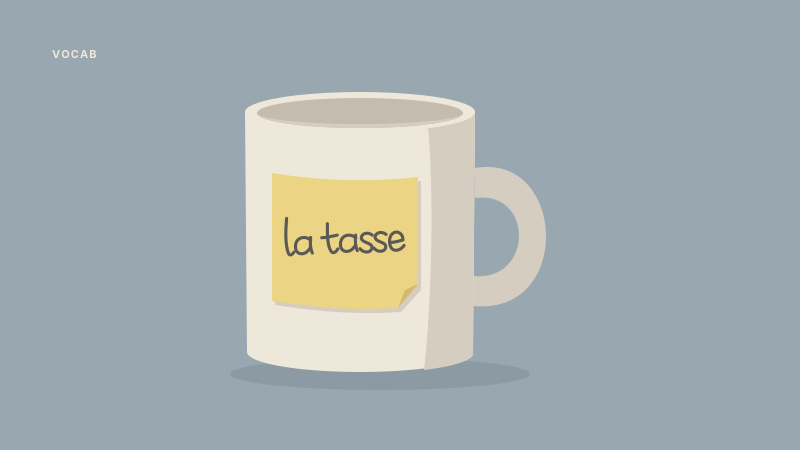
Language learning without living in Anki
Anki is the gold standard for vocab, but the setup cost is high. Here is how to choose an alternative for language learning if you bounced off the configuration.
If you are looking for an Anki alternative for languages, you are likely in one of two camps. You either love the idea of spaced repetition but hate the 1990s interface, or you are tired of spending more time configuring "card types" than actually speaking your target language.
Anki is still the most powerful tool for this job. If you are using a massive pre-made deck like the AnKing or a 10,000-word core frequency list, you should probably stay there. But if your bottleneck is the friction of creating cards while you read or the "overwhelming" feeling of a setup that requires a degree to customize, there are other ways to keep a due queue.
I work on Nebulearn. I built it because I wanted the power of a real scheduler without the setup tax. That is a conflict of interest, so I will be blunt: if you already have a 500-day streak in Anki, do not switch. Moving your review history is messy and usually not worth the time.
Why language learning needs a real scheduler
Before looking at apps, we have to define what makes a tool work for vocab. Most "study apps" use session-scoped learning. You sit down, you see 20 words, and you repeat them until you get them right in that sitting.
Spaced repetition (SRS) is different. It tracks every individual word on its own timeline. If you know "Bonjour" perfectly, you shouldn't see it for three months. If you keep tripping over a specific verb conjugation, you should see it tomorrow.
Without a real due queue, you end up in the "cramming cycle." You study hard for a week, forget half of it, and then have to restart the whole set. A real SRS tool prevents this by giving you a specific list of cards that are "due" each day based on how well you remembered them last time.
Comparing the big players for languages
Most people find Anki too complex, but they find Quizlet too "shallow" because it lacks a long-term calendar. Here is how the trade-offs actually look in 2026.
| Feature | Anki | Quizlet | Nebulearn |
|---|---|---|---|
| Price | Free (Desktop/Android), ~$25 (iOS) | Free (Basic), Paid (Plus) | Free (1000 cards), Paid (Unlimited) |
| Scheduler | FSRS / SM-2 (Real SRS) | Session-scoped (Basic) | FSRS (Real SRS) |
| Setup Time | High (Config heavy) | Low | Low |
| Card Creation | Manual / Bulk Import | Manual / AI | Chrome Extension / AI |
| Best For | 10-year decks & Power users | Friday night cramming | Fast card creation from web/PDF |
Anki: The powerhouse
Anki is the winner for anyone who wants total control. If you want to use the FSRS algorithm and tweak every weight, Anki is the only choice. It is also the home of the best shared decks. If you are looking for a "Core 2k/6k" Japanese deck with audio and images already attached, you will find it in the Anki ecosystem.
The downside is the "Anki tax." You have to learn what a "cloze" is, how to sync with AnkiWeb, and how to manage media files. For many, this complexity is why they stop using SRS entirely.
Quizlet: The session king
Quizlet is great for a quick win. If you have a vocab test on Friday and you just need to drill 50 words, Quizlet is faster than anything else.
However, they retired their "Long-Term Learning" feature years ago. The free version of "Learn" mode is session-based. Even with a Plus subscription, the "Memory Score" is a paid spacing feature that isn't as granular as a true FSRS scheduler. It is built for passing a test, not for owning a language for a decade. You can read more about how to use flashcards effectively or check our breakdown of study apps that save the most time to see why this distinction matters.
The setup-bounce case
If you "bounced" off Anki, it was probably because of the card creation friction. Language learning happens while you are consuming content: reading an article, watching a show, or going through a textbook PDF.
If you have to stop your flow, open a separate app, type the word, look up the translation, and then go back to your reading, you will eventually stop making cards.
This is where I focus with Nebulearn. Instead of a complex configuration menu, I built a Chrome extension that lets you highlight a phrase in your target language and send it directly to your queue. It handles the AI translation and the card formatting without you ever leaving the page you are reading.
Making the choice
If you are trying to decide which path to take, look at where you are in your journey.
- If you are a medical student or a hardcore polyglot who already has a massive deck: Keep using Anki. The $25 for AnkiMobile is a one-time fee that is worth it for the ecosystem.
- If you are a student cramming for a single exam and you don't care about remembering the words next year: Use Quizlet. It is the easiest way to drill a set of cards someone else already made.
- If you are learning a language by reading and you want a real due queue without the configuration headache: This is why we built Nebulearn.
The free tier of Nebulearn gives you 1,000 saved questions and 40 weekly AI credits with no ads in your study sessions. We use the FSRS scheduler by default, so you get the same scientific backing as high-end Anki setups without having to touch a single settings menu.
The "best" app for languages is the one that gets out of your way. If you spend more time looking at your flashcard settings than your target language, you are doing it wrong.