Why your 'Study Streak' is a trap (and how to actually stay consistent)
Study streaks feel productive but often incentivize low-quality reviews. Learn why streaks fail and how to build a consistency model that survives real life.
Hello there! If you are reading this, you are likely trying to figure out how to stay consistent with studying without burning out by week three. A little about me first. My name is Daniel. I'm a third year engineering science student at UofT, specializing in machine intelligence.
I also work on Nebulearn. Because I build a study tool, I think about consistency mechanics constantly. It is a conflict of interest, but it also means I see exactly where the "gamified" approach to learning breaks down for real students.
To stay consistent with studying, you have to stop optimizing for a consecutive day count and start optimizing for the health of your due queue. A streak is a measure of attendance; learning is a measure of retrieval quality. When those two conflict, the streak usually wins, and your retention loses.
The Honeymoon crash
Most study habits start with a burst of high intensity. You download a new app, you make 50 cards, and you promise yourself you will never miss a day. This is the Honeymoon phase.
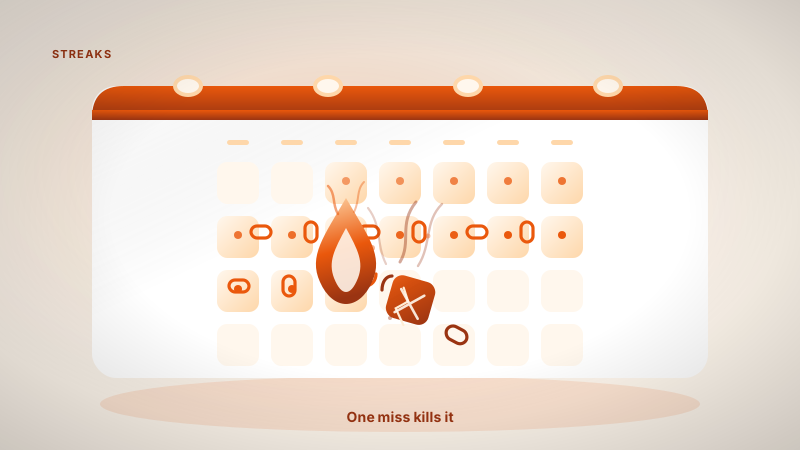
The problem is that streaks are fragile. They are an all-or-nothing mechanic. On day 14, you feel like a hero. On day 15, if you have a late lab or a family dinner and miss your window, the number resets to zero. For many students, a broken streak feels like a permission slip to stop entirely. If the only thing keeping you coming back was the fear of losing a "14," there is no reason to log in on day 16 when that number is gone.
This "crash" happens because the streak focuses on the wrong unit of progress. It treats a 5 minute session of easy cards the same as a 40 minute deep dive into complex material.
Why streaks incentivize low quality reviews
When a streak is the primary reward, your brain looks for the path of least resistance to keep it alive. I have seen this happen in my own study sessions. If it is 11:30 PM and I am exhausted, I might open my flashcards just to clear the "easiest" five cards so the app registers activity.
This creates a "review-only day" where no real learning happens. You aren't pushing your memory or tackling the difficult concepts you actually need for the exam. You are just servicing a database entry.
Quality of retrieval is what matters for long term retention. If you are clicking "Easy" on cards you barely remembered just to finish the set and keep your streak, you are lying to the algorithm. Eventually, those cards will come back to haunt you during finals week when you realize you never actually learned the underlying logic.
The difference between a session and a schedule
To understand why streaks fail, we have to look at how different apps handle consistency. There is a massive gap between doing a "session" and maintaining a "schedule."
Apps like Quizlet are great for a quick session. Their free Learn mode is largely session-scoped, meaning it helps you master a specific set in one sitting. However, Quizlet retired their Long-Term Learning feature a while ago. While they have a paid Plus Memory Score, it is not a full FSRS (Free Spaced Repetition Scheduler) implementation. It doesn't really care if you missed yesterday; it just wants you to pay to see your "score."
On the other hand, a tool like Anki is built entirely around a schedule. If you miss a day in Anki, the cards don't disappear and your progress doesn't reset to zero. They just pile up. This is more honest, but it can be overwhelming. Anki Mobile costs about $25 on iOS, though the desktop and Android versions are free. It is the gold standard for many, but it still doesn't solve the "guilt" of a growing pile.
| Metric | Streak-Based Apps | Spaced Repetition (Anki/Nebulearn) |
|---|---|---|
| Primary Goal | Don't break the chain | Clear the due pile |
| Failure State | Number resets to 0 | Pile gets larger |
| Incentive | Speed and attendance | Honest retrieval |
| Long-term Value | High ego, variable retention | High retention, high effort |
How to recover from a broken streak
If you have already broken a streak and feel like giving up, the first step is to change your metric. Stop looking at the "Day Count" and start looking at your "Due Queue."
When I miss a day of studying at UofT, I don't try to "catch up" by doing 5 hours of cards at once. That leads to a second burnout. Instead, I use a "limit" approach. I tell myself I will clear 20 cards today. It doesn't matter if there are 200 due. By doing 20 high quality reviews, I am doing more for my brain than I would by rushing through 100 just to see a green checkmark.
Consistency is about the average volume over a month, not the consecutive string of days. You can read more about this in my post on consistency vs intensity in flashcards.
Building a system that allows for being human
The "Dark Side" of study streaks is that they treat learning like a game of Flappy Bird. One mistake and you are back at the start. Real learning is more like a gym routine. If you miss Monday at the gym, you don't lose all your muscle. You just go back on Tuesday.
This is why I built Nebulearn to focus on the health of the due pile rather than a gamified streak. We use the FSRS algorithm by default because it is better at calculating exactly when you will forget something, even if your study patterns are irregular. You can learn more about the dark side of study streaks and why "perfect" attendance is often a lie.
If you are struggling to stay consistent, try this:
- Set a "minimum viable" review count (e.g., 5 cards).
- Focus on the cards that are actually "Due" according to a real scheduler.
- Forgive yourself for the days life gets in the way.
The goal is to pass the exam, not to have a high number in an app. If your current tool makes you feel like a failure for having a life outside of school, it might be time to look at how to use flashcards effectively without the gamified pressure.