Anatomy: Memorizing Origins, Insertions, and Innervations
How to break down muscle OIAN tables into flashcards that actually stick without mixing up your facts.
Memorizing the musculoskeletal system usually involves a massive table. You have the muscle name, then four high-stakes columns: Origin, Insertion, Action, and Nerve supply (OIAN).
The fastest way to memorize muscle origins and insertions is to split every muscle into four distinct flashcards rather than one large "everything" card. If you put the whole OIAN row on one card, you will likely memorize the sequence of the words rather than the anatomy. You might remember that "long head" comes before "coracoid process" in your head, but fail to recall the nerve supply when it is asked in isolation on a practical exam.
I work on Nebulearn. I built it because I was tired of manual data entry for these exact types of tables, but I still use other tools when they fit. If you are using a pre-made deck like AnKing for med school, keep using it. The time you save by not making cards is worth the friction of a legacy UI. But if you are staring at a fresh PDF from your professor, the way you structure your cards this week determines if you actually know the material by the final.
Why the OIAN mnemonic fails on a flashcard
The OIAN mnemonic is a great way to organize a notebook, but it is a terrible way to organize a due queue. When you put Origin, Insertion, Action, and Nerve supply on a single card, you create a "serial position" dependency.
Your brain is very good at shortcuts. If a card asks for "Biceps Brachii: O, I, A, N," you aren't learning four facts. You are learning one long string of text. In a clinical setting or a lab practical, no one asks for the whole string. They point at a nerve and ask what it supplies. If you can only recall the nerve by reciting the origin and insertion first, your recall is too slow.
| Strategy | Result |
|---|---|
| One card per muscle | You memorize the "rhythm" of the text. High chance of mixing up similar muscles. |
| Four cards per muscle | True isolation. You learn the nerve supply independently of the bone attachment. |
| Image Occlusion | Best for identifying the muscle on a diagram, but doesn't help with text-heavy origins. |
Origin vs Insertion: The naming trap
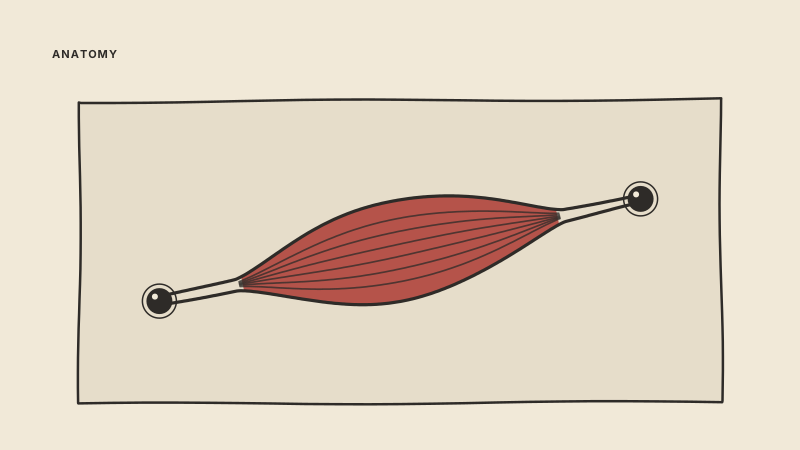
The Origin is usually the proximal attachment (closer to the center of the body) that stays relatively fixed during contraction. The Insertion is the distal attachment that moves.
Many students try to memorize these as "Top" and "Bottom," but that fails the moment the muscle orientation changes or you move to the lower limbs. Instead of memorizing coordinates, your flashcards should focus on the bone and the specific landmark (like the "greater tubercle" or "linea aspera").
When you create these cards, use the "Minimum Information Principle." A card should have one question and one answer.
Bad Card:
- Front: Biceps Brachii Origin and Insertion
- Back: O: Supraglenoid tubercle and Coracoid process. I: Radial tuberosity.
Good Cards (Two separate cards):
- Card 1: Origin of Biceps Brachii (Long Head)? -> Supraglenoid tubercle.
- Card 2: Insertion of Biceps Brachii? -> Radial tuberosity.
Breaking these down prevents the "interference" effect where you accidentally swap the origins of the brachialis and the biceps because the cards look identical in your peripheral vision. You can read more about this in my guide on how to use flashcards effectively.
Managing Nerve Supply and Action
Nerve supply (innervation) is the column most people skip until the night before the exam. This is a mistake because innervations often follow logical patterns based on compartments.
Instead of memorizing the nerve for every single muscle as a unique fact, group your cards by "Nerve -> Muscles supplied." This helps you see the musculoskeletal system as a functional map rather than a list of 600 names.
For the "Action" or "Function" column, avoid long descriptions. If a muscle flexes the elbow and supinates the forearm, make those two separate cards or one card with two very clear bullet points. If you find yourself writing a paragraph on the back of a card, you are no longer doing spaced repetition; you are just reading a textbook in small chunks.
Netter's Anatomy vs Anki vs Nebulearn
The tool you choose depends on where your material is coming from.
If you are a medical student, Anki is the standard because of the community decks. If you have an iPhone, AnkiMobile costs about $25 once, while the desktop and Android versions are free. The learning curve is steep, but for a four-year degree, it is a solid investment.
If you are a student who needs to turn a specific professor's PDF or a set of lab slides into cards quickly, Quizlet is often the first stop. However, Quizlet's free "Learn" mode is session-scoped. It helps you "master" a set in one sitting, but it doesn't give you a long-term due calendar based on how well you know each card. Their "Memory Score" is a paid feature, and it isn't based on the FSRS algorithm that modern researchers recommend.
I built Nebulearn to handle the "OIAN" problem. When you have a table in a PDF, you shouldn't have to type "Origin of..." fifty times. You can highlight the table and have the AI draft separate cards for origin, insertion, action, and innervation, then check them before they go in your queue. FSRS is on by default, so each of those cards gets its own schedule from day one.
You can compare how these different apps handle your study time in my breakdown of study apps that save the most time.
How to handle the volume without burning out
Anatomy is a volume game. The bottleneck is almost always card creation. If it takes you three hours to make cards for a one-hour lecture, you will fall behind by week three.
- Don't wait for the weekend. Make cards the day of the lecture while the "Action" of the muscle still makes sense in your head.
- Use Image Occlusion. For the "Action" column, sometimes a GIF or a diagram of the movement is better than a text description.
- Trust the algorithm. If a card says it isn't due for 4 days, don't "cram" it early. Spend that time making cards for the next chapter.
If you are struggling with the sheer number of cards, you might need to adjust how you filter your notes. I wrote a specific guide on anatomy flashcards without overwhelming queues that covers how to decide what is "testable" and what is just noise.
The goal is to get through the musculoskeletal system without your due queue hitting 500 cards a day. By splitting your OIAN tables into atomic, single-fact cards, you spend less time "thinking" about what the card is asking and more time actually reinforcing the memory.