Chemistry Nomenclature: Why you can't remember IUPAC names
Stop memorizing organic chemistry names as whole strings. Learn how to use flashcards to master IUPAC priority rules, functional groups, and suffixes.
Hello there! If you are staring at a molecule and the name looks like a random string of alphanumeric soup, you are likely falling into the same trap I did during my first year of engineering science at UofT.
You are trying to memorize the name as a single word.
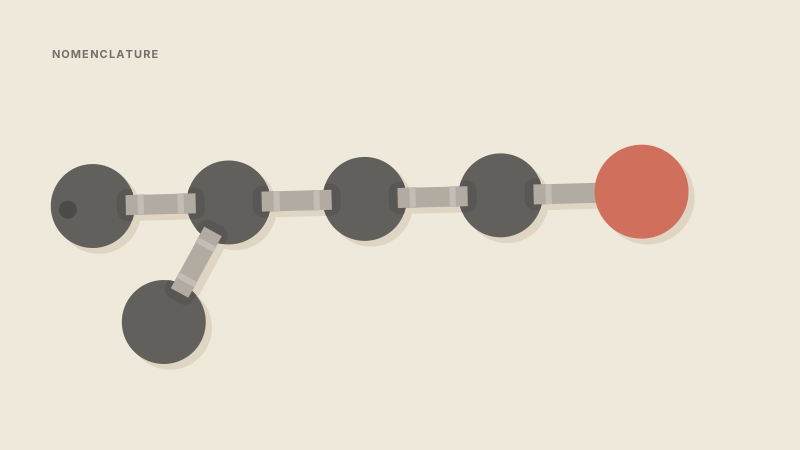
Organic chemistry nomenclature is not a vocabulary list. It is a set of grammatical rules. If you treat "3-methyl-pent-1-ene" as one block of data, you will fail the moment the professor adds a hydroxyl group or moves a double bond. You have to learn how to memorize organic chemistry names by breaking them into their functional components: the prefix, the stem, and the suffix.
I work on Nebulearn, so I have a bias toward using a real due queue to handle this. But before we get into the software, we need to fix the way you are actually encoding the chemistry.
The prefix stem suffix split
The most common mistake in chemistry naming practice is creating flashcards that show a structure on the front and the full IUPAC name on the back.
This is a high-friction way to study. Because the name is long, you might get 90 percent of it right but miss one number. Then you have to decide: do I mark this as correct or wrong? If you mark it correct, you ignore the mistake. If you mark it wrong, you are forced to re-study the parts you already knew, like the parent chain length.
Instead, you should atomize the rules. A name is a construction of three distinct layers:
- The Stem: How many carbons are in the longest continuous chain containing the highest priority functional group?
- The Suffix: What is the highest priority group (the "principal" group)?
- The Prefix: What are the substituents (the "extra" bits) and where are they located?
If you can't identify the parent chain, you can't name the molecule. If you don't know the functional group hierarchy, you won't know which suffix to use.
Mastering functional group hierarchy
The IUPAC priority rules determine which part of the molecule gets the suffix and which parts are relegated to the prefix. This is the "law of the land" in nomenclature.
If you have a molecule with both a carboxylic acid and an alcohol, the acid wins. The molecule ends in "-oic acid" and the alcohol is named as a "hydroxy-" prefix. If you don't have this hierarchy internalized, you will spend every exam second-guessing your suffixes.
| Functional Group | Suffix (as priority) | Prefix (as substituent) |
|---|---|---|
| Carboxylic Acid | -oic acid | carboxy- |
| Ester | -oate | alkoxycarbonyl- |
| Amide | -amide | amido- |
| Nitrile | -nitrile | cyano- |
| Aldehyde | -al | oxo- / formyl- |
| Ketone | -one | oxo- |
| Alcohol | -ol | hydroxy- |
| Amine | -amine | amino- |
You should not make one giant card for this table. That is a recipe for mental burnout. Instead, create "priority battle" cards. Put two groups on the front (e.g., Ketone vs. Alcohol) and ask which one takes priority for the suffix. This forces your brain to navigate the hierarchy tree quickly.
Suffix encoding and the principal group
The suffix is the most important part of the name because it identifies the core identity of the molecule. This is where suffix encoding comes in.
When you see a functional group, your brain should immediately trigger the suffix. But you also need to know the "dropped" version of the name. For example, when naming an alkane that becomes an alcohol, you drop the "e" (ethane becomes ethanol).
If you are struggling with this, link your nomenclature cards to your organic chemistry reaction mechanism flashcards. Understanding how a group reacts often helps reinforce what that group is actually called. If you know how an "al" (aldehyde) behaves, you are less likely to confuse it with an "ol" (alcohol) during a timed test.
IUPAC priority rules in practice
Once you have the hierarchy down, you need to practice the "tie-breaker" rules. These are the details that separate an A from a B in organic chemistry.
For example, when numbering the parent chain, you want the lowest possible locants (numbers) for the principal functional group. If there is a tie, you look for the lowest locants for the substituents. If there is still a tie, you go alphabetical.
These are logic gates. You can study them by creating "minimal pair" cards. Show two similar structures where only the numbering direction changes. Ask: "Which numbering scheme is IUPAC compliant and why?"
This is much more effective than staring at a textbook page of rules. You are forcing your brain to apply the rule rather than just recognize it.
Where to build your chemistry deck
You have a few options for where to put these cards. The best tool depends on how much time you have and whether you already have a library of cards. I've compared the study apps that save the most time before, but for chemistry nomenclature, the choice usually comes down to how the app handles notation.
Anki (The Power User Choice)
If you want total control over your deck's CSS and have the patience to manage your own database, Anki is the gold standard for long-term retention. If you are a medical student or someone planning to use these cards for the MCAT and beyond, Anki is a strong choice. It uses the FSRS algorithm (or the older SM-2) to schedule your reviews.
The downside is that Anki can be a pain for chemistry. By default, it doesn't handle subscripts or chemical notation well. You often have to mess around with LaTeX or install specific add-ons just to make $CH_{3}$ look right.
Also, if you are on an iPhone, the AnkiMobile app is about $25. The desktop and Android versions are free, but that entry price is a factor for a lot of students.
Quizlet (The Friday Cram)
For students who aren't worried about the final exam yet and just need to survive a quiz, Quizlet is fine. If your exam is tomorrow and you just need to see the functional groups 50 times in a row, Quizlet is fine. Their "Learn" mode is built for a single sitting. It helps you achieve "mastery" within a session.
However, Quizlet is not a great tool for long-term nomenclature. They retired their "Long-Term Learning" feature a while ago. While they have a "Memory Score" on the Plus tier, it is a paid feature and it is not based on FSRS. If you stop studying for a week, Quizlet doesn't have a robust way to bring back the specific cards you are about to forget.
Nebulearn (The Middle Ground)
I built Nebulearn to bridge the gap between the speed of Quizlet and the long-term science of Anki. I work on Nebulearn, and I built it specifically to solve the "friction" problem of creating science cards.
In Anki, you spend ten minutes setting up a template. In Nebulearn, the card editor has a LaTeX formula button, so a subscript in a formula like H_2SO_4 renders properly instead of sitting there as flat text. You don't need a LaTeX plugin to write a proper chemical formula.
If you are studying from a slide deck or a PDF of IUPAC rules, you can use the Nebulearn Chrome extension to snip structures directly into cards without switching tabs. This keeps you in the "flow" of reading your textbook.
Nebulearn also uses FSRS by default on the free tier, so each card gets its own schedule from the first review. You get 1,000 saved questions and 40 weekly AI credits for free, which is more than enough to cover a full semester of organic chemistry naming.
How to structure your session
When you start your chemistry naming practice, don't just go through the cards in order. Mix them up.
Interleaving is a technique where you mix different types of problems. If you only study "Alkanes" on Monday and "Alcohols" on Tuesday, you are using your short-term memory to cheat. In a real exam, the molecules are mixed.
Your flashcard queue should include:
- Identify the principal functional group.
- Identify the longest carbon chain.
- Convert a name into a structure.
- Convert a structure into a name.
This variety prevents "pattern matching" where you get a card right just because you know it's in the Alkane folder.
Dealing with common nomenclature errors
The "alphabetical rule" for substituents is where most people lose points. Remember that prefixes like "di-", "tri-", and "tetra-" are ignored when alphabetizing. However, "iso-" and "cyclo-" are usually included.
These are perfect candidates for "trick" cards. Create a card with a "diethyl" and a "methyl" group. Ask which one comes first in the name. If you can't answer it in under three seconds, you don't know it well enough for an exam.
Naming is the foundation for everything else in organic chemistry. If you can't name the reactants, you can't follow the mechanisms. If you can't follow the mechanisms, you can't predict the products.
Stop treating the names like vocabulary. Treat them like a puzzle where you just need to find the right pieces. Break the molecule down, identify the priority, and use a real due queue to make sure those rules actually stick in your head.