Driving Permit Test Flashcards: Signs, Numbers, and the Questions That Trip People Up
Most permit test fails come from numbers and near-identical signs, not road sense. How to card your handbook, what to skip, and how long to study for the knowledge test.
The written permit test, the knowledge test, whatever your state or province calls it, is mostly not a test of whether you would be a sensible driver. Most of the questions you could answer with common sense. The ones that fail people are the numbers (how many feet from a fire hydrant, how many days to report an address change, what blood alcohol limit applies to a driver under 21) and the signs that look almost the same as other signs. So the useful way to use flashcards here is not to card the whole handbook. It is to card the numbers and the look-alike signs, and to let common sense handle the rest.
(This is the Nebulearn blog, and Nebulearn makes a flashcard app. Paper cards work fine for this, and the handbook itself is free.)
Your handbook is the only source that counts
This sounds obvious and people still get it wrong. The numbers on the test come from your state's or province's driver handbook, and they do differ from place to place. Parking distance from a hydrant, the speed limit in a school zone when no sign is posted, how close you can park to a crosswalk, how far ahead you signal before turning. A card you copied from a random website, or from a friend who got their license three states away, can be confidently wrong.
So before you make a single card, download the current handbook from the official licensing site for where you live. Not a summary, the actual handbook. Then every card you make should come out of that document, ideally with the page number on the back so you can check it when something looks off.
What to card and what to skip
Here is roughly how a handbook breaks down when you look at it with a test in mind.
| Part of the handbook | Card it? | Why |
|---|---|---|
| Specific numbers (distances, speeds, fines, days, ages, alcohol limits) | Yes, every one | These are pure recall, no amount of good sense gets you "15 feet" |
| Signs by shape and colour | Yes | A small set of rules that unlocks every sign you have never seen |
| Look-alike signs and pavement markings | Yes, in pairs | This is where people lose points on questions they thought they knew |
| Right of way at intersections | A few cards, as scenarios | These are rules, but they read better as situations than as sentences |
| General safe driving advice (stay alert, do not tailgate) | Mostly skip | The correct answer is almost always the cautious one, and you already know that |
| Licensing paperwork (what documents to bring) | Skip for the test | Useful for the office visit, rarely on the exam |
The skip column matters. If you card every sentence in a handbook, you end up with three hundred cards, most of which say something like "a good driver pays attention to the road," and you spend most of your study time on cards that were never going to cost you a point. That trap has its own article, stop making flashcards for things you already know, and the permit test is a very clean example of it.
Number cards: one number per card, and put the unit in the question
The number cards are the most valuable cards in the deck, and they are also the ones people write badly. The typical bad card has a whole paragraph on the back, something like, "Do not park within 15 feet of a fire hydrant, 20 feet of a crosswalk, 30 feet of a stop sign, or 50 feet of a railroad crossing." You read the front, which says "parking distances," you flip, you read the four numbers, and you think, "yep, knew those." You did not know those. You recognized them.
Split it into four cards, one number each, and put the unit right in the question so you are not also guessing whether the answer is in feet or metres:
Front: How many feet must you park from a fire hydrant? (in my state)
Back: 15 feet. (Handbook p. 42)
Then the crosswalk card, then the stop sign card, then the railroad card. Four small cards that are each obviously right or wrong. That is the atomic encoding rule, and it matters more here than almost anywhere, because these numbers are close together and easy to swap.
And when two numbers keep swapping on you, which they will, make one comparison card on purpose. "Which is farther, the distance you park from a crosswalk or from a stop sign?" That card forces you to tell them apart, which is exactly what the multiple choice question is going to ask you to do when it lists both numbers as options.
Sign cards: learn the system, then the exceptions
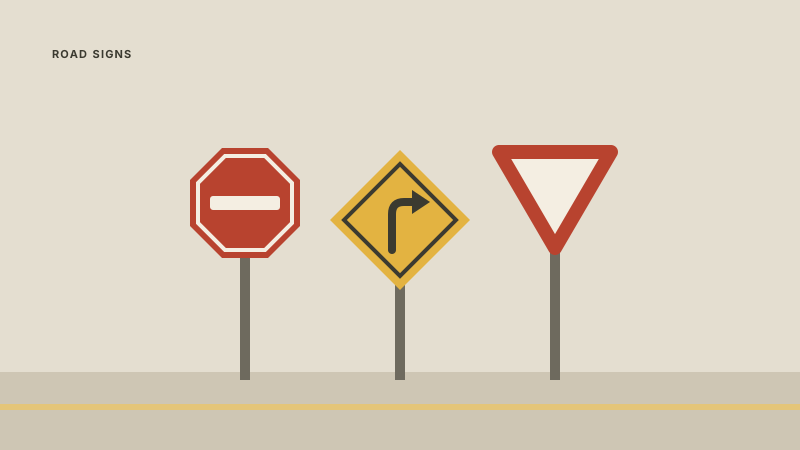
Road signs look like a lot to memorize, but they are built from a small system. In North America, shape and colour tell you a lot before you read a single word. An octagon is a stop sign. A downward pointing triangle is yield. A diamond is a warning. A pentagon is a school zone. A round sign is a railroad crossing warning. Red means stop or prohibited, yellow is a general warning, orange is construction, green gives directions, blue is services, brown is recreation.
So the first cards to make are the system cards, not the individual signs:
Front: What does a yellow diamond shaped sign mean, in general?
Back: A warning about a hazard or a change ahead.
Once you know the system, you can work out most individual signs on the spot, even ones you have never carded. Then the individual sign cards only need to cover the ones the system does not explain, or the ones that are easy to confuse.
For those, use the picture of the sign on the front, not the name. The test shows you the picture. If your card says "What does the 'divided highway begins' sign look like?" you are practicing the wrong direction. Put the image on the front and ask what it means. If you want both directions, reverse flashcards covers when that is worth it, but for the permit test, picture to meaning is the one that counts.
Right of way, as little stories
Right of way rules do not card well as sentences. "At a four way stop, the vehicle that arrives first goes first, and if two arrive at the same time, the vehicle on the right goes first." You read that, you nod, and then the question describes a specific situation and you have to translate it back, and that is where it falls apart.
So write these as small scenarios, the same way the test will:
Front: You and another car reach a four way stop at the same time. The other car is on your left. Who goes first?
Back: You do. When two cars arrive together, the car on the right goes first, and you are on their right.
The answer explains itself in one line. That one line is the thing that lets you handle the version of the question you have not seen, where the other car is on your right instead, or there are three cars. Five or six of these scenario cards covers most of what the test asks about intersections. This is the same idea as case study encoding, just with cars.
How long to study
The permit test is not a big exam. For most people, a good deck for it ends up around 60 to 120 cards once you have skipped the common sense parts. That is small enough that you do not need months.
| Time until the test | What to do |
|---|---|
| About two weeks | Read the handbook once, normally, then make the deck over two or three days. Then about 10 minutes of reviews a day. |
| One week | Make the deck in one or two sittings, add all the cards at once, review every day, take a practice test every couple of days. |
| Two or three days | Do the numbers first, since those are what you cannot guess, then the dozen or so sign system cards. Skip the scenarios unless you have time. Take a practice test every day. |
Practice tests are worth doing near the end, but they are not a replacement for the cards. A practice test tells you which questions you missed today. It does not bring those questions back to you in two days, then in five days, which is how you make them stick. Use the practice tests to find your gaps, and then turn every question you got wrong into a card, if it is not one already.
When you keep getting the same question wrong
You will probably have a few cards that will not stay. Very often it is two numbers fighting each other, like the fine for a first offence versus a second offence, or the distance for a stop sign versus a traffic light. The fix is almost always to put them side by side, with a comparison card like the one above, rather than reviewing them more and more often.
If it is one stubborn number with nothing to pair it with, add a short reason on the back if the handbook gives one, or find one that is easy to picture. "A fire truck needs room to pull up to the hydrant, and 15 feet is about one car length." A reason like that gives the number a story, and that is often enough. There is more on this in mnemonics on flashcards.
Official practice tests beat everything else
Many licensing offices publish free practice tests, and those are the closest thing to the real exam you can get, because they come from the same office that writes it. Many states and provinces also have official apps. Use them.
There are also plenty of permit test practice apps with question banks already loaded, and they are fine for drilling, but watch out for two things. The questions are sometimes generic, written for "all states," which means some of the numbers will be wrong for where you live. And a question bank of five hundred items with a "mastered" checkmark is not spaced repetition. You can see the difference in Quizlet mastery vs retention.
A flashcard app is most useful for the small set of things that practice tests keep catching you on. In Nebulearn you can paste in your numbers or upload the handbook PDF and make cards from it side by side, and FSRS takes care of when they come back. But a stack of 80 paper cards made from the handbook, reviewed for ten minutes a day, will also get you there.
Reason out the signs, remember the numbers
The permit test splits cleanly into the parts you can reason out and the parts you can only remember. Signs and right of way are mostly reasoning, so card the system and the confusing pairs. Numbers are only memory, so card every one of them, one per card, straight from your own handbook. Skip the rest, take the official practice tests near the end, and go get your permit.