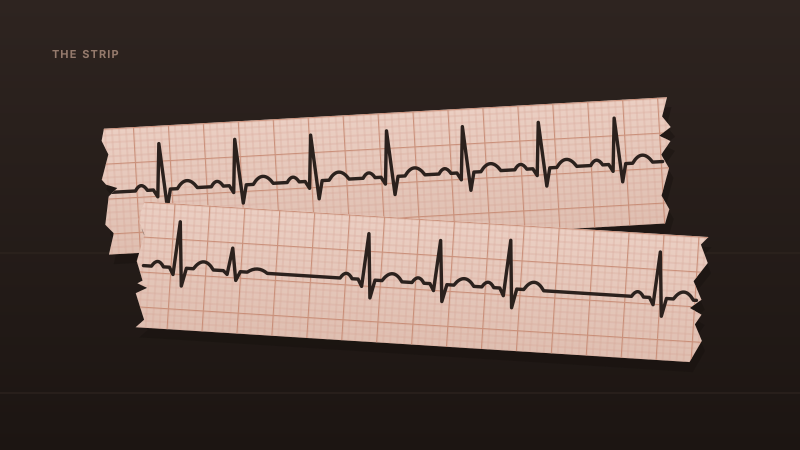
How to Learn EKG Interpretation (The Strip Goes on the Front)
EKG reading is visual discrimination, not definition recall. How to build strip-first image cards, the criteria card behind them, and lookalike pairs.
If you want to learn EKG interpretation, the short version is this: you have to look at a lot of strips, and something has to make you name what you are looking at before it shows you the answer. Reading an EKG is visual discrimination. You are deciding which of about a dozen patterns is printed in front of you, at 25 mm per second, on paper somebody folded in half. A flashcard whose front says "atrial flutter" and whose back lists the criteria asks the opposite question.
That backwards card is the one almost everyone makes first, because it is the one that is easy to type. A rhythm name is eleven characters. A strip is a screenshot you have to find, crop, and paste. So the deck drifts toward the direction that is cheap to produce instead of the direction the exam uses, and you end up with fifty cards you can pass while still freezing when a real tracing goes up on the screen.
I work on Nebulearn, so treat anything I say about tooling as coming from someone with a stake in it. Blunt about the other half too: I am a third year engineering science student at UofT, not a clinician. What I can tell you is card mechanics, a learning problem and not a medical one. Every criterion you put on a card should come from your course or your textbook, not a study blog. My own version of this was ECE waveform identification, staring at scope traces and having to say which filter produced that curve, and the failure mode was identical.
The card direction most EKG decks get backwards
There are two different questions hiding inside "do I know atrial fibrillation," and a deck usually only trains one of them.
The first is recall of a definition: given the name, produce the criteria. Irregularly irregular, no distinct P waves. That is a verbal fact, and a name-on-front card trains it well.
The second is discrimination: given ink on paper, produce the name. That is a perceptual skill, and it improves only when you are made to look at the thing and commit to an answer. You cannot get there from the definition side, because the hard part was never the words. The hard part is that a tracing with a messy baseline and a fast ventricular rate does not announce which category it belongs to.
Tests and wards ask the second question. So the front of the card has to be the strip, every time, and the name lives on the back. This is the same asymmetry that makes a name-first anatomy card weaker than a picture-first one, and it is why origin and insertion cards work better when the image leads. Once the image is on the front, the next question is what goes on the back, and that is the part people get wrong second.
What a strip card looks like
A good strip card has three parts: the image, the name, and the one feature that decided it.
The front is a cropped tracing. Keep enough of it to be fair, which usually means a few seconds of a rhythm strip rather than one lonely complex, and keep the lead label inside the crop so you are not guessing from an unlabeled squiggle. Then crop out everything that gives the answer away, including the machine's own printed interpretation across the top of a hospital EKG, which will happily tell your future self "ATRIAL FIBRILLATION" while you congratulate yourself on recognizing it.
The back is the name plus the discriminator, and the discriminator is the part people skip. Not the full criteria list. One line naming the feature that made the call on this tracing. "Atrial fibrillation: irregularly irregular, no discernible P waves." "Third degree block: P waves and QRS complexes marching independently." Writing that line forces you to say what your eye just did, and that sentence is what transfers to a tracing you have never seen. A card that says only the name lets you grade yourself on a hunch.
Image occlusion is the right tool for one job here, and it is not the job most people use it for. Its job is covering the labels on a teaching figure so the annotations stop answering the question. Screenshot a nicely labeled textbook figure with arrows pointing at the sawtooth baseline and the words "flutter waves" printed beside them, and the figure has already done your work. Occlude the annotations and the printed interpretation, reveal them on the flip, and the same image becomes a real question. Nebulearn has image occlusion and I built it partly for this, but the honest framing is the one in stop using image occlusion for everything: it is a masking tool, not a comprehension tool. The crop and the discriminator line are what make the card work, not the red box.
The criteria card that backs up the visual one
Recognition without words is a trap of its own, so the visual card needs a partner.
If your only cards are strips, you build an eye that is faster than your mouth. That feels fine in review and falls apart the moment you have to justify a read or answer a follow-up about why it is not the other thing. So each rhythm gets a second card running the other direction: name on the front, the criteria checklist on the back. Rate, regularity, whether there are P waves and how they relate to the QRS, PR interval, QRS width. That is the ordinary definition card, and it is useful. It just cannot be the only card.
Two cards, two jobs, and they fail independently, which is the reason they should not be one card. Mash the strip and the checklist together and a miss tells you nothing about which half broke. That is the atomic encoding rule applied to a skill with a visual and a verbal side. It is normal for the criteria card to go quiet and mature while the strip version of the same rhythm still comes back every two days, because the eye takes longer than the vocabulary does.
The measurements deserve their own small set, and they really are just facts. One small box is 0.04 seconds, one large box is 0.2 seconds, the usual taught upper limit for a normal PR interval is 200 ms, plus whatever rate estimation method your course wants. Ten or so cards, name on front, done. Get those solid early, because the discriminations below cash out in numbers you have to read off the paper without stopping to think.
The lookalike pairs are the difficulty
Nobody fails an EKG station because they cannot recognize normal sinus rhythm. People fail on the pairs, so the pairs are what the deck should be built around.
Here are the ones most courses hammer, described the way they are usually taught:
| Pair | What separates them | Why it is hard |
|---|---|---|
| AFib vs atrial flutter | Chaotic baseline vs organized sawtooth | Both read as "fast and messy" |
| Flutter at 2:1 vs sinus tach | Sawtooth in the baseline vs a real P per QRS | Classic 2:1 puts the rate near 150 |
| Mobitz I vs Mobitz II | PR lengthening first vs a constant PR | Both drop beats |
| First vs third degree block | Long constant PR vs no PR relationship | Both get called "a block" |
| Wide complex tachycardias | The criteria your course gives you | Regular, fast, wide, not one thing |
What that table implies about the deck is the useful part. The cards that matter are the ones where the wrong answer is a specific other rhythm, not "I have no idea." So build them as pairs on purpose. Take two tracings that already fooled you, put them side by side on one front, and ask which is which and what feature settles it. Then keep the single-strip cards for both members of the pair in the same deck, so the alternative stays live when you review.
That runs against a habit a lot of people have, which is tagging cards into tidy per-topic decks and reviewing one topic at a time. Do not separate the confusables. Discrimination only trains when the competing pattern is a plausible answer in that moment, and a blocks-only session lets you be right for the wrong reason, because a Mobitz II is obvious when nothing else is on the table. It is the same context dependency problem that makes a card you only ever see in one setting feel stronger than it is.
Where this breaks, and what to do
Strip-first cards have their own failure mode, and it shows up around the second week.
You start memorizing the strip instead of the rhythm. There is a smudge at the left edge of that one tracing, or the crop sits slightly crooked, and your eye locks onto that instead of the sawtooth. You pass in a tenth of a second and learn nothing. The fix is redundancy: three strips per rhythm, from three sources, cropped differently. If a rhythm appears only once in your deck, you are one artifact away from a card that tests your memory of an image file.
The second break is the pair you keep failing forever, sitting at the bottom of the deck missing for a month while spaced repetition politely hands it back. That is a leech, and the move is not to grind it in review. Pull it out, sit with the two tracings side by side with no timer, write the single discriminating feature in your own words, then rebuild the card around that sentence. My rule for when a card becomes a leech is that repeated failure is information about the card, not about you.
The third break is the one to be honest about: cards do not teach the systematic read. Rate, rhythm, axis, intervals, morphology, in that order every time, is a procedure, and procedures get learned by running them out loud on a stack of tracings, ideally next to somebody who can tell you when your axis call is off. Flashcards hold the base layer so the procedure has something to run on.
The deck I would build in one week
Here is the shape of it, so that "build strip cards" turns into a countable pile.
Take the twelve or so rhythms your course actually tests. Three strips each gives you 36 image cards. Add one criteria card per rhythm for 12 more, roughly 10 measurement cards, and 8 side-by-side pair cards for the confusions in that table. That is about 66 cards, small enough to finish and small enough to fix. The free tier holds 1,000 saved questions, so the limit you hit is not slots. It is how many good strips you can get your hands on.
Which is the real bottleneck, and worth naming plainly. AI generation does very little for you here, because the answer key is not text. The work is finding a tracing and getting it onto the front of a card, cropped, without the machine read attached. That is why the piece of Nebulearn I would point at for this job is the Chrome extension: while you work through your course's tracing library in the browser, you snip what is on screen straight into a card with a keybind and stay on the page. No screenshot folder, no tab switch, no cropping app.
Two honest exceptions. If a mature community deck for your exam already exists with thousands of tagged tracings, Anki plus that deck beats anything you assemble by hand in a week, and Anki is local-first, so it works on a plane with no signal; Nebulearn has no offline mode and shows a connection banner if you drop off the network mid-session. And if your study group wants one shared set of strips by Friday, Quizlet gets you there with less friction. More on that split in when to use Anki for medical school.
EKG interpretation is one of the few topics where card direction is the whole argument. Name on the front trains vocabulary you already have. Strip on the front trains the skill you are tested on. The only reason people do not flip it is that finding and cropping 36 tracings is more work than typing 36 rhythm names, and making that part cheap is what the snip-to-card extension and image occlusion are for.