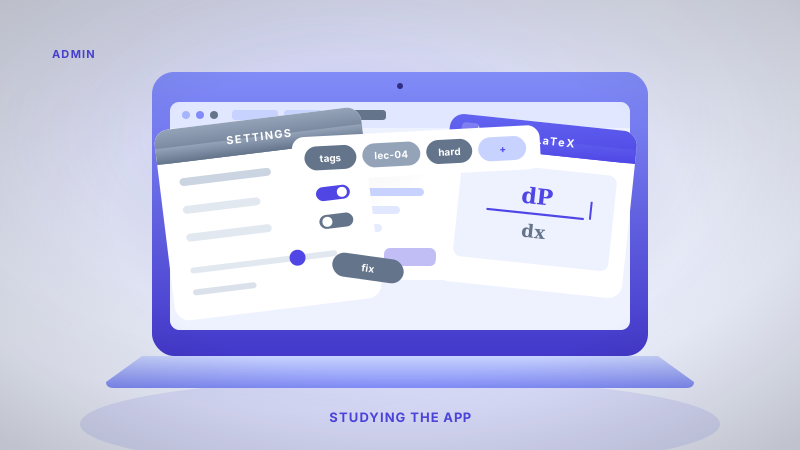
Flashcard 'Maintenance Time': The hidden tax of spaced repetition
Spaced repetition is efficient, but tagging, formatting, and card creation can eat the week. Here is how to cut the admin tax.
Spaced repetition is time consuming because of the administrative work, not the actual studying. If you spend three hours a week reviewing cards but four hours a week making them, fixing broken LaTeX formulas, and organizing tags, you are not using a study tool. You are managing a database.
I am Daniel, a third year engineering science student at UofT. I work on Nebulearn, so I have a clear conflict of interest here. I built it specifically because I was tired of the "maintenance tax" that comes with traditional flashcard apps.
To decide if spaced repetition is worth the effort, you have to look at three distinct time costs: the Creation Tax, the Maintenance Tax, and the Review Tax.
The three bills you pay for every card
Most people only talk about the Review Tax. They tell you that spending 20 minutes a day on Anki will save you 20 hours of cramming later. That is usually true. But they ignore the work required to get to that first review session.
The Creation Tax is the time it takes to turn a lecture PDF or a textbook chapter into individual cards. If you do this manually, it is the single biggest bottleneck in your schedule. You have to read the material, decide what is important, and type out the prompt and answer.
The Maintenance Tax is the "hidden" cost. This is the time spent fixing cards you wrote poorly, adjusting your deck settings, or organizing your tags. I once spent four hours on a Sunday afternoon fixing my tagging system for a fluid mechanics course instead of actually studying fluid mechanics. My tags were beautiful, but I still didn't know how to solve the practice problems.
The Review Tax is the actual study time. This is the only part of the process that actually helps you pass your exams.
| Cost Type | What it looks like | Is it productive? |
|---|---|---|
| Creation | Copy-pasting from PDFs, typing cards | Barely (passive) |
| Maintenance | Fixing tags, formatting LaTeX, tweaking intervals | No (admin) |
| Review | Recalling the answer to a card | Yes (active) |
If your Creation and Maintenance taxes are higher than your Review Tax, your system is broken.
Why I spent 4 hours fixing tags instead of studying
I used to be a perfectionist with my decks. I thought that if I had the perfect hierarchical tagging system, I would magically understand the course better. I would spend hours downloading add-ons for Anki or finding the perfect CSS for my card templates.
This is a form of productive procrastination. It feels like work, but it has zero impact on your retention. The goal of spaced repetition is to minimize the time spent thinking about the system so you can spend all your energy thinking about the content.
When you spend your Sunday afternoon "optimizing" your deck, you are usually just avoiding the hard work of active recall. If you find yourself spending more than 15 minutes a week on "admin" tasks, you need a simpler workflow. This is why I built Nebulearn to automate the creation and organization steps. I wanted a system where I could upload a PDF and start reviewing immediately, without the tagging rabbit hole.
The break-even point for a 15-week semester
Spaced repetition is not always the right choice. If you are three days away from a final and you haven't started, flashcards are a trap. The Creation Tax will eat your remaining time before the Review Tax can pay off.
In a standard 15-week semester, the break-even point usually happens around week three or four. If you start making cards early, the daily 15-minute review sessions prevent the 20-hour weekend crams. But if you spend 2 hours making cards for every 1 hour of lecture, you will fall behind by midterm week.
To stay profitable on your time, you need to keep your creation-to-study ratio low. If it takes you longer than 10 minutes to make cards for a 50-minute lecture, your process is too slow. You can speed this up by using pre-made decks, like the AnKing decks for medical students, or by using AI to generate your initial drafts.
Where Anki and Quizlet fit in the time equation
Anki is the gold standard for long-term retention, but it has the highest Maintenance Tax. Between the $25 price tag for AnkiMobile on iOS and the steep learning curve of its settings, you pay a lot upfront. It wins if you are a med student with a 2-year horizon and a massive pre-made deck. The "maintenance" is worth it because the deck is already built for you.
Quizlet is faster to start but more expensive in the long run. Their free "Learn" mode is now session-scoped, meaning it helps you master a set in one sitting rather than over a semester. They retired their "Long-Term Learning" feature years ago. To get any form of spacing now, you need the paid Plus tier, and even then, it doesn't use the same advanced algorithms like FSRS.
If you want to understand which tool fits your specific bottleneck, I wrote a guide on study apps that save the most time.
How to lower your maintenance tax
To make spaced repetition worth the effort, you have to be ruthless about what you allow into your "admin" time.
- Stop formatting. Your cards don't need to be pretty. They need to be readable.
- Use FSRS. If your app supports the FSRS algorithm, turn it on. It is more efficient than the older SM-2 logic and requires less manual "tweaking" of intervals.
- Automate creation. This is the biggest time sink. Whether you use a faster way to create flashcards like AI generation or just copy-paste less, you have to get the cards into the system faster.
I work on Nebulearn because I wanted to solve the "Creation Tax" specifically. I didn't want to spend my Friday nights typing out definitions from a slide deck. I wanted to drag the slide deck into a box and have my due queue ready for Saturday morning.
If you find that you are constantly "fixing" your study system instead of using it, your tool is likely too complex for your needs. Spaced repetition is a powerful engine, but if the engine requires four hours of maintenance for every hour of driving, you might be better off walking.