How to Stay Consistent With Studying: Build the Habit, Not the Willpower
Consistency is not a personality trait. It is a cue, a tiny first step, and a plan for bad days. How to build a study habit that survives busy weeks and missed days.
People who study consistently are not, for the most part, people with more willpower. They are people who have made studying the default thing that happens at a certain point in their day, so that it does not need a decision every time. If you rely on deciding to study each day, you will lose to tiredness, to friends, and to your phone a few times a week, and every lost day makes the next one harder. If studying is attached to something you already do, starts with a step so small it feels silly, and has a plan for the bad days, it keeps happening even when you do not feel like it.
(This is the Nebulearn blog, and Nebulearn makes a flashcard app, but nothing here needs an app. These are habit ideas that work for any kind of studying.)
Why "I will study more this week" never works
Here is the pattern most people know. It is Sunday evening. You feel a bit guilty about last week, and you think, "okay, this week I am going to study every day. Two hours a day. No excuses." Monday goes great. You study for two and a half hours and feel amazing. Tuesday you study for an hour and a half, because you had a late class. Wednesday a friend invites you out, and you think, "I will make it up tomorrow." Thursday you are tired, and the thought of a two hour session feels so big that you just do not start. Friday, nothing. And by Sunday evening you are making the exact same promise again.
What went wrong was not your character. It was the plan. The plan required a big decision every single day, it set a bar that only works on good days, and it had nothing for what happens after you miss one. Every one of those is fixable.
How habits form
There is a well known study by Phillippa Lally and colleagues at University College London that followed people trying to build a new daily habit, things like eating a piece of fruit with lunch or going for a run before dinner. They measured how long it took for the behaviour to become automatic, meaning people did it without really thinking about it.
The median was about 66 days, but the range was huge, from 18 days to more than 200, depending on the person and how hard the habit was. Two other findings are just as useful. First, missing a single day did not meaningfully set people back. Second, simple behaviours, like drinking a glass of water, became automatic faster than harder ones, like exercise.
So if you are in week two and it still feels like effort, that is completely normal. It is supposed to feel like effort for a while. And if you miss a day, it is not a reset. It is just a missed day.
Step one: attach it to something you already do
The single most effective thing you can do is to tie studying to an existing part of your day. Psychologists who study this, starting with Peter Gollwitzer's work on "implementation intentions," have found that a specific if-then plan ("when X happens, I will do Y") works much better than a general goal. The most practical version, sometimes called habit stacking, uses something you already do as the "when." Instead of "I will study more," you make a plan in the form:
"After I [thing I already do every day], I will [study for X minutes] at [place]."
Some examples that work for real people:
- "After I pour my morning coffee, I will do my flashcard reviews at the kitchen table."
- "After I get on the bus home, I will review on my phone until my stop."
- "After I finish dinner, I will sit at my desk and do one Pomodoro of reading."
- "After I brush my teeth at night, I will do ten minutes of vocab before lights out."
The "after" part matters most. The thing you already do becomes the cue. You do not need to remember to study, or decide to study, because the coffee reminds you. After a few weeks, pouring coffee and opening your cards start to feel like one action.
Pick a cue that happens every single day, at roughly the same time, including weekends if you want to study on weekends. If your morning routine is different on Saturdays, pick a different cue for Saturday. And pick one, not five. One solid habit is better than five fragile ones. If you are choosing a time for flashcards specifically, best time of day for spaced repetition covers the trade-offs.
Step two: make the first step tiny
The hardest moment in a study session is the first minute. Once you are in, it is usually fine. The trouble is getting in.
So make the start tiny. Not "study for two hours," but "open the book and read one page," or "do five flashcards." You are allowed to stop after that. Most of the time you will not, because once you have started, keeping going is easier than stopping. But on the bad days, five cards is still five cards, and more importantly, you kept the habit alive.
This sounds almost too simple. It works because it removes the scary decision. Thinking "I have to study for two hours" when you are tired feels like a wall. Thinking "I just have to do five cards" does not. The session ends up being whatever it ends up being, and the habit stays intact either way.
This is also why short daily sessions beat long occasional ones. As consistency vs intensity explains, four hours once a week is much worse than thirty minutes a day, both for memory and for actually keeping it going.
Step three: remove the friction
Every small thing between you and starting is a chance to not start. If your flashcards are in an app that takes you four taps to get into, that is four chances to get distracted. If your textbook is in your bag in the other room, that is a reason to wait.
So go through your study start and remove every bit of friction you can:
| Friction | Fix |
|---|---|
| Materials are somewhere else | Leave the book open on the desk, or keep the app on your home screen |
| You have to decide what to study | Decide the night before, write it on a sticky note |
| Phone notifications pull you away | Put the phone in another room, or face down and on silent. More in studying with your phone nearby. |
| The place is uncomfortable or noisy | Pick one spot and make it the study spot |
| You have to set up a timer, a playlist, a drink | Make those part of the cue, or skip them |
And here is the reverse trick: add friction to the things that compete with studying. Log out of the game. Move the social apps off your home screen. You are not trying to be perfect, you are just making the right choice slightly easier than the wrong one.
Step four: plan for the bad days, in advance
Every habit has bad days. You get sick. You have a deadline at work. Something sad happens. The difference between a habit that survives and one that dies is almost always what happens in the two or three days after a bad day.
So plan for them now, while you are calm. Two rules help most people:
A minimum day. Decide what the smallest acceptable version of your study habit is. Maybe it is five minutes of reviews. On a bad day, you only do that. It still counts. There is a whole post on this, the minimum viable study day, and a flashcard version where you only do due reviews, the review only day.
Never miss twice. Missing one day is fine and normal. Missing two days in a row is how a habit starts to disappear. So if you missed yesterday, today is the day you do the minimum, no matter what.
Step five: track the right thing, lightly
Tracking helps consistency, but it is easy to track the wrong thing. If you track hours, you will feel bad about short days, even though short days are the backbone of a consistent habit. Stop tracking study hours makes the full case.
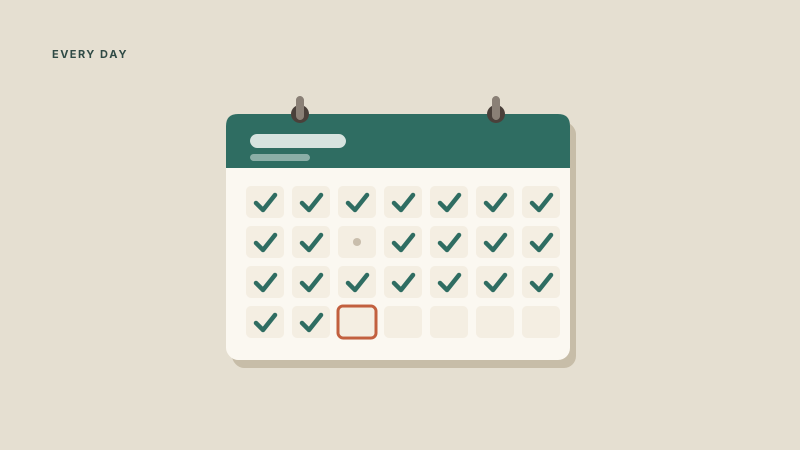
Track whether you showed up, not how much you did. A simple mark on a calendar for each day you did your minimum is enough. It is satisfying to see a row of marks, and a gap is visible without being dramatic.
Streaks in apps do the same thing, with a bit more pressure. They help most early on, and they can become a problem if they become the only reason you study, which the science of gamification goes into. Use them, but make sure your plan for a broken streak is "start again tomorrow," not "well, that is over."
When you fall off completely
Sometimes you do not miss a day. You miss three weeks. This happens to almost everyone at some point. Exams end, you go on holiday, life gets busy.
The most important thing to know is that coming back is much easier than starting fresh. You still know most of what you learned, even if it feels rusty. And the habit, the cue, the spot, are all still there. You just need to restart them.
Start with the minimum version for the first few days, not the full plan. If you use flashcards, there will be a big pile of overdue reviews waiting, and trying to clear all of them on day one is a good way to burn out on day two. Do a manageable amount each day. Restarting after a long break has a step by step version of this.
When outside structure works better
Some people study better with external structure, and if that is you, use it. A study group that meets at the same time every week is a very strong cue, and you get the social side too. How to study in a group with flashcards covers how to make those work. A tutor, a class, or even a friend who texts you "did you study?" can do much of what a habit does, with less effort from you.
There are also apps built entirely around habits, which let you track any habit with reminders and charts. If you want to build several habits at once, one of those can be a good home base. And books like James Clear's Atomic Habits go into the cue and friction ideas above in much more depth, with plenty of examples.
What a flashcard app with spaced repetition adds is that the daily task is already decided for you. In Nebulearn, FSRS works out what is due, so "do today's reviews" is always a clear, finite thing, and there is a streak freeze for the day life gets in the way. That removes the "what should I study?" decision, which is one of the biggest bits of friction there is.
Design, not willpower
Consistency comes from design, not from willpower. Attach studying to a cue you already have, make the first step tiny, remove the friction, and decide in advance what a bad day looks like. Track whether you showed up, not how much you did. And when you fall off, which you will, come back with the minimum and build up from there.