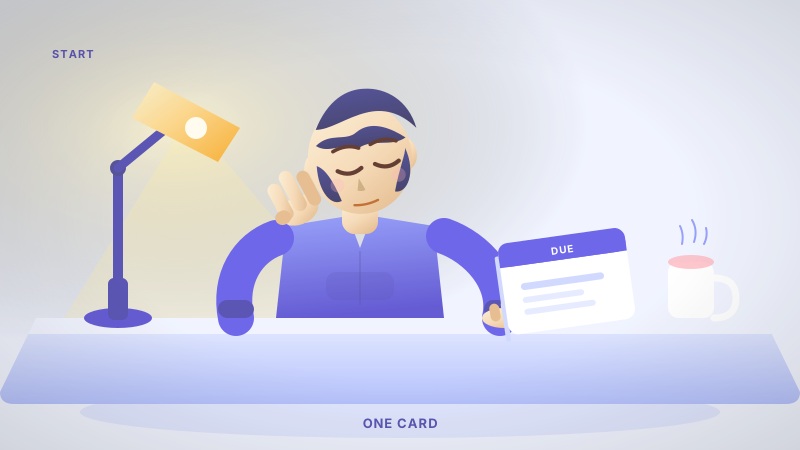
How to study when you have no motivation
Why willpower is a bad strategy for heavy workloads and how to use a due list to automate your study sessions.
Hello there! If you're reading this, you probably have a midterm coming up or a pile of lectures you haven't touched, and the thought of opening your textbook makes you want to stare at a wall for three hours.
A little about me first. My name is Daniel. I'm a third year engineering science student at the University of Toronto, specializing in machine intelligence. I also work on Nebulearn. Because I build a study tool, I have a conflict of interest here, but I also have a very specific view on why "motivation" is the wrong thing to look for when you're overwhelmed.
In my first year, I thought I needed to feel inspired to study. I waited for that burst of energy to tackle a 40 slide PDF. It rarely came. What I realized is that motivation is a feeling, but finishing a degree is a mechanical process. You don't need to feel like studying; you just need a system that removes the choice.
The myth of the inspired student
We often treat motivation like a battery that needs to be charged before we can start. If the battery is at 0 percent, we decide we can't work.
The problem with this mental model is that heavy workloads in engineering or medicine are too large for willpower to handle. Willpower is an expensive resource. If you have to decide what to study, how to study it, and how long to go for every single afternoon, you will hit decision fatigue before you even open a book.
Decision fatigue is the real reason you end up scrolling on your phone instead of starting. It isn't that you are lazy. It is that the "startup cost" of organizing your thoughts is higher than your current energy level. To fix this, you have to stop relying on a to-do list and start relying on a due list.
Why your to-do list is killing your momentum
A to-do list is a menu of chores. When you look at it while tired, you see "Study Biology" and your brain immediately starts calculating the effort required.
Because "Study Biology" is a vague, massive task, your brain chooses the easiest option on the list or finds a distraction. To-do lists require you to be the manager and the worker at the same time. When you have no motivation, the manager is the first one to quit.
A due list is different. This is where spaced repetition systems like Anki or Nebulearn come in. A due list doesn't ask you what you want to do. It tells you exactly which 15 cards are about to be forgotten today.
The just 5 cards rule
Lowering the barrier to entry is the only way to bypass a lack of motivation. When I'm at my absolute lowest energy, I tell myself I will only do five cards. I don't look at the whole deck. I don't look at the Anki review queue that is too big. I just commit to five.
This works because the hardest part of studying is the transition from "not studying" to "studying." Once you are in the interface and you've answered a few questions, the friction drops. Usually, those five cards turn into fifty. If they don't, and I really stop at five, I'm still five cards ahead of where I was.
This is the "low friction" approach. If your system requires you to spend an hour formatting notes or setting up complex tags, you will never start when you're tired. This is why I built Nebulearn to be fast. I wanted to go from a PDF to a due list without the "setup phase" that usually kills my drive. However, not every app treats 'setup' or 'due dates' the same way, and picking the wrong one can actually increase your friction.
Comparing systems for the unmotivated student
If you are struggling to start, the tool you choose matters. Some tools are better at reducing that initial friction than others.
| Feature | Anki | Quizlet (Free) | Nebulearn |
|---|---|---|---|
| Startup Cost | High (Learning curve) | Low | Very Low |
| Scheduling | Automated (Due list) | Session-based | Automated (Due list) |
| Input Speed | Manual / Add-ons | Manual / AI | PDF to Cards in seconds |
| Price | Free (mostly) | Free / Paid | Free tier available |
Anki is the gold standard for long term retention, but it can be brutal when you have no motivation. The interface is clinical and the setup is steep. If you already have a deck from a friend, Anki is great. But if you have to build the deck yourself while feeling burnt out, the friction might stop you entirely. Note that AnkiMobile for iOS is about $25, while the desktop and Android versions are free.
Quizlet is very easy to start, but the free version uses "Learn" mode which is session-scoped. It helps you master a set in one sitting, but it doesn't give you a permanent due list that tells you what to do tomorrow. They retired their Long-Term Learning feature a while ago. Their "Memory Score" is part of the paid Plus tier, but it isn't the same as a true FSRS scheduler.
I work on Nebulearn because I wanted something that felt like Quizlet but worked like Anki. We use FSRS (Free Spaced Repetition Scheduler) by default so your due list is mathematically optimized. You can check out our guide on study apps that save the most time to see how these different schedulers affect your total workload, or read about how to use flashcards effectively if you're new to the method.
Using a due list as an anchor
When you have a system that tracks your "due" items, it acts as an anchor for your day. Even on days when I don't "study" (meaning I don't learn new material), I still clear my due list.
This prevents the "snowball effect" where a few days of no motivation turn into a month of being behind. By separating "Learning" from "Reviewing," you make it possible to keep progress alive even when you're at 10 percent capacity.
Reviewing cards you already know takes significantly less mental energy than learning a new concept from scratch. If you can't open the textbook, just clear the queue. It keeps the habit alive.
How to get started right now
If you are currently staring at a screen and feeling stuck, do these three things in order:
- Close all tabs except one. Pick the one lecture or PDF that is most urgent.
- Set a timer for 5 minutes. Tell yourself you can stop when it beeps.
- Turn one page into five questions. Don't try to summarize the whole thing. Just find five facts and put them into a due list.
If you find that your main bottleneck is the time it takes to actually create the cards, that is where I think we can help. Nebulearn's free tier gives you 1000 saved questions and 40 weekly AI credits to help you turn slides into a due list instantly. There are no ads in the study session, so you won't get distracted by a flashing banner when you're already struggling to focus.
The goal isn't to find motivation. The goal is to build a system that is so easy to start that you don't need motivation in the first place.