Coding Syntax vs. Logic: Why Your LeetCode Cards Feel 'Easy' but You Still Fail Interviews
Why memorizing code snippets leads to the Syntax Illusion and how to use spaced repetition to master algorithm logic instead.
Hello there! If you are grinding LeetCode, you have likely hit the "blank page" wall. You spend hours reviewing your flashcards, you recognize the optimal solution within seconds, but when a recruiter asks you to solve a similar problem on a whiteboard, your mind goes quiet.
A little about me first. My name is Daniel. I'm a third year engineering science student at UofT, specializing in machine intelligence. I've interned at IBM and Intel, and I spend a lot of my time thinking about how to make technical knowledge stick. I also work on Nebulearn, which is a conflict of interest you should know about before we dive in.
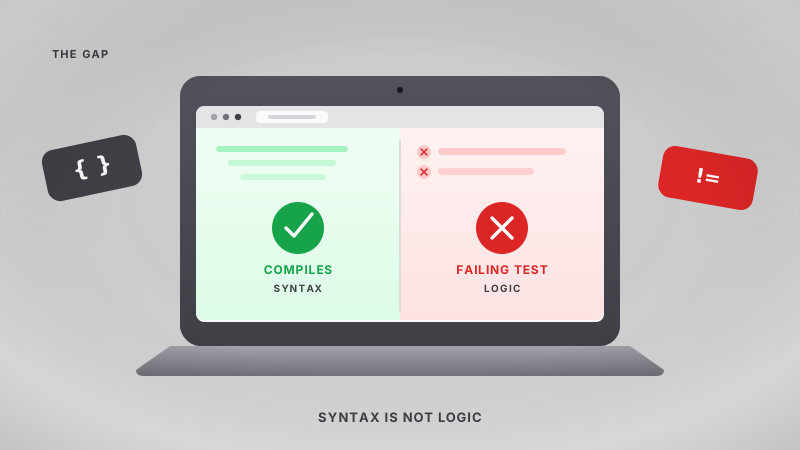
The reason your cards feel easy while the interview feels impossible is a phenomenon I call the Syntax Illusion. You aren't actually retrieving the algorithm. You are just recognizing the shape of the code.
The difference between recognition and retrieval
When you put a block of Python or C++ on the back of an Anki card, you aren't training your brain to solve a problem. You are training it to recognize a pattern of text.
Recognition is passive. It is why you can read a solution and think "that makes sense" without being able to write it from scratch five minutes later. Real learning requires blank sheet retrieval practice, where you generate the answer from zero cues. If your flashcard has while left < right: written on it, the card has already done the hard work of choosing the two-pointer pattern for you.
To pass a technical interview, you need to bridge the gap between knowing what a binary search is and knowing why this specific problem requires one.
Why code snippets make terrible flashcards
Most people use Anki for LeetCode by pasting the entire "Accepted" solution onto the back of a card. This creates a massive bottleneck in your review queue.
First, code is fragile. If you forget a single semicolon or a specific library method, do you mark the card as "Again"? If you do, your queue explodes with cards you actually understand but failed on a typo. If you don't, you start tolerating "mostly right" answers, which is how the logic-gap starts to grow.
Second, code snippets are too high-level. A 20-line solution usually contains four or five distinct logical leaps. If you card the whole block, you are testing five things at once. This violates the minimum information principle. You might remember the initialization but forget the edge case handling, yet you'll likely hit "Good" because you got the "gist" of it.
The Logic-First encoding rule
To fix this, you have to stop carding the "How" (the syntax) and start carding the "Why" (the logic). I call this Logic-First encoding.
Instead of one card for "Merge Sort," you should have three or four cards that target the specific pivots of the algorithm. You are trying to capture the intuition that leads to the code. This is a core part of using spaced repetition for computer science effectively.
Ask yourself: what was the "Aha!" moment when I looked at the discussion forum? That moment is what belongs on the card.
- The Trigger: What specific constraint in the problem (e.g., "sorted array," "find the shortest path") tells me to use this algorithm?
- The State: What variables do I need to track, and what do they represent at any given moment?
- The Edge Case: What happens when the input is empty, or the target isn't found?
The Pseudo-code retrieval method
If you want to ensure your logic is sound, stop writing full code during your reviews. Use the Pseudo-code retrieval method instead.
When the front of your card asks for the solution to "Two Sum," your goal shouldn't be to type the exact syntax. Your goal is to sketch the logical flow. I usually do this with bullet points or high-level pseudo-code.
- Initialize a hash map (Value -> Index).
- Iterate through the array.
- Calculate the complement (Target - Current).
- If complement is in the map, return indices.
- Otherwise, add current to the map.
This forces you to retrieve the steps. If you can do this, the syntax is just a translation layer. If you can't do this, having the Python code memorized won't help you when the interviewer asks you to optimize for space or change the data structure.
Choosing your tools for the grind
I see a lot of students debating between Anki, Quizlet, and newer tools. The right choice depends on how much time you want to spend on setup versus actually solving problems.
Anki is the gold standard for long-term retention. It is free on desktop and Android, though AnkiMobile for iOS is about $25. If you are a med student or someone with a 10-year horizon, the complexity is worth it. But for LeetCode, the overhead of managing decks and syncing can become a distraction from the actual coding.
Quizlet is great for a quick session, but their free "Learn" mode is session-scoped. It helps you master a list today, but it doesn't give you a true due-date calendar unless you pay for Plus. Even then, it doesn't use the FSRS (Free Spaced Repetition Scheduler) algorithm that we use to maximize efficiency.
I work on Nebulearn because I wanted something that felt like a modern study tool rather than a database manager. I use it for my own technical prep because I can clip logic notes directly from my browser and have the FSRS scheduler handle the review dates automatically. It keeps the focus on the logic rather than the card management.
| Feature | Anki | Quizlet (Free) | Nebulearn (Free) |
|---|---|---|---|
| Scheduler | FSRS / SM-2 | Session-based | FSRS (Default) |
| Setup Cost | High (Manual) | Low | Low |
| Code Support | Add-ons required | Basic | Native |
| Price | Free* ($25 iOS) | Free (Ads) | Free (1000 cards) |
Bridging the gap to the interview
The goal of spaced repetition is not to replace coding; it is to make coding faster.
If you use your cards to nail the logic, you free up your "working memory" during the interview. You won't be struggling to remember how a heap works. You will be free to talk through your thought process, handle follow-up questions, and catch your own bugs.
If your current cards feel too easy, try deleting them. Replace them with cards that ask "Why did we use a stack here?" or "What is the time complexity if we use a recursive approach?" The harder the card is to answer in English, the more it is actually teaching you.