How to Study Microbiology: Card the Sorting Tree Before the Bugs
Microbiology is a sorting problem. Learn the Gram stain, shape and test tree first, then card one distinguishing clue per organism and run it in reverse.
Microbiology feels like memorizing a phone book, and the reason it feels that way is that most people card it one organism at a time. A card per bug, with everything about that bug on the back. The way out is to learn the sorting tree first: Gram stain, then shape, then the one or two lab tests that split each branch. Once the tree is in your head, each organism has an address, and the facts about it have somewhere to attach.
After the tree, you card one distinguishing clue per organism, and then you practice in the direction the exam uses, which is from the clue back to the bug. That is the whole method. The rest of this page is the detail.
Two disclosures. I work on Nebulearn, a flashcard app. And I am an engineering student, not a clinician, so treat this as a guide to structuring the studying. For the content itself, your course notes and your textbook are the authority, and you should check any example here against them.
Why the one card per bug deck collapses
It helps to see exactly how the usual deck fails, because it fails in a predictable way.
You make a card with "Staphylococcus aureus" on the front. The back says Gram positive, cocci in clusters, catalase positive, coagulase positive, and then a list of the diseases it causes and the toxins it makes. That is eight or ten facts. You review it, you recite three of them, you flip, you see the rest, and you think, "yeah, I knew most of that." You press Good.
Now multiply that by sixty organisms. Every card is a paragraph, none of them can be graded honestly, and they all blur, because twenty of them start with "Gram negative rod." This is the exact problem the atomic encoding rule describes, and microbiology is probably the subject where it does the most damage.
There is a second problem, which is direction. Your card goes from the name of the organism to its features. The exam goes the other way. It gives you a patient, a specimen and a lab result, and asks you which organism it is. You have practiced the trip from name to features sixty times and the trip from features to name zero times. Those are different retrievals, as I explained in reverse flashcards, and only one of them is being tested.
Build the tree first
Before any organism cards, spend a day or two on the classification itself. For bacteria, the first few decisions sort the majority of what an intro course covers.
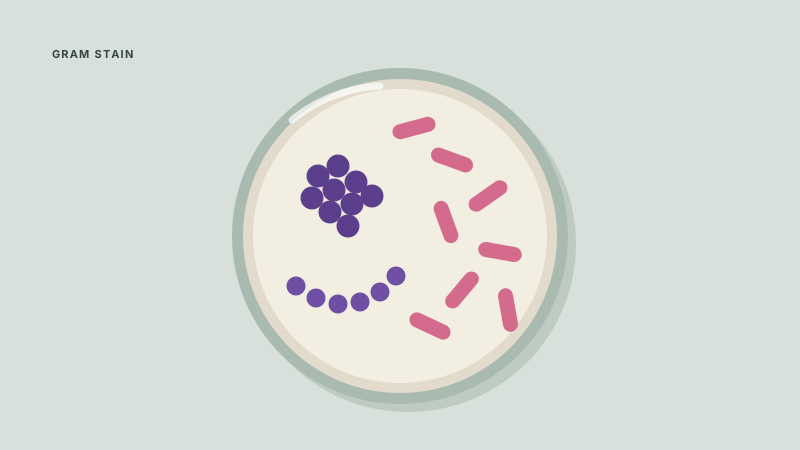
Here is a simplified version of the Gram positive cocci branch, which is the standard place to start.
| Step | Test | Result | Where it sends you |
|---|---|---|---|
| 1 | Gram stain | Positive (purple) | Gram positive branch |
| 2 | Shape | Cocci | Staphylococcus or Streptococcus |
| 3 | Arrangement and catalase | Clusters, catalase positive | Staphylococcus |
| Chains or pairs, catalase negative | Streptococcus | ||
| 4a | Coagulase (staph) | Positive | S. aureus |
| Negative | Coagulase negative staph, such as S. epidermidis | ||
| 4b | Hemolysis on blood agar (strep) | Alpha (partial, greenish) | S. pneumoniae or the viridans group |
| Beta (complete, clear) | Group A (S. pyogenes) or group B (S. agalactiae) |
Each of those steps becomes a small card, and the cards are about the decision, not about any one organism:
Front: Gram positive cocci. Which single test separates staphylococci from streptococci?
Back: Catalase. Staph are catalase positive, strep are catalase negative.
Front: Among the staphylococci, which test picks out S. aureus?
Back: Coagulase. S. aureus is coagulase positive.
There are maybe thirty or forty of these for a whole course, across the Gram positive branch, the Gram negative branch (where the early splits are things like lactose fermentation and oxidase), and the handful of organisms that do not Gram stain well and get their own corner. That is a small deck. It is also the most valuable part of everything you will make, because every later card hangs off it.
A useful thing to do alongside the cards is to draw the tree from memory on a blank page once or twice a week. It takes five minutes, and you immediately see which branch you cannot finish. That is blank sheet retrieval, and a branching diagram is one of the best things to use it on.
Then one clue per organism
Once the tree is solid, you add the organisms, and here the rule is one distinguishing feature per card. Not everything about the bug. The thing that makes it this bug and not its neighbour.
For each organism, ask what a question writer would use to point at it without saying its name. Usually that is one of these:
- A lab feature beyond the basic tree (a particular test result, a growth requirement, how it looks under the microscope)
- A virulence factor or toxin and what it does
- A classic route of transmission or a typical setting
- A signature disease or presentation
Each of those is its own card. So instead of one card for an organism with ten lines, you have four or five cards with one line each. You will have more cards. Each one takes three seconds, you can grade it honestly, and when you fail one you know exactly which fact you are missing.
Keep the wording specific enough that the card has a single answer. "Which organism causes pneumonia?" is not a card, because the answer is a long list. "Which Gram positive, alpha hemolytic, optochin sensitive organism is a classic cause of community acquired pneumonia?" has one answer. If you read the front of a card and think, "well, it could be several," the card needs more on the front.
Run it backwards, because the exam does
This is the step that most decks are missing. For the high yield organisms, write the card in the direction of the exam: findings on the front, organism on the back.
Front: Gram positive cocci in clusters, catalase positive, coagulase positive. Organism?
Back: Staphylococcus aureus.
Then go one step further and write a few as short scenarios, because that is how the questions actually arrive. A couple of lines about a patient, the specimen, and one or two lab results. The skill being tested is picking the two words in the scenario that matter and walking the tree from there. I wrote about this card shape in the case study flashcard, and it is worth using here for maybe the top twenty organisms.
Do not write scenarios for everything. They take time to write well, and a scenario card is slow to review. Use them where the exam will.
And be careful about memorizing buzzwords as triggers on their own. A classic phrase pointing at one organism is useful, and question writers know students memorize them, so they describe the finding in plain words instead. If your card has only the buzzword on the front, you will miss the question that describes the same thing without it. Put the description on the front and keep the buzzword on the back.
Keep bugs and drugs on separate cards
Treatment is where the deck tends to double in size, so it is worth a rule.
Do not put the antibiotic on the organism card. Learn the organisms first. Then learn the drug classes as their own small tree: what each class targets and roughly which kinds of bacteria it covers. Then connect the two with a third set of cards, and only for the pairings your course actually asks for.
The reason is the same as before. "Organism, then everything about it including treatment" is a paragraph. "For this organism, what is the usual first choice?" is a card. And treatment questions often hinge on an exception, like resistance, or an allergy, or a particular site of infection, and exceptions need their own cards with the condition on the front. That is a pattern I went through for pharmacology in the mechanism vs dose split.
Treatment recommendations also change over time and vary by region, so this is the part where you should lean hardest on your own course materials and not on anything you find in a shared deck or a blog post, including this one.
Viruses, fungi and parasites get their own trees
Everything above used bacteria, because that is where most courses start. The same approach carries over, with different first questions.
For viruses, the sorting is usually by genome type (DNA or RNA), whether the virus is enveloped, and then by family. For fungi, a common first split is by how they grow and the kind of infection they cause. For parasites, it is by broad type and then by how they are acquired. Your course will have its own preferred scheme for each, and you should use that one, because the exam will be written by the same people.
In each case, do the same two things. Card the sorting scheme first as small decision cards. Then add one clue per organism, and reverse the important ones. The mistake is treating virology as a fresh pile of names when it is the same kind of problem with a different tree.
Where other tools are better
Microbiology has some of the strongest study resources of any subject, and it would be silly not to say so.
Sketchy Micro is the big one. It turns each organism into an illustrated scene, where every object in the picture stands for a fact, and a lot of medical students credit it with getting them through the subject. If you have access to it, it is very good at exactly the part of this that is hardest, which is making sixty similar organisms feel distinct. It works well alongside the tree approach: the tree tells you where the organism lives, the scene tells you what it does. I talked about where picture mnemonics belong on a card in mnemonics on flashcards.
For medical students, the large community Anki decks have microbiology sections that are tagged to match those videos, already atomic, and already reviewed by thousands of people. If you are on that path, use them. Building your own micro deck from scratch in medical school is mostly a way to fall behind. I covered when that tradeoff flips in when premade flashcard decks actually work.
For an undergraduate or nursing course, where the list of organisms is shorter and specific to your instructor, a deck you build from your own lecture notes is usually the better fit, because the big medical decks contain far more than you need.
Nebulearn has an official deck in its Explore catalog called Microbiology: Pathogens and the Diseases They Cause, which connects organisms to their infections and includes a section that runs the findings in reverse. You can subscribe to it for a ready made starting point. It is a general deck, though, so the same warning applies as with any premade one: your instructor's list is the one that counts.
When it still blurs together
Even with the tree, a few things go wrong.
Two organisms keep swapping. This is the most common one. If two bugs are on the same branch and differ by one test, separate cards will not hold them apart. Make a single card that puts them side by side and asks for the difference: "Both are Gram positive, beta hemolytic streptococci. What separates group A from group B?" That is the pair card I use for near synonyms in GRE vocabulary, and it does the same job here.
The tree is fine and the clue cards are not sticking. Usually the clue cards were written as bare facts with no reason. Where there is a mechanism, put it on the back in one line. A toxin that does something specific is easier to remember when you know what it does to the cell.
The deck is too big to finish. Go back to the syllabus. Intro courses often list forty or fifty organisms and students card a hundred and fifty from the textbook. Card the list you were given, and if the pile is already out of hand, the three day audit is the fastest way to cut it down before an exam.
A card keeps failing no matter what. It goes to the leech protocol. In microbiology the fix is almost always that the front is ambiguous, so rewrite the front before anything else.
The split on this page is the phone book against the tree. The phone book is a list of names with a paragraph next to each. The tree is a set of decisions that sorts those names, with one clue hanging at each leaf. That is how I would build it in Nebulearn: the decision cards first, one clue per organism from the lecture slides in the side by side PDF view, reverse cards for the organisms that matter most, and FSRS on by default so the two that keep swapping stay in front of you until they stop.