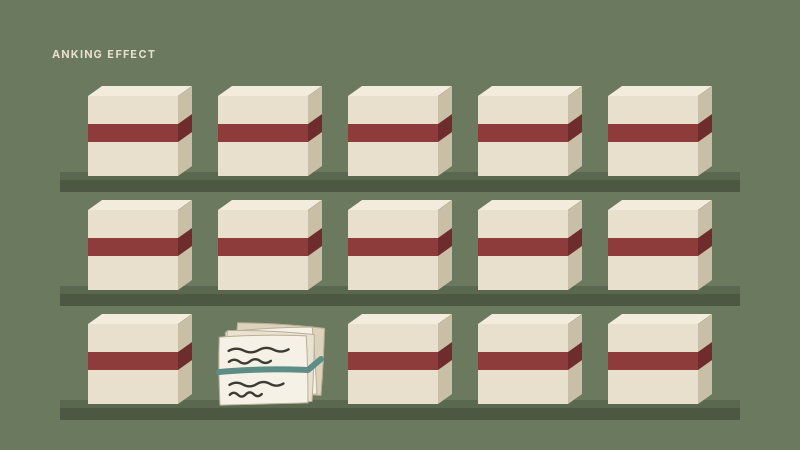
The AnKing Effect: When premade flashcard decks actually work
Premade decks like AnKing are gold for standardized exams, but they often fail for university lectures. Learn when to download and when to create.
Hello there! If you are staring at a 10,000 card Anki deck you just downloaded from Reddit, you are probably wondering if you just saved a semester of work or signed up for a second full time job.
My name is Daniel. I am a third year engineering science student at UofT, specializing in machine intelligence. I also work on Nebulearn. I have spent a lot of time looking at how students bridge the gap between a massive PDF and a review queue that actually sticks.
The short answer is that premade decks are incredible for standardized nomenclature (like medical school or law) but are often a trap for lecture-based university courses.
The Standardized Exam exception
If you are studying for the MCAT or the USMLE, using a premade deck like AnKing is almost always worth it. These decks have been refined by thousands of students over a decade. The facts they cover (the Krebs cycle, anatomy, pharmacology) do not change based on which school you attend.
In these cases, the "cost" of creating your own cards is purely wasted time. You are better off spending that energy on spaced repetition for nursing school or med school where the volume of raw facts is the primary bottleneck.
However, most students are not in medical school. Most of us are sitting in lectures where the exam is based on a specific syllabus that changes every year.
Nomenclature vs Conceptual cards
To decide if you should download a deck or make your own, you have to look at the type of information you are learning. I split these into two categories: Nomenclature and Concepts.
Nomenclature is the "what" of a subject. Names of bones, vocabulary in a new language, or legal definitions. These are arbitrary facts. They are the same in a premade deck as they are in your textbook.
Concepts are the "how" and "why." Why does this circuit behave this way? How do these two historical events relate? Premade decks struggle here because they reflect someone else's mental model, not yours.
| Feature | Premade Decks | Custom Decks |
|---|---|---|
| Setup Time | Instant | High |
| Understanding | Borrowed (Shallow) | First-hand (Deep) |
| Relevance | General / Standardized | 100% Lecture-accurate |
| Best For | MCAT, Languages, Law | Engineering, STEM, Humanities |
If you use a premade deck for a conceptual course, you often find yourself memorizing the words on the card rather than the idea behind them. You might get the card right in your app but still fail the exam because the professor asked the question from a different angle.
The Lecture-to-Card gap
The biggest risk of premade decks is the gap between your lecture notes and the downloaded cards. Every hour you spend searching a 5,000 card deck for the three cards that match your Monday lecture is an hour you could have spent actually studying.
When I was in first year, I tried using a shared deck for a biology course. I spent more time "suspending" cards that we didn't cover than I did reviewing. It felt productive because I was clicking buttons in Anki, but I was just doing administrative work.
This is why learning how to make flashcards from lecture notes is a core skill. If your material is unique to your professor, the "time saved" by downloading a deck is a myth. You pay for it later with a lower grade.
When Anki wins the trade-off
If you decide to go the premade route, Anki is the undisputed king. The community around shared decks is its greatest strength. If you are on an iPhone, AnkiMobile is about $25 as a one-time purchase, while the desktop and Android versions are free.
The trade-off with Anki is the learning curve. You have to manage deck imports, tags, and "cloze deletions" that someone else wrote. If you have a 10 year old deck with proven results, that overhead is worth it.
If your bottleneck isn't "finding a deck" but rather "I have a 60-slide PDF from today and I need it in my queue by tonight," then the premade approach falls apart. This is where most students lose their week to manual card creation.
Making your own cards without the grind
I work on Nebulearn because I found the "creation" step of flashcards was where most of my classmates gave up. We didn't have the luxury of a standardized AnKing deck for Engineering Science. We had to make our own, and doing it manually took hours.
We built Nebulearn for the 90% of students who aren't in med school. Instead of downloading a generic deck, you can use our Chrome extension to highlight your actual lecture slides or open a PDF side-by-side with an AI assistant that understands your specific context.
Our free tier includes 1,000 saved questions and 40 weekly AI credits. We use FSRS as the default scheduler, which is the same modern algorithm the Anki community is currently moving toward. It ensures you don't see the same "easy" cards every single day.
The goal isn't just to have cards; it is to have the right cards for your specific exam. Sometimes that means a shared deck. Usually, it means making your own as fast as possible.