Music Note Reading Flashcards: Learn Treble and Bass Clef for Good
Mnemonics get you started reading notes, but speed comes from landmark notes and short timed drills. How to card both clefs, ledger lines and key signatures, and when to switch to real music.
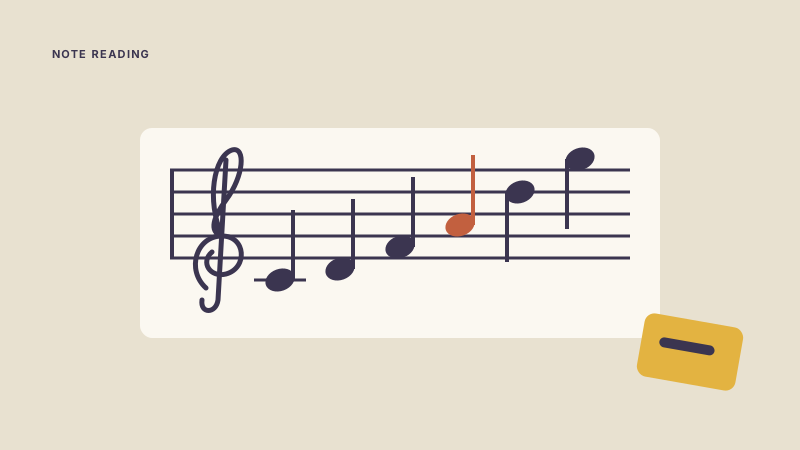
Learning to read notes on the staff is one of the best uses of flashcards in music, because the goal is instant recognition and the set is small: about 20 to 30 notes per clef including ledger lines. The usual mnemonics ("Every Good Boy Does Fine") get you started, but counting up a mnemonic is slow. Readers who are fast use landmark notes, a handful of notes they know instantly, and read everything else as a step or skip from the nearest landmark. So card the landmarks first, then fill in the rest, drill for speed, and move to real music as soon as recognition is quick.
(This guide comes from the Nebulearn blog, and Nebulearn makes a flashcard app. The method works with paper cards or any note reading app.)
The mnemonics, and their limit
| Clef | Lines (bottom to top) | Spaces (bottom to top) |
|---|---|---|
| Treble | E G B D F ("Every Good Boy Does Fine") | F A C E ("FACE") |
| Bass | G B D F A ("Good Boys Do Fine Always") | A C E G ("All Cows Eat Grass") |
These work, and they are the right place to start. Mnemonics on flashcards covers how to use them without depending on them forever. The problem is speed. To name a note on the fourth line of the treble clef, you count "Every, Good, Boy, Does," and get D. That takes a second or two, which is fine on a flashcard and far too slow while playing. And the mnemonics stop at the edge of the staff, so ledger lines need yet another method.
Landmark notes: the faster system
Instead of counting from the bottom every time, learn a few notes so well they are instant, then read nearby notes by interval: one step up from a line is the space above it, a skip of a third goes line to line or space to space.
| Landmark | Where | Why it is useful |
|---|---|---|
| Treble G | Second line of the treble clef (the treble clef curls around it) | The clef itself points to it, so it is easy to find |
| Bass F | Fourth line of the bass clef (between the clef's two dots) | Marked by the clef, so it is easy to find |
| Middle C | One ledger line below the treble staff, or one above the bass staff | Connects both clefs |
| Treble C | Third space of the treble staff | An octave above middle C |
| Bass C | Second space of the bass clef | An octave below middle C |
| High G | Space just above the treble staff (the top line is F) | Reading above the staff |
| Low F | Space below the bass staff | Reading below the staff |
Once these are automatic, a note one line above treble G is B (a third up), a note in the space just above it is A (a step up). You are reading relationships, which is also how you will need to read when playing melodies, since melodies move by steps and skips.
Card set by stage
| Stage | Cards | Count |
|---|---|---|
| 1 | Landmark notes in both clefs | About 8 |
| 2 | All line and space notes on the treble staff | 9 |
| 3 | All line and space notes on the bass staff | 9 |
| 4 | Ledger lines: two above and two below each staff | About 16 |
| 5 | Mixed clefs, random order | Uses the cards above |
| 6 | Key signatures (sharps and flats for each major key) | 15 |
Use an image of the note on the staff as the front and the letter name as the back. For piano, add a second set where the back is the key on the keyboard, or play the note before flipping. Music theory interval flashcards and guitar fretboard flashcards cover the next steps for those instruments.
Drilling for speed
Recognition speed is the real goal. A few ways to build it:
- Short daily sessions. Five minutes a day beats an hour a week. Optimal flashcard session length explains why short sessions hold quality.
- Say it out loud. Saying the note name engages more than thinking it, and it is easy to time.
- Mixed order, both clefs. Once each clef is solid, mix them. Pianists especially need to switch clefs instantly.
- Note reading apps with timers. Several apps flash notes and score your speed, which complements spaced repetition cards nicely.
Key signatures
Key signatures are a small, fixed set and ideal for cards. Learn the order of sharps (F C G D A E B) and flats (B E A D G C F, the reverse), and two shortcuts:
- Sharp keys: the key is a half step above the last sharp. Three sharps, last sharp G sharp, so the key is A major.
- Flat keys: the key is the second to last flat. Three flats (B, E, A), second to last is E flat, so the key is E flat major. (One flat, F major, is the exception to memorize.)
Card both directions: key signature image to key name, and key name to number of sharps or flats. Reverse flashcards explains why both directions need practice.
When to move to real music
Flashcards teach single notes. Reading music means reading groups of notes in rhythm, while playing. Once you can name staff notes in about a second, start sight reading easy pieces daily, a few lines a day, slightly below your playing level. Keep the flashcards for ledger lines and whatever you still hesitate on. Flashcards vs practice problems describes the same split between recall and skill in other subjects. Most learners find that daily sight reading plus a few minutes of cards is the fastest combination.
Where other resources are better
A teacher can correct habits early, such as reading by counting from the bottom, which is hard to unlearn later. Graded sight reading books give a gentle progression of real music. Note reading apps and websites with timed drills are excellent for speed. Paper flashcards work well too, especially for children.
In Nebulearn, you can make image cards of notes on the staff, and FSRS brings back the ledger lines and bass clef notes you hesitate on more often than the ones you know.
Landmarks, then speed, then music
Start with the mnemonics, but build reading on landmark notes so you read by steps and skips. Card the landmarks, then each staff, then ledger lines and key signatures. Grade for speed, not just correctness, drill both clefs mixed, and move into easy sight reading as soon as single notes come quickly.