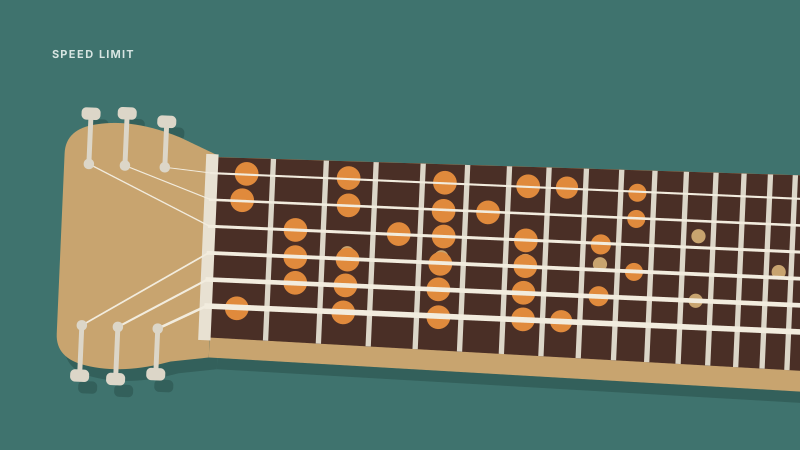
How to Learn the Guitar Fretboard: cards with a speed limit
Fretboard cards only count if you answer at playing speed. The anchor deck, the octave shapes, and the honest limit of what flashcards can do here.
You learn the fretboard with a small deck and a hard time limit, not with a card for every position. Card the natural notes on the low E and A strings, card the four octave shapes, and then grade yourself on speed: if the answer took you longer than about a second, mark it wrong even though you got it right. That last rule is the whole post, and it is the part every fretboard deck I have seen gets backwards.
I work on Nebulearn, so treat anything I say about apps as a conflict of interest. The pattern I keep seeing from players who try this is the same one: the deck runs for three weeks, the pass rate looks great, and then they sit down with the guitar and still cannot say what they are playing. The deck was not lying about whether I knew the notes. It was lying about whether I knew them fast enough to use, which on an instrument is the only kind of knowing that counts.
A right answer in eight seconds is still a failed card
For almost every deck I own I use the rule from the time-per-card metric: six to ten seconds a card is a healthy session, and past about eight I call it a miss. The fretboard is the one deck where that rule is far too generous, and you have to know why before the rest of this is useful.
Do the tempo arithmetic. At 80 beats per minute, one quarter note lasts three quarters of a second. Play eighth notes at 120 and you get a quarter of a second each. Those are not fast tempos; that is a beginner backing track. A fretboard fact that arrives in eight seconds arrives about eleven beats after you needed it, which in practice means you stop playing, count up from an open string, and lose the bar. The knowledge was real and still useless.
So the deck needs a threshold instead of a grade. Mine is one second, enforced out loud: metronome at 60, look at the card, and I have to have said the note name before the next click. Anything slower is an "Again," and I do not get to argue with myself about it. It feels harsh for about a week and then stops feeling like anything, because a fact you can produce in a second is stored differently from one you can reconstruct in eight.
That threshold also changes what belongs in the deck, because you are never going to get seventy two separate items under one second each.
Why carding all 72 positions is the wrong deck
The obvious deck is one card per position. Six strings times twelve frets, since the pattern repeats at the octave, is seventy two cards, seventy eight if you count the open strings. That is the deck almost everyone builds first, and three things are wrong with it.
First, it does not finish. A standard neck has twenty or twenty two frets, so the positions above fret 12 either get carded too, doubling the deck for zero new information, or get left out, which quietly teaches you that the neck ends where your cards do.
Second, it is enormously redundant. There are only twelve note names in play, so the same note turns up over and over. C alone sits at six places inside the first twelve frets: 8th fret of the low E, 3rd fret of the A, 10th fret of the D, 5th fret of the G, 1st fret of the B, and 8th fret of the high E. One card per position means six unrelated memories of C, each earning its own interval schedule, none of them telling you anything about the others.
Third, it trains the wrong direction. A position card asks "6th string, 8th fret, what note is this," which is the question you need when reading. Playing mostly asks the reverse: "I need a C, where is the nearest one." Seventy two lookup cards get you fluent at the question you ask least.
Atomic encoding is still the right instinct here, one question and one answer per card, but atomic is not the same as exhaustive. Card the generators, not everything the generators produce.
The fourteen cards that anchor the neck
The two lowest strings do most of the work, because in standard tuning (low to high: E, A, D, G, B, E) the root of nearly every open-position and barre shape you will play sits on the 6th or 5th string. So the first deck is the natural notes on those two strings and nothing else.
| Note | Low E string (6th) | A string (5th) |
|---|---|---|
| E | open, 12 | 7 |
| F | 1 | 8 |
| G | 3 | 10 |
| A | 5 | open, 12 |
| B | 7 | 2 |
| C | 8 | 3 |
| D | 10 | 5 |
Seven notes on each string, so fourteen cards, and the accidentals are deliberately not in there. If you know F is the 1st fret of the low E, then F sharp is one fret up, and you get it by moving rather than by remembering. Once all fourteen are under a second, add the reverse direction as a second set of fourteen ("where is C on the A string"), because that is the question you actually ask mid-song. Twenty eight cards total, which is a four minute review, not a chore you quit in week two.
What the table implies is that the rest of the neck is not a memory problem. It is a geometry problem, and the geometry is four shapes.
The octave shapes, and the one place they break
If you know one position for a note, you can reach the others by moving in fixed patterns, which is the reason the anchor deck is enough. Moving toward the treble side:
- 6th string to 4th string: same note, two frets higher
- 5th string to 3rd string: same note, two frets higher
- 4th string to 2nd string: same note, three frets higher
- 3rd string to 1st string: same note, three frets higher
The shape changes for the last two because the strings are not evenly spaced. Every adjacent pair in standard tuning is a perfect fourth apart, five semitones, except G to B, which is a major third, four semitones. Any jump that crosses the 3rd to 2nd string boundary loses a semitone, so you add a fret to compensate. That single exception is worth its own card, phrased as the reason and not just the offset, because it is also why barre chord shapes change when they cross the B string.
Here is the worked version, finding all six C positions from the anchor deck. C is the 3rd fret of the A string. Apply the 5th to 3rd shape: two frets up on the G string is the 5th fret. Apply the 3rd to 1st shape: three frets up on the high E is the 8th fret. Now take the other anchor, C at the 8th fret of the low E. The 6th to 4th shape gives you the 10th fret of the D string. The 4th to 2nd shape gives the 13th fret of the B string, and since the neck repeats every twelve frets, that is also the 1st fret. Two remembered facts and four shapes produced all six positions, and they came out connected instead of as six strangers.
Which name goes on the back of an accidental card
The shapes hand you positions, but not what to call the black notes, and this is where fretboard decks quietly teach a wrong thing. The 2nd fret of the low E string is F sharp, and it is also G flat. Same pitch, two names, and which one is correct depends on the key. In G major, the one sharp in the key signature is F sharp, so calling that fret G flat is wrong even though the pitch is right. In D flat major you would call it G flat.
A card whose answer is "F sharp / G flat" trains the ambiguity instead of resolving it, so I do it two ways. For pure position drills, the card accepts either name and I say whichever comes first, because at that stage I am drilling geometry. For key work, the key goes on the front: "in A major, what is the 4th fret of the low E string" has one answer, C sharp, and it is a different card from the same fret in E flat major. Two pairs of notes have no accidental between them at all, because B to C and E to F are already a single semitone apart. There is no fret between the 7th and the 8th on the low E, and no name for one.
If ear training and interval names are the part you are actually short on, that is a different deck and I wrote it up separately in music theory flashcards for intervals and progressions. This page is only about position to name at speed. Mixing the two is how you end up with a few hundred cards where nothing hits the threshold.
Where the deck stops and the guitar starts
This is the limit I have to be honest about, because a post that sells you cards as the whole answer is selling you three weeks of reviews that never reach your hands. Flashcards build declarative recall. They can get "5th fret of the A string is D" down to a reflex. They cannot build the motor pattern, the part where your hand goes to that fret without routing through the name at all. That is the same gap I wrote about for syntax versus logic on LeetCode: recalling that a fact exists is not the same skill as using it under pressure.
The instrument builds that half, and it needs its own five minutes. The drill I use is the one in the box above, plus playing a scale I already know and naming every note out loud as I play it. Out loud matters. Thinking it lets you skip ahead; saying it forces the name and the finger to land together, which is the thing you are trying to wire.
One honest note on tooling, since a guitar means you are on a couch or in a practice room and not at a desk. Nebulearn has no offline mode. There is no cached deck, and the study page shows a connection problem banner if the browser drops. Anki is local first, so if your practice spot has bad wifi, Anki genuinely wins that scenario and I would use it there without feeling weird about it. Just know that review history does not carry over between apps, so pick the one that fits where you practice before you build up months of scheduling data in it.
When the drill stalls
Two failures show up often enough to plan for. The first is passing every card under a second and still freezing in a song. That is not a deck problem, it is the transfer gap, and adding cards makes it worse. The card gives you a still frame and an empty hand; the song gives you a hand already in a shape and a beat already moving. The fix is the metronome drill, and you will know it is working when you can name what you just played rather than what you were about to play.
The second is a cluster that stays slow no matter how often it comes back, usually the accidentals around frets 6 through 9 on the D and G strings. That is a leech, and the honest read is that those positions have no anchor near them. The fix is one anchor card, not ten position cards. Learn that the 7th fret of the D string is A and the 5th is G, and the frets between them stop being their own facts.
If the creation side is what stops you, this is the one spot where the tool matters, and it is why I use my own. Nobody wants to draw seventy eight fretboard diagrams by hand. One clean fretboard chart plus image occlusion gives you the whole position deck from a single image, and unlike most occlusion decks the spatial recognition trap does not really apply, because the fretboard is a fixed grid that never shows up rotated on you.
So: a fretboard deck fails when it is big and untimed, and it works when it is small, structural, and graded against a clock you can actually play to. That is the deck I build in Nebulearn, an occluded fretboard chart, twenty eight anchor cards with the reverse direction, one card for why G to B breaks the shape, and FSRS on by default so the anchors drift out while the accidentals you keep missing stay close. The guitar still has to do its half.