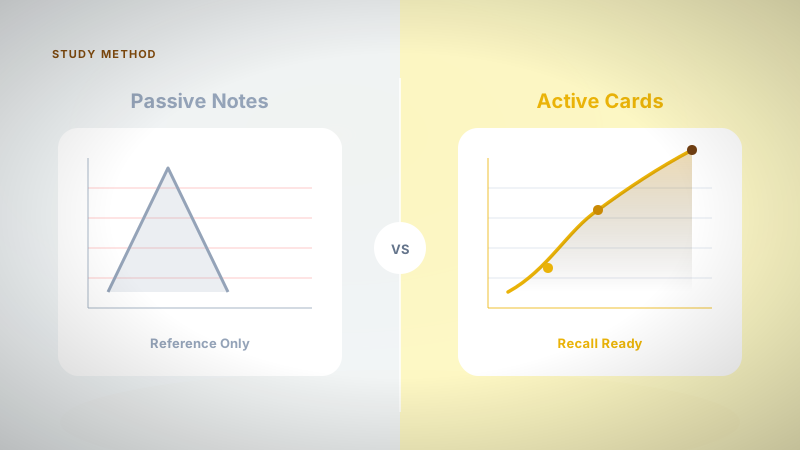
Notes vs. Cards: The 'Encoding Gap' that wastes your study time
Why taking notes feels productive but often fails at exam time, and how to bridge the gap between reference material and active recall.
If you have ever spent three hours making a beautiful Notion page only to realize you cannot remember a single concept from it two days later, you have hit the encoding gap.
The choice between taking notes or making flashcards is usually framed as a rivalry. We are told notes are for "understanding" and flashcards are for "memorizing." In reality, most students use notes as a safety blanket. We write things down so we don't have to hold them in our heads, but then we never actually move that information into our long term memory.
I am Daniel. I am a third year Engineering Science student at UofT, and I work on Nebulearn. I built it because I was tired of the friction between my lecture PDFs and my study queue. That is my conflict of interest, but the logic here applies whether you use my app, Anki, or a physical notebook.
The illusion of competence in note taking
Note taking often feels like work because it is high volume. You are moving your hand, you are organizing headers, and you are capturing what the professor says. But this often creates an illusion of competence.
When you look at a page of notes you just wrote, your brain recognizes the information. Recognition is not the same as recall. Recognition is seeing a face and knowing you have seen it before. Recall is being able to name that person when they aren't in the room.
If you only take notes, you are essentially building a library that you never visit. You pay a "passive re-reading tax" every time you open that notebook before an exam, trying to force the information back into your brain through sheer repetition.
Why flashcards feel harder (and work better)
Flashcards force a different mental process called active recall. Instead of looking at the answer and nodding, you are presented with a hole in your knowledge that you have to fill.
This is the "encoding" part of the gap. When you struggle to remember an answer, you are strengthening the neural pathway to that information. Notes are a reference material; flashcards are a training tool. The problem is that flashcards are terrible for high level context. You cannot learn the "big picture" of organic chemistry by looking at 500 isolated cards if you don't understand the underlying mechanics first.
This is why the "should I take notes or make cards" question is a trap. You need both, but you need to know when to stop writing and start testing.
The Information Density decision tree
The most efficient way to study from lecture slides is to categorize information based on its density. Not everything deserves a flashcard, and not everything should stay buried in a PDF.
| Type of Information | Best Format | Why? |
|---|---|---|
| Broad Narratives (e.g., The causes of a war) | Notes / Outline | You need to see the flow and connections between events. |
| Hard Facts (e.g., Dates, anatomy, syntax) | Flashcards | These are arbitrary and must be memorized through repetition. |
| Complex Processes (e.g., The Krebs cycle) | Both | Notes to understand the steps; cards to drill the individual enzymes. |
| Reference Material (e.g., A massive table of constants) | Notes | You just need to know where to find it, not memorize it. |
If you can explain the concept in your own words without looking, the "understanding" part is done. If you then find yourself forgetting the specific terms or steps three days later, that is a signal to bridge the gap and turn those notes into flashcards.
Moving from reference to active recall
The biggest waste of time in a semester is the transition period where you "clean up" your notes to make cards later. This is double work.
I used to have my lecture PDF on one half of my screen and Anki on the other. I would read a slide, try to understand it, and then manually type a question into Anki. The friction of switching windows and re-typing text often meant I just gave up and went back to highlighting the PDF.
I got tired of that split, which is why the editor in Nebulearn sits next to the PDF. You highlight the sentence you already decided is a card. If the notes are already in the browser, the Chrome extension is the same move without uploading anything.
When flashcards are the wrong choice
Flashcards are not a silver bullet. If your bottleneck is a deep, conceptual math problem, making 100 cards about formulas won't help you if you don't know when to apply them.
Anki is incredible for medical students because they have a massive volume of discrete facts to memorize. For those students, AnkiMobile is often worth the $25 price tag on iOS. I've written about where Anki spends your time if you're in a high-volume field like med or law. But if you are in a design class or a philosophy seminar, your "notes" are your primary tool. The goal is to spend the least amount of time possible on the format and the most amount of time on the mental effort.
If your notes are just a graveyard of information you never look at again, you are better off with fewer, higher quality cards.