Nursing Pharmacology: Why your drug cards are 3x too long
How the nursing brain dump mistake leads to burnout and how atomic encoding fixes your pharmacology flashcards.
If you are a nursing student, you have likely spent a Sunday afternoon staring at a drug table for Warfarin or Digoxin and feeling a deep sense of dread. You have a stack of 50 drugs to memorize, and each card looks like a miniature textbook page.
The reason you are failing to remember them is not a lack of effort. It is a structural failure in your cards. Most nursing drug cards are three times too long because they follow the nursing brain dump mistake.
I work on Nebulearn. I built it because I saw students at UofT spending four hours making cards they could never actually finish reviewing. I have a conflict of interest here, but the physics of memory do not change based on which app you use. If your cards are too long, you will burn out before the midterm.
The nursing brain dump mistake
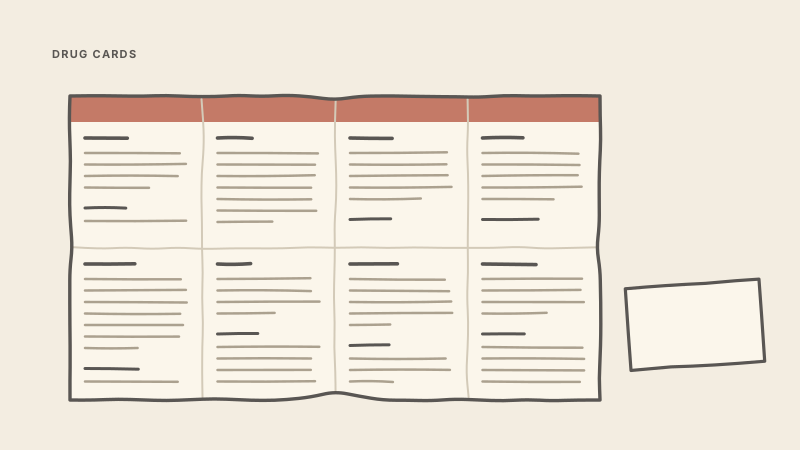
A typical nursing pharmacology card usually has the name of the drug on the front and a wall of text on the back. It looks like this:
Front: Warfarin (Coumadin) Back: Anticoagulant. Inhibits Vitamin K synthesis. Used for DVT, PE, AFib. Side effects: bleeding, bruising, hemorrhage. Nursing considerations: Monitor PT/INR (target 2-3). Antidote is Vitamin K. Avoid leafy greens.
This is not a flashcard. It is a digital note that you are pretending is a card.
When you see this card in your queue, your brain does one of two things. It either skims the first three words and clicks "Good" (passive recognition), or it gets overwhelmed by the seven different facts it needs to recall and clicks "Again" (frustration). This is how a 50-card deck feels like a 500-card deck. You are trying to recall an entire paragraph in one go, which is the opposite of how atomic encoding works.
Atomic encoding for pharmacology
To fix this, you have to break the drug down into single, "atomic" questions. You should never be asked "What is Warfarin?" You should be asked specific questions about its mechanism, its monitoring, and its risks.
If we take that Warfarin "brain dump" and apply atomic encoding, it becomes four distinct cards.
| Front | Back |
|---|---|
| What is the antidote for Warfarin? | Vitamin K |
| Which lab value is monitored for a patient on Warfarin? | PT/INR |
| What is the therapeutic INR range for a patient on Warfarin? | 2.0 to 3.0 |
| What is the mechanism of action for Warfarin? | Inhibits synthesis of Vitamin K-dependent clotting factors |
By splitting these up, you can fail the "INR range" card without being forced to re-study the "Antidote" card that you already know perfectly. This is the only way to keep your pharmacology active recall sessions under twenty minutes.
Mechanism of action vs side effects
One of the hardest parts of nursing pharmacology is the sheer volume of side effects. Every drug seems to cause "nausea, vomiting, and diarrhea."
The mistake is listing every possible side effect on the back of the card. Instead, focus on the "red flag" side effects or the ones directly linked to the mechanism of action.
If you understand that a beta-blocker slows down the heart (mechanism), you do not need a list of 20 side effects. You just need one card for bradycardia and one for hypotension. If you try to memorize a list of 10 side effects for every drug, you are fighting a losing battle against your own biology.
Why Anki or Quizlet might be your current choice
If you are already using a tool, you might be hesitant to switch.
Anki is the gold standard for long-term retention if you have the time to learn the interface. If you are a med student using the AnKing deck, stay there. AnkiMobile costs about $25 on iOS, but the desktop and Android versions are free. It is a powerful tool if you are willing to manage the complexity.
Quizlet is great for a Friday night cram session because it is very fast to set up. However, Quizlet retired their "Long-Term Learning" feature years ago. Their free "Learn" mode is session-based, meaning it helps you learn a set today, but it does not manage a real due queue over the course of a semester.
I work on Nebulearn because I wanted something in the middle: the power of a real FSRS scheduler (like Anki) but with the speed of modern AI.
How I handled the nursing textbook bottleneck
When I was looking at nursing textbooks, I realized the biggest time-sink wasn't the cards themselves. It was the tables. Nursing textbooks love dense tables with 15 rows of drugs, dosages, and considerations.
I built Nebulearn's PDF extractor specifically to handle these. Instead of you manually typing out "Warfarin... Anticoagulant... Vitamin K," you can upload the PDF of your lecture or textbook chapter. The AI identifies the drug properties and lets you generate atomic cards from the table rows in seconds.
The goal is to spend your time studying the labs and the patient safety, not formatting cards on a Sunday night.
If you are tired of cards that feel like paragraphs and want a system that builds a real due queue without the manual labor of Anki, give Nebulearn a look. The free tier includes 1,000 saved questions and 40 weekly AI credits, which is usually enough to get through a heavy pharmacology rotation.