Why you feel like you're 'faking' your flashcard reviews
Flashcards only work if you are actually performing active recall. Learn how to spot the difference between recognition and recall to stop faking your reviews.
If you have ever flipped a flashcard, seen the answer, and thought "I definitely knew that," you are probably lying to yourself.
It is a specific kind of frustration. You spend two hours clearing your queue, but when the exam paper sits in front of you, the information is gone. The cards feel like they are working while you are in the app, but they don't stick in the real world. Usually, this happens because you have drifted from active recall into passive recognition. You aren't remembering the concept; you are just recognizing the card.
A little about me: my name is Daniel. I'm a third year engineering science student at UofT. I work on Nebulearn, so I have a conflict of interest here, but I built the app specifically because I was tired of "gaming" my own study sets.
The difference between recognition and recall
Flashcards fail when you stop retrieving information and start identifying it. Recognition is the "I’ve seen this before" feeling. It is why multiple choice questions are easier than short answer questions. Your brain sees a prompt, notices it is familiar, and stops the hard work of searching your memory.
Recall is different. It is the act of pulling a fact out of the void without any hints. If recognition is like finding a name in a phone book, recall is like remembering the phone number from scratch.
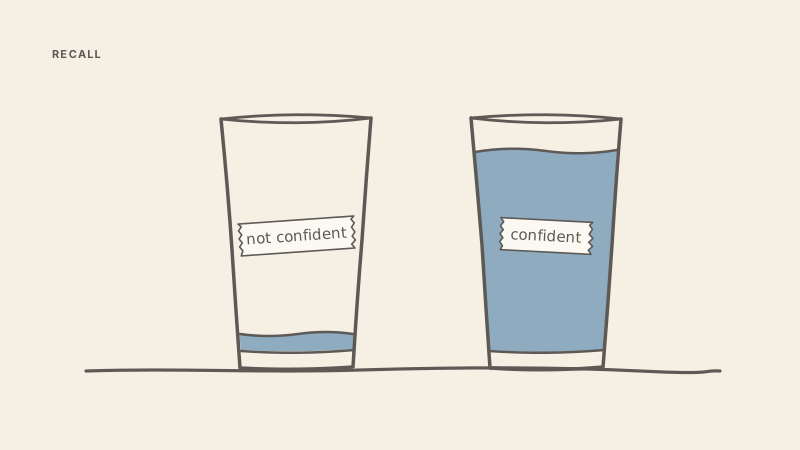
When you study, recognition feels good because it is easy. Recall feels bad because it is cognitively demanding. If your study session feels effortless, you are likely not learning. You are just looking at things you already know exist.
The Layout Trap
The most common way students fake their reviews is by memorizing the "Layout" of a card rather than the content. This is the "Layout Trap."
Your brain is incredibly efficient at finding shortcuts. If a specific card has a typo in the third line, or an image of a mitochondria in the top right, or even just a very long sentence structure, your brain will anchor to those visual cues. You aren't answering the question "What is the Krebs cycle?" You are answering the question "What is the answer to the card with the blurry diagram?"
This is why you can hit "Easy" ten times in a row in your bedroom but fail the question in a lecture hall. The visual anchors are gone. You never learned the concept; you just learned the card.
Why hitting 'Easy' is often a lie
The feeling of a card being "Easy" is often a signal that you are performing passive review. When a card is truly easy, it means the connection in your brain is so strong that the retrieval was instantaneous. But more often, we hit Easy because the card was familiar.
Familiarity is the enemy of retention. If you hit Easy on a card you merely recognized, the algorithm will push it weeks or months into the future. Because you didn't actually perform the hard work of recall, that weak connection will wither before you see the card again.
I wrote about this in my guide on why you should stop hitting easy. Most of the time, "Good" is the honest answer. If you have to think for even one second, it was not easy.
How to make your cards harder to 'fake'
If you want flashcards to work, you have to break the visual anchors. This starts with how you write the cards. If your cards are too long or contain too much context, you give your brain more "junk" to memorize instead of the core fact.
- The Atomic Principle: One card should ask one thing. If a card has five bullet points, you will inevitably memorize the shape of the list rather than the facts.
- Vary the prompt: If you are learning a definition, don't just have "Word -> Definition." Create a second card that is "Definition -> Word."
- Remove the fluff: If you have 20 cards that all start with the same introductory phrase, your brain will start to tune out.
I have a full breakdown on how to write flashcards that stick if you want to fix your card quality. Usually, the harder a card is to write, the harder it is to fake. If you're spending hours just making cards, you're likely adding too much 'junk' context that creates those visual anchors. I track which parts of the workflow eat the most hours in my guide on study apps that save the most time. The goal is to make the card so plain that there is nothing to memorize except the actual answer.
Choosing the right tool for the job
The app you use changes how easily you can "fake" your way through a deck.
Anki is the gold standard for long term retention because it forces you into a strict due queue. If you use Anki, I recommend the desktop version or AnkiDroid because they are free. AnkiMobile for iPhone is about $25, which is a one time cost that is worth it if you are a med student with a ten year deck. Anki is great because it is boring. There are no animations or "streaks" to buy, which keeps the focus on the cards.
Quizlet is the opposite. Their free "Learn" mode is session-scoped, meaning it focuses on getting you through a set in one sitting. This is great for a Friday night cram session, but it is the peak of recognition-based study. You see the same cards so many times in twenty minutes that you can't help but memorize the layout. They retired their Long-Term Learning feature a while ago. Now, they have a "Memory Score" on the Plus plan, but it isn't a true FSRS-based scheduler.
When I built Nebulearn, I wanted something that sat in the middle. I wanted the power of a real spaced repetition scheduler (we use FSRS by default) but with a UI that didn't have a thousand "anchors" to memorize. I kept the study interface as clean as possible so your brain has nothing to look at but the text.
If you are currently using an app that feels like a game, you might be winning the game but losing the material. Real study feels like work.