How to Memorize the Periodic Table (Card the Position, Not the List)
Reciting elements in order is the slow way. Learn where each element sits, because group and period are what chemistry questions use. A block by block plan.
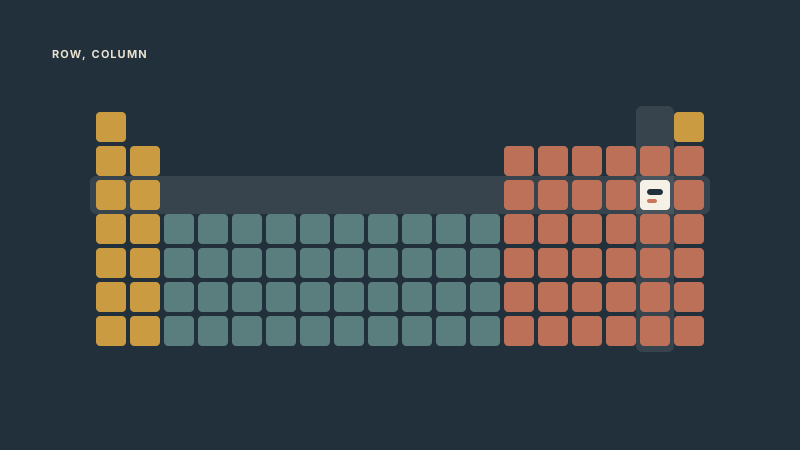
If you need to memorize the periodic table, do not learn it as a list from 1 to 118. Learn where each element sits: which column, which row. The position is the useful part. It tells you how many outer electrons the element has, what charge it tends to take, what it behaves like, and who its relatives are. The atomic number order, on its own, tells you almost none of that.
And before any of that, find out how much of the table you actually need. For most first year chemistry courses the honest answer is the first 20 or the first 36 elements cold, plus the names of the main groups, plus a handful of heavier ones that show up constantly, like silver, gold, mercury, lead and iodine. Almost nobody is asked for all 118, and learning the lanthanides for an intro course is time you could have spent on stoichiometry.
I work on Nebulearn, a flashcard app, so weigh the tool mentions accordingly. The card plan here works in any app that can show an image.
Why the song is the slow way
A lot of people start with a song or a sentence that runs through the elements in order. It is fun and it does work, in the narrow sense that you can then recite them. The problem is what kind of knowledge that gives you.
A recited list is a chain. Each element cues the next one. So when a question asks you about chlorine, the only way to reach chlorine is to start from hydrogen and run the chain, counting on your fingers. You sit in the exam going, "hydrogen, helium, lithium, beryllium, boron," under your breath, and you get to seventeen, and now you know chlorine is number 17. You still do not know it is a halogen, or that it wants one more electron, or that it sits right under fluorine, unless you learned those separately.
That is the same weakness as knowing a deck only in its original order, which I wrote about in the context dependency problem. You have serial recall, and what the exam wants is random access.
Position gives you random access. If what you know about chlorine is "group 17, third row," then you already know it has seven valence electrons, it forms a 1 minus ion, and it behaves like fluorine and bromine. You got four facts from one, and you did not have to count.
What the position is telling you
Here is why the layout is worth learning as a layout. The table is not an arbitrary grid. The columns and rows mean something, and once you know what they mean, a lot of facts stop being separate things to memorize.
| What you know | What it gives you |
|---|---|
| Group (column) for main group elements | The number of valence electrons, and so the usual ion charge and bonding behaviour |
| Period (row) | How many electron shells are occupied, so roughly how big the atom is |
| Block (which region of the table) | Which type of orbital is being filled, which is most of electron configuration |
| Left or right side | Metal or nonmetal, with the metalloids along the staircase between them |
| Position relative to a neighbour | Trends: which of two elements is larger, more electronegative, harder to ionize |
That last row is where a lot of exam marks are. Electronegativity and ionization energy generally increase as you go up and to the right. Atomic radius generally increases as you go down and to the left. If you can picture where two elements sit, you can answer "which is more electronegative, sulfur or chlorine?" by looking at the picture in your head. If all you have is a list, you have nothing to look at.
So the plan is to build that picture, and to build it in the pieces that chemistry actually uses.
The card types, in the order I would add them
There are four kinds of card worth making, and it matters which you do first.
1. Symbol and name, in both directions. You need to read formulas and you need to write them, so this is one of the cases where a reversed card earns its place. I went through when two way cards are worth it in reverse flashcards, and element symbols are close to the ideal case: one to one, short on both sides.
Most symbols are easy because they are the first letter or two of the name. Spend your effort on the ones that are not. There are about ten that come from older Latin or German names, and they cause most of the mistakes:
- Na is sodium (natrium), K is potassium (kalium)
- Fe is iron (ferrum), Cu is copper (cuprum)
- Ag is silver (argentum), Au is gold (aurum)
- Hg is mercury (hydrargyrum), Pb is lead (plumbum)
- Sn is tin (stannum), W is tungsten (wolfram)
Put the old name on the back of the card as a one line reason. "Pb, from plumbum, same root as plumbing" holds much better than Pb on its own. That is the idea from mnemonics on flashcards: a real reason beats an invented trick.
2. Position cards, using a blank table. This is the core of the method. Take an image of the periodic table with the element names removed, cover one cell, and ask what goes there. Image occlusion is the right tool for this, since the whole point is that you are learning a place on a picture.
3. Group cards. "Which group is the halogens?" "Name the alkali metals in order going down." "What charge do group 2 metals usually form?" These are small and they pay off constantly.
4. Trend cards. "Going down a group, what happens to atomic radius, and why?" Always include the why. A trend memorized as an arrow is easy to get backwards. A trend you can explain in one sentence is not: more shells, so the atom is bigger.
Do them in that order. Symbols first, because you cannot do position cards if you cannot read the cells. Groups and trends last, because they make much more sense once the picture exists.
Build the table one block at a time
The mistake with position cards is occluding the whole table on day one. A hundred and eighteen masks on one image gives you a pile of new cards that all look the same, and I have argued before, in stop using image occlusion for everything, that masking a whole diagram at once mostly trains you to recognize the image.
Break it into pieces that are meaningful on their own. Here is the order I would use for a course that needs the first 36.
| Stage | What you add | Roughly how many cards |
|---|---|---|
| 1 | Rows one and two: hydrogen to neon | 10 |
| 2 | Row three: sodium to argon | 8 |
| 3 | The two left hand columns down to row four, and the names of groups 1, 2, 17 and 18 | about 8 |
| 4 | The right hand side of row four: gallium to krypton | 6 |
| 5 | The first row of transition metals: scandium to zinc | 10 |
| 6 | The handful of heavy elements your course keeps using | 5 to 10 |
Each stage is a day or two. Do not start the next one until the current one feels boring. At around ten new cards a stage, the whole thing takes two weeks at a few minutes a day, and by the end you can sketch the first four rows from memory, which is the real goal.
There is a useful trick inside this. For the main group elements, add a second kind of position card that goes the other way: "third row, group 16, what is it?" and the answer is sulfur. That forces you to find the element by its coordinates, which is the direction a trend question needs.
Electron configuration mostly falls out of the map
Once the picture is in place, a topic that looks like a separate pile of memorization turns out to be mostly reading the table.
The two left columns are the s block. The six right columns are the p block. The ten columns in the middle are the d block, and the two rows pulled out at the bottom are the f block. As you read across a row, you are filling those orbitals in that order. So to write the configuration for an element, you walk the table from hydrogen to that element and write down each block as you pass through it. Phosphorus is in the third row, three columns into the p block, so it ends in 3p3.
One detail to card on its own: the d block in the fourth row is filling 3d, not 4d. The d orbitals run one number behind the row they sit in. That trips up nearly everybody the first time.
And there are two exceptions in the first row of transition metals that courses love to test. Chromium is 4s1 3d5, and copper is 4s1 3d10, instead of the 4s2 pattern you would expect. Those are worth one card each, with the reason on the back: a half filled or completely filled d subshell is especially stable. Do not try to memorize the configuration of every element as a separate fact. Card the method, card the exceptions, and practice on paper.
Where a premade deck or a game is the better call
For the pure memorization part, there are tools that will get you there faster than building your own cards, and I would use them.
If you want the whole table as a ready made deck tonight, Anki's shared decks include periodic table decks with the positions already occluded, and that is hours of setup you do not have to do. The usual caution applies, which is that a deck someone else built covers what they needed, so suspend the elements your course does not ask for. I wrote about when a premade deck helps and when it does not in when premade flashcard decks actually work.
If you just need symbols and names for a quiz on Friday, a Quizlet set or one of the click-the-element map quiz sites is honestly the quickest route. Those quiz sites are very good at one thing, which is drilling location quickly with a timer, and they are fun in a way that a flashcard queue is not. What they do not do is schedule the elements you keep missing to come back next week, so use them for the first pass and a scheduler for keeping it.
And if your course gives you a periodic table in the exam, which many do, most of this article shrinks. You do not need to memorize positions that are printed in front of you. You need the group names, the trends, the exceptions and the skill of reading the table quickly. That is the situation I covered in open book exams: card the things the sheet cannot tell you.
When it does not stick
A few specific things go wrong with this, and they have specific fixes.
Symbol pairs that swap. Magnesium and manganese (Mg and Mn). Sodium and sulfur, because S looks like it should be sodium. Potassium and phosphorus, because P looks like it should be potassium. Silver and gold. When two keep trading places, stop reviewing them separately and make one card that puts them side by side: "Mg or Mn: which one is the transition metal?" It is the pair card idea I used for near synonyms in GRE vocabulary, and it works on symbols for the same reason.
Knowing the cell only by its neighbours. If you can name an occluded cell only when the cells around it are showing, you have learned the image, not the table. Use the coordinate cards from earlier, and do the blank sheet check once a week.
Learning far more than the course needs. If you are in an intro course and you are drilling the sixth row, stop. Go and check the syllabus or an old exam. The elements past krypton that matter in a first course can usually be counted on two hands.
A card that keeps failing for no clear reason. That is a candidate for the leech protocol. For elements, the fix is nearly always to add a reason or a picture to the back before you think about deleting it.
The split this whole page turns on is list versus map. The list is easy to start and gives you one fact per element. The map takes a little longer to build and gives you four or five. That is the deck I would build in Nebulearn: a blank table with image occlusion, added one block at a time, symbol cards in both directions for the ten awkward ones, and FSRS on by default so the elements you already know drift out to long intervals while Mg and Mn keep coming back until they stop swapping.