The hidden costs of Anki
Why the gold standard of spaced repetition might be costing you more time than it saves.
Anki is the "free" app that every medical student swears by. If you spend five minutes on a study subreddit, you will be told it is the only serious way to learn. But after three years of engineering at UofT, I have realized that Anki is only free if your time has zero value.
The real cost of Anki isn't the $25 one-time fee for the iOS app. It is the hours spent configuring Python add-ons, tweaking interval modifiers, and fighting an interface that looks like a Windows 95 spreadsheet.
I work on Nebulearn. I built it because I was tired of spending my Sunday nights formatting cards instead of actually studying them. This is a conflict of interest, but it is also why I can tell you exactly where the Anki "guru" advice breaks down for most students.
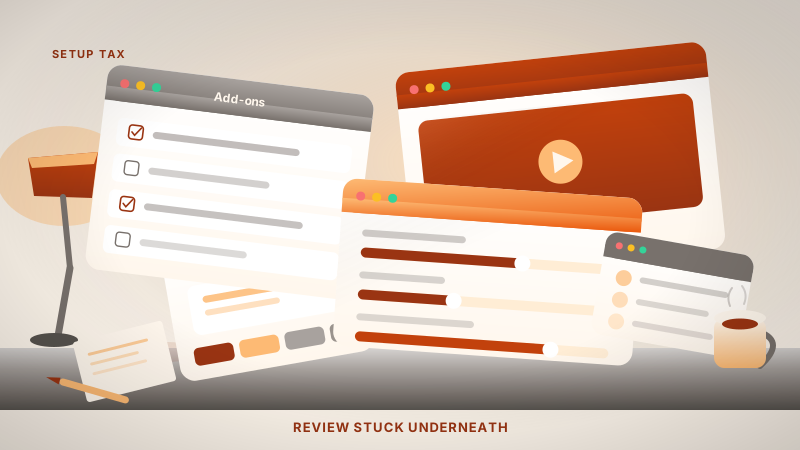
The setup tax is a productivity trap
Most people start using Anki because they heard about the AnKing deck or a legendary pre-made set for their major. They download the software looking for something simple, then they immediately hit a wall.
Anki is not a "plug and play" app. To make it modern, you have to hunt through forums for the right add-ons. You need one for heatmaps, one for image occlusion, and maybe a custom CSS theme so the cards don't look depressing. By the time you have a functional setup, you have spent three hours doing "meta-work."
That is the part I still find weird. Students get pointed at Anki as the simple option, then they spend hours on tutorials before they review a single card. Most students I know are looking for the same things: cards from this week's lecture, and a queue that comes back later. That should not need setup.
This meta-work feels like studying, but it isn't. It is procrastination disguised as optimization. If you are a med student with a ten-year horizon, maybe that setup tax pays off. If you are an engineering or business student with a midterm in forty-eight hours, that time is better spent elsewhere.
The cult of the perfect interval
The setup tax does not stop when the window looks usable. There is a specific echo chamber around Anki that treats the algorithm like a religion. For years, the community obsessed over the SM-2 scheduler and "ease factor" hell. Now, everyone is talking about FSRS (Free Spaced Repetition Scheduler), which is a massive improvement, but still requires you to understand parameters and weights.
The gurus tell you that if you don't have the perfect settings, you are wasting your time. This creates a psychological burden. You start worrying more about the "algorithm" than the actual content of your lectures.
The truth is that any decent spaced repetition system will get you 90% of the results. The bottleneck for most students isn't the interval logic; it is the friction of getting cards into the system in the first place.
Friction in card creation
Anki was built in an era before LLMs and modern OCR. To create a good card in Anki, you usually have to manually copy and paste text from a PDF, find an image, and format the fields.
When you have a 60-slide deck from a Tuesday lecture, this process is brutal. You end up making fewer cards because it is so tedious. Or, you download a massive pre-made deck that doesn't actually align with what your professor is testing.
This is the point where most people quit. They see the "due" count climbing, they realize they haven't even finished making cards for the new material, and they go back to just re-reading their notes. Re-reading is less effective, but it has zero friction.
| Feature | Anki | Modern Alternatives |
|---|---|---|
| Initial Setup | High (Add-ons required) | Low (Web-based) |
| Mobile App | $25 on iOS / Free on Android | Usually free or subscription |
| Creation Speed | Manual / Slow | AI-assisted / Fast |
| Collaboration | Difficult (Shared decks) | Real-time folders |
The mobile tax and the couch barrier
Anki is famous for being free, but that is only true on desktop and Android. If you use an iPhone, AnkiMobile costs about $25. While that is a fair price for software that has been maintained for a decade, it is a barrier for a lot of students.
More importantly, the desktop version of Anki is where you have to do all the heavy lifting. If you want to change a card type or fix a typo, doing it on mobile is a headache. This tethers you to your desk.
I found that I did my best reviews when I was on the bus or waiting for a coffee. If the app makes it hard to edit or create on the go, those "micro-moments" of study time disappear. You end up waiting until you have a "real" study session, which makes the daily queue feel even more daunting.
When Anki is actually the right choice
I am not saying Anki is bad software. It is incredibly powerful. If you are in a field like medicine where you need to memorize 30,000 discrete facts over four years, Anki is the gold standard for a reason. The community-made decks for the USMLE are better than anything else on the market.
If you have already spent years building a library of cards and you have your add-ons dialed in, do not switch. The time you would spend migrating your data is a cost you don't need to pay. You can even import Anki decks into other tools if you just want a better interface, but the "cost" of the system is already sunk for you.
However, if you are a student who just needs to get through this semester's heavy workload without becoming a part-time software configurator, the Anki "guru" path is a trap. You don't need a life-long knowledge base; you need to pass your finals without burning out on data entry.
For most of us, the goal is to spend the least amount of time possible in a flashcard app while still getting the grade. If you want to see how we handled the speed problem at the University of Toronto, you can check out the fastest way to create flashcards.