Active recall vs spaced repetition
Active recall and spaced repetition are often used interchangeably, but they do different jobs. Here is how to use both to actually remember what you study.
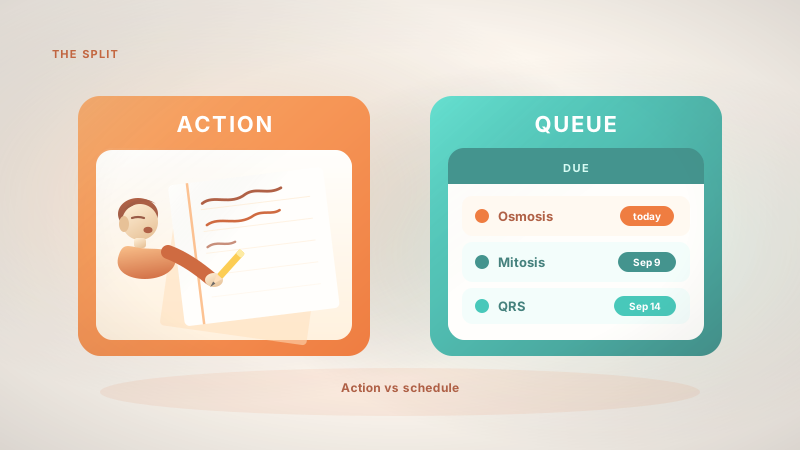
If you are looking for the difference between active recall and spaced repetition, here is the short version: active recall is a study action, and spaced repetition is a study schedule.
Active recall is the act of pulling information out of your brain without looking at your notes. Spaced repetition is the timing of when you do that act so you do not forget it. You need active recall to learn something once, but you need spaced repetition to keep it in your head for a final exam.
I work on Nebulearn. That is a conflict of interest. I still keep Anki when the deck is already an AnKing-style pile. For my own lecture PDFs at UofT, I wanted the recall hit and the due list in the same queue, without a weekend of setup. FSRS is on by default. That is the one thing I actually use.
Active recall meaning
Active recall is the opposite of passive review. Most students study by reading their textbook, highlighting sentences, or rewatching lecture slides. This feels productive because the information looks familiar, but familiarity is not the same as mastery.
When you use active recall, you close the book and ask yourself a question. You force your brain to retrieve the answer from scratch. This process strengthens the neural pathways associated with that information. It is essentially a practice test for every single fact you need to know.
Common ways to practice active recall include:
- Blurting (writing down everything you remember on a blank sheet of paper).
- The Cornell note-taking method.
- Flashcards where the front is a question and the back is the answer.
Spaced repetition meaning
If active recall is how you exercise your memory, spaced repetition is the workout calendar.
The human brain follows a forgetting curve. After you learn something new, the memory of it decays quickly. If you review it right before you are about to forget it, the memory becomes stronger and lasts longer before the next decay. What is spaced repetition is a deeper dive into the math, but the goal is to increase the intervals between reviews.
You might review a new card after one day, then three days, then ten days, then a month. This ensures you are not wasting time reviewing things you already know while focusing your energy on the facts that are slipping away.
Why you need both
You can use active recall without spaced repetition. If you spend five hours on a Sunday doing practice questions for a Monday quiz, you are using active recall. You will likely pass the quiz, but by next Friday, you will have forgotten most of it because you did not space out the sessions.
Conversely, you cannot really do spaced repetition without active recall. If you just read your notes once every three days, you are spacing your study, but you are still doing passive review. Your brain will not work hard enough to make the memory stick.
Flashcards are the most common way to combine these two. The card forces you to perform active recall, and the software handles the spaced repetition schedule.
| Feature | Active Recall | Spaced Repetition |
|---|---|---|
| Primary Goal | Stronger encoding (learning) | Longer retention (remembering) |
| The Mechanism | Testing yourself | Increasing time intervals |
| The Feeling | Hard and mentally taxing | Efficient but repetitive |
| Typical Tool | Practice tests, Blurting | Anki, Nebulearn, Paper boxes |
Where Quizlet and Anki fit in
The reason many people get confused is that different apps prioritize different sides of this coin.
Quizlet is built for the "action" of active recall. Its "Learn" mode on the free tier is great for mastering a set of cards in a single sitting. You can go from zero to 100% mastery for a Tuesday morning quiz. However, Quizlet is not spaced repetition for free users. They retired their "Long-Term Learning" feature years ago. If you want a real spaced repetition schedule on Quizlet, you have to pay for Plus to get a "Memory Score."
Anki is the gold standard for the "schedule." It uses an algorithm to tell you exactly which cards are due today. It is incredibly powerful for long-term retention, especially for medical students using the AnKing deck. The trade-off is that Anki can be difficult to set up, and AnkiMobile costs about $25 for iPhone users, though the desktop and Android versions are free.
If you already live in Anki, stay there. If you need a shared set by Friday, Quizlet still wins. If you are carding this week's lecture and you need a due count that is still there in week 13, I use Nebulearn for that. The due list is the product. There is no Learn-mode sitting pretending to be a schedule.
How to use flashcards effectively
To get the most out of these methods, you have to write your cards correctly. If you write long, complex cards, active recall becomes too hard and you will start to dread your reviews.
I wrote a guide on how to use flashcards effectively that covers the "Minimum Information Principle." The idea is to keep each card focused on one tiny fact. This makes the active recall "hit" fast and the spaced repetition schedule more accurate. If a card has five facts and you only remember four, the algorithm does not know how to score you. If you split those into five cards, the algorithm can precisely track what you are forgetting.
If you are just starting out, do not worry about the math of the algorithms. You need the recall hit, and you need a schedule that brings the card back. Nebulearn is both of those. The front of the card is active recall. FSRS is a modern spaced repetition scheduler, so you see the fact again when it is about to slip, not when a sitting says you are done. The loop is retrieve, grade, due count drops. That is the whole reward. I built it that way because a session score that feels productive is how I used to fool myself.