Does Quizlet Have Spaced Repetition?
Learn ranks terms in a session, not a due calendar. They retired Long-Term Learning. Plus Memory Score is paid spacing, not FSRS. When I still use it.
Does Quizlet have spaced repetition? The one-word answer is useless until you know which machine you mean.
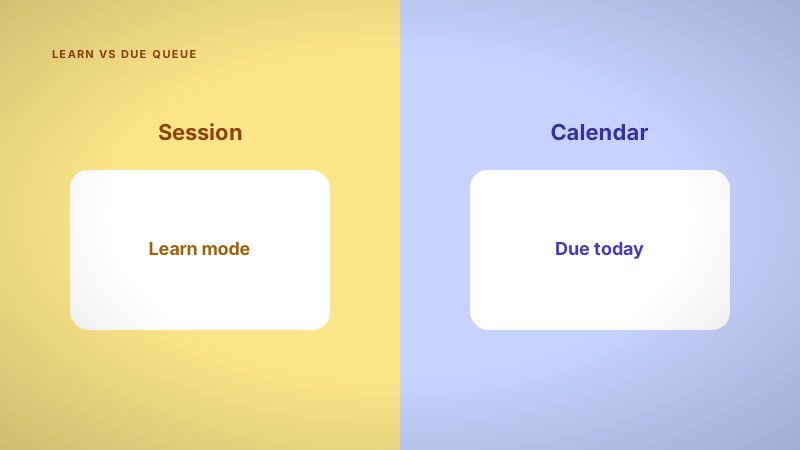
A lot of people, me included for years, think it means you sat down and did flashcards. You open a set, Learn shuffles the hard terms to the front, the bar goes green, you feel done. That's a study session. It's fine for tonight. It is not a schedule.
Spaced repetition is the list that shows up between sittings. You rate a card. The app stores a next date on that card. Tomorrow you get the ones that are due, not the whole set because you remembered to reopen it. Get it right, the gap gets longer. Miss it, it comes back soon. That is the whole feature. Themes and a green bar are not.
The sitting isn't "bad." It's a bad system for a course that still wants week 2 on the midterm. Nothing puts the weak cards in front of you on a Tuesday. You think you're done. The exam doesn't care.
I used Quizlet that way through high school. Someone dropped a set in the group chat, I ran Learn or Match the night before a vocab quiz, Friday was fine, we moved on. First year at UofT, courses stacked. I'd "master" a set, close the laptop, and two weeks later I couldn't write the same definitions. The set was still in my library. I had been grinding. I had not been keeping a schedule.
So the actual Quizlet question: does it keep that due list, or does it only run the sitting?
Free Learn only runs the sitting. It ranks the terms you're likely to miss inside the sitting you already opened. Quizlet Plus adds Memory Score and Scheduled Review, a paid layer across sessions. That layer is real. It is not published FSRS. It was also not the due queue I needed once courses started stacking.
I work on Nebulearn now, so this is a conflict of interest. I also used Quizlet for years, which is why I'm not writing another "Quizlet vs Anki" roundup. Feature-by-feature is Nebulearn vs Quizlet. The rest of this page is the scheduling split: what Learn is actually doing, the scheduler they retired, what Plus adds, and when I still open Quizlet anyway.
That bar is Learn doing the job it was built for. Here is that job.
What Learn is actually doing
Quizlet's own engineering writeups describe Learn as a model that ranks terms in the current session. Previous answers, time since you last saw the term, even which direction you are going (English to Spanish is not the same card as Spanish to English). Lowest predicted chance of getting it right goes first.
That is a smart way to order a worksheet. It is also why the progress bar moves and why missed terms come back before you log off. Useful the night before a quiz.
When you close the session, there is no calendar that says card 14 is due Thursday. Reopen the set next week and you're studying the set again. The app did not spend seven days building a queue. Free Learn is session-scoped ranking. That's the product.
If you've heard Quizlet used to do real spacing, that was not Learn. They shipped a different mode. Then they retired it, which is why the "does Quizlet have spaced repetition" answer keeps changing depending on which year someone last used the app.
They used to ship a real scheduler
Quizlet used to have Long-Term Learning. Classic interval logic: a few new terms a day, stretch the gap when you get one right, reset toward tomorrow when you miss. Same family as SuperMemo and Anki.
Their 2017 post is still up. There is a note at the top: Long-Term Learning is no longer available. They point you at Memory Score and Scheduled Review instead.
They also said why the old scheduler did not fit. In that post they wrote that the majority of users study a set on a single day, and that 95% study a set over four days at most, which was still too few days for a long-term algorithm to matter. So they built Learn for the way people actually opened Quizlet: a deadline this week, not a deck you keep alive until April.
That is a reasonable call if your users are cramming. It is a bad fit for a course that still wants week 2 on the midterm. I needed the long-term product and I was using the cram one.
The replacement they point you at is paid. So if the question is "do they have it now," you have to split free Learn from Plus.
What you actually get on Plus
Quizlet now sells "spaced repetition" on Plus through Memory Score and Scheduled Review. Cross-session. Reminders to come back. If you already live in Quizlet and you'll pay, try that before you migrate. Paid Quizlet has a spacing layer.
It is also not FSRS. They have not published a benchmark or a per-card stability formula you can inspect, and you cannot pick that schedule up and take it somewhere else. Last I checked Plus was about $36/year. Confirm on their upgrade page.
If you need a due list that is the core of the app and still exists when you switch phones, that's Anki or another FSRS app. Free Learn will not do that. Plus is a paid reminder layer on a set library.
Those are three different machines. This is the short version.
| Free Learn | Plus Scheduled Review | Anki / FSRS | |
|---|---|---|---|
| Scope | This session | Cross-session, paid | Cross-session, the product |
| Per-card next date you can see | No | Reminders to review | Yes |
| If you never reopen the set | Nothing happens | Only if you follow their reminders | The queue is waiting |
| Algorithm you can read | Session ranking (their 2017 post) | Proprietary | SM-2 / FSRS (open) |
| I open it for | Tonight's quiz | People who are staying in Quizlet | Material that has to survive the next midterm |
Left column is still useful. I use it. I just stopped asking it to be the right column.
When I still tell people to open Quizlet
I still send people to Quizlet when the job is tonight, not March.
The set already exists and it matches this prof, this year. The quiz is Friday and it is mostly recognition. Match is faster than sitting down to write cards. The group chat already sent a link and you have twenty minutes.
Don't rebuild that workflow in Anki for a one-off vocab quiz. That's how you spend the evening on note types and open the set on your phone at 11pm anyway.
The other case is the stacked course, which is most of my engineering classes, and it is why the high-school habit died.
When I tell people to stop using Learn as the system
The course stacks. Unit 4 assumes you still have unit 2.
The public set is wrong, old, or from a different textbook. You are about to memorize someone else's mistakes at high speed.
You want a daily queue that shrinks, not a folder you have to remember to reopen.
Then the question is which app actually saves hours, not which logo looks like school.
Quizlet is the fastest way to study a set that already exists. A spaced repetition app is a due list that follows you into next month. I still use the first for Friday. I stopped asking Learn to do the second.