Anki vs RemNote: Notes App or Flashcard App
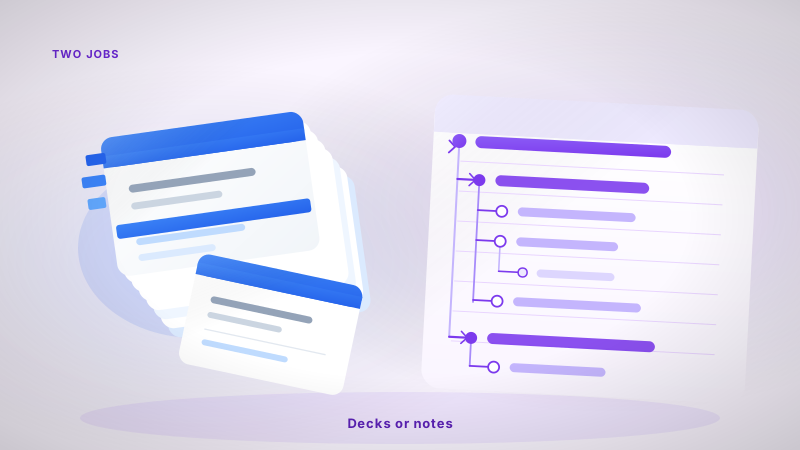
Choosing between Anki and RemNote depends on whether you need a database of flashcards or a network of connected notes.
Hello there! If you are reading this, you are likely trying to decide where to store everything you need to learn. But before we start, a little about me first.
My name is Daniel. I am a third year engineering science student at the University of Toronto, specializing in machine intelligence. I also work on Nebulearn. I built it because I found the gap between reading a PDF and having a functional due queue was too wide in existing tools. I treat that as a conflict of interest, so I will be upfront about where the other apps win.
If you want the short answer: Anki is a dedicated flashcard app for people who already have their material or want to build a massive, long-term deck. RemNote is a note-taking app that happens to have a spaced repetition scheduler built into its bullet points.
The core difference between cards and notes
The main reason people struggle to choose between these two is that they are solving different problems. Anki treats every card as a discrete unit. You create a card, it goes into a deck, and you see it when the algorithm says so. It does not care about the context of the lecture or the chapter once the card is made.
RemNote treats your knowledge as a graph. You write notes in a hierarchical outline, and those notes can be turned into cards instantly using specific symbols. The card lives inside the note. If you change the note, the card changes.
| Feature | Anki | RemNote | Nebulearn |
|---|---|---|---|
| Primary Unit | Flashcard | Note / Document | Question (from PDF/Source) |
| Note-taking | Minimal / Add-ons | Full-featured Outliner | Focused on PDF Extraction |
| Mobile App | Free (Android) / Paid (iOS) | Free / Paid Tiers | Web-first / Mobile Friendly |
| Collaboration | Shared Decks (Public) | Shared Folders / Documents | Shared Group Folders |
| Scheduler | SM-2 or FSRS | Proprietary Spaced Repetition | FSRS Default |
Anki wins if you are using a pre-made deck like AnKing for medical school. RemNote wins if your study process involves "active writing" where you need to see how concept A links to concept B while you type.
When Anki is the right choice
Anki is the gold standard for pure memory. It is a tool for people who want total control over their review schedule. Because it has been around for so long, the ecosystem of add-ons and community decks is unmatched.
I usually tell people to stay with Anki if they are in a field with massive, standardized exams. If you are a med student, the sheer volume of shared decks means you might never have to make a card yourself. You just download the .apkg and start reviewing.
The cost is also a factor. Anki is free on desktop and Android. There is a one-time fee of about $25 for AnkiMobile on iOS, which supports the developer and keeps the synchronization servers running. If you want a tool that will still be exactly the same ten years from now, Anki is the safe bet. You can read more about how it compares to other modern tools in my Nebulearn vs Anki breakdown.
When RemNote wins on linked notes
RemNote is better if your subject is "heavy" rather than just "dense." If you are studying law or philosophy, where the relationship between ideas is as important as the facts themselves, a flat list of cards in Anki will feel limiting.
In RemNote, you can use "backlinking" to see every time a specific concept appears across your entire database. When you turn a bullet point into a flashcard, you are not duplicating information. You are just telling the app to show you that specific line in your queue later.
This solves the problem of "orphaned cards." In Anki, it is easy to forget why a card exists after six months. In RemNote, you just click a button and you are back in the original document where you wrote that note. This context is incredibly valuable for complex subjects.
The third option for PDF-heavy workflows
While Anki is great for decks and RemNote is great for notes, neither is particularly fast when you are staring at a 50-page PDF on a Sunday night.
If your study routine starts with a pile of lecture slides or textbooks, the bottleneck is often the manual labor of copying text and images into cards. This is where I found both apps felt slow during my engineering courses. You end up spending three hours "prepping" and zero hours actually studying.
I work on Nebulearn to solve that specific transition. Instead of building a full note-taking database or managing a complex deck structure, it focuses on getting you from a source document to a functional FSRS due queue as fast as possible.
If you are looking for a study app that saves the most time, you have to look at where your hours are actually going. If they are going into formatting, you might be using the wrong tool.
Which one should you pick?
Your choice should depend on where you currently keep your information.
Choose Anki if you want the most powerful scheduler, if you use a pre-made deck, or if you are on a budget and use Android. It is a "forever" tool that is hard to learn but impossible to beat for raw durability.
Choose RemNote if you find that you learn best by writing outlines and you want your flashcards to live inside those outlines.
If the hours are going into copying a PDF into cards, that is the gap I built the upload flow for. RemNote still wins linked notes. Anki still wins AnKing.