The 'Feynman' Flashcard: Encoding for Deep Understanding
Most people use the Feynman technique on paper. Here is how to break a teaching explanation into a 3-card sequence that actually fits in a due list.
The Feynman Technique is simple: explain a concept like you are teaching it to a five-year-old. If you hit a gap in your logic, go back to the source material and fix it. It is the gold standard for understanding, but it has a major flaw when paired with flashcards.
Most people use Feynman on a whiteboard or a piece of paper, realize they "get it," and then never look at it again. Or worse, they take that massive, paragraph-long explanation and paste it onto the back of a single flashcard.
When that card comes up three weeks later, you won't want to recite a 200-word monologue. You will just press "Good" because you recognize the text, even if you can no longer reconstruct the logic. To make the Feynman Technique work with spaced repetition, you have to break the "teaching moment" into a specific sequence of atomic cards.
A little about me: my name is Daniel. I'm a third-year engineering science student at UofT. I work on Nebulearn, which is my conflict of interest for this post. I spend most of my week trying to turn complex machine intelligence concepts into cards that don't make me want to quit during my morning review.
Why the 'Explain like I'm 5' prompt fails in SRS
The "Explain like I'm 5" (ELI5) prompt is a great way to start, but it is a terrible way to test.
If your flashcard says "Explain backpropagation like I'm 5," the mental load is too high for a quick review session. Spaced repetition works best when cards are atomic. If you're new to the concept, check out our guide on what is spaced repetition to see why session-based learning usually fails. If a card takes two minutes to answer, you will eventually start skipping your queue.
The goal isn't to put the explanation on the card. The goal is to use the Feynman process to find the logic chain, then turn each link of that chain into its own card. You are using the technique to "encode" the information before you ever hit the "Create" button. This solves the problem of why you can't remember what you read by ensuring you aren't just memorizing strings of words.
The 3-card sequence for conceptual logic
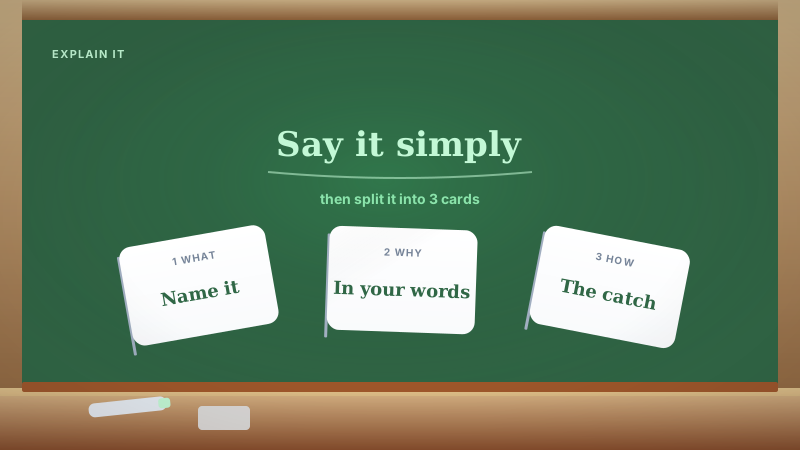
Instead of one giant "Feynman card," I use a three-step sequence. This keeps the cards fast while forcing you to maintain the deep understanding you gained during the initial study session.
| Card Type | Goal | Example Question |
|---|---|---|
| The 'What' Card | Define the core component. | "In the Feynman analogy for electricity, what does the 'water pressure' represent?" |
| The 'Why' Card | Connect the component to the result. | "Why does increasing 'pressure' (Voltage) increase the flow if the pipe size (Resistance) stays the same?" |
| The 'Mechanism' Card | Identify the breaking point or constraint. | "What happens to the 'flow' if the pipe is completely blocked, and why?" |
By splitting the concept this way, you are following the atomic encoding flashcard rule. Each card tests one specific pivot in your explanation. If you miss the "Why" card, you know exactly which part of the Feynman explanation you actually forgot.
Breaking logic chains into atomic cards
To actually build this sequence from your notes, you need a trigger for where one card ends and the next begins. When you are sitting with your notebook and your "five-year-old" explanation, look for the word "because."
Every time you use "because" in your explanation, that is a flashcard. For example, if I am studying the concept of "Opportunity Cost," my Feynman explanation might be: "You can't have the cake and the toy because you only have five dollars."
That sentence generates two cards:
- The Constraint: "In the cake/toy analogy, what is the limiting factor? (The $5 budget)."
- The Result: "If you buy the toy, why is the cake the 'opportunity cost'? (Because the budget is exhausted and the cake is the next best alternative)."
This is much more effective than a card that just says "Define Opportunity Cost." You are testing the mechanics of the concept, not the dictionary definition.
When to use Anki vs. specialized tools
If you are a power user who has a 10-year-old deck, stay in Anki. You can use "Cloze Deletion" to hide different parts of your logic chain within a single paragraph. It is the most robust way to keep everything in one place, and AnkiMobile is a one-time ~$25 fee that is worth it for the long-term stability.
I work on Nebulearn because I found the process of manually typing out these 3-card sequences to be the biggest bottleneck in my study routine. When you are staring at a 40-slide PDF on a Tuesday night, you don't always have the energy to play "Logic Chain Architect."
In Nebulearn, the editor is built to handle these multi-step sequences. You can upload the PDF, run the Feynman prompt to find the gaps, and then immediately split those gaps into atomic cards. It uses FSRS by default, which is the same modern scheduling algorithm that Anki users often have to manually configure.
The 'Why' card vs. the 'What' card
The biggest mistake I see is people making 100 "What" cards and zero "Why" cards.
A "What" card is "What is the mitochondria?" (The powerhouse of the cell). A "Why" card is "Why does the cell need a powerhouse to function?" If you only have the "What" card, you have a trivia deck. If you have the "Why" card, you have an education.
When you finish a Feynman explanation, count your cards. If you don't have at least one "Why" card for every two "What" cards, you haven't actually used the technique. You’ve just made a fancy list of definitions.
Spaced repetition is for maintenance. Use the Feynman Technique to build the engine, then use atomic cards to keep it running. If you try to put the whole engine on one card, you'll never get out of the driveway.