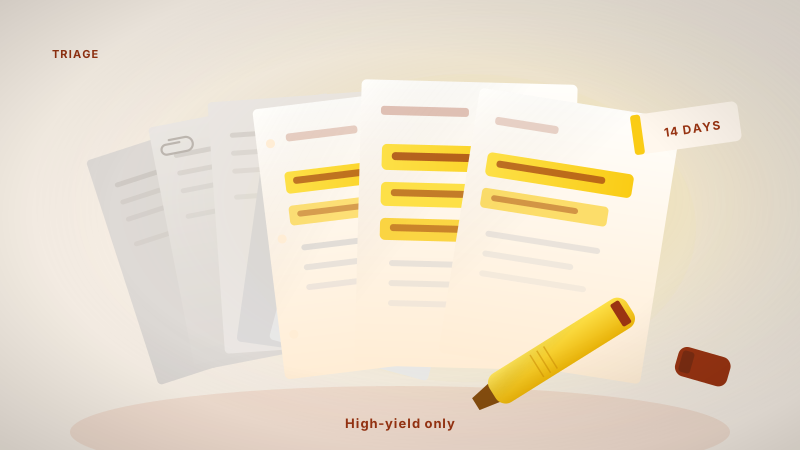
How to study for finals in 2 weeks (without the 12-hour days)
A triage guide for engineering-level finals. How to pick what to study, what to skip, and how to pass when you are behind on your lecture slides.
If you are reading this two weeks before your first exam, you are likely looking at a pile of PDFs and lecture slides you never fully processed. The instinct is to pull 12-hour shifts at the library, drink too much coffee, and try to brute-force the entire syllabus.
A little about me before we start. My name is Daniel. I am a third year engineering science student at the University of Toronto, specializing in machine intelligence. I have been in the position where I have 14 days to cover five courses that each feel like a full-time job.
I also work on Nebulearn. I built it because I realized that the hardest part of studying for finals is not the review itself, but the time it takes to turn raw notes into something you can actually test yourself on. That is a conflict of interest, so I will be clear: if you already have a perfect set of Anki cards, stop reading and go do your reviews. This guide is for everyone else who is currently staring at a blank screen and a looming deadline.
Why 12-hour days usually fail
The problem with the marathon study session is the "forgetting curve." If you read ten chapters of a textbook on Monday, you might feel like you know it by Monday night. By Thursday, without active recall, you have lost about 70 percent of that information.
When you try to pass finals in a short window, you cannot afford to relearn the same chapter three times. You need to move information from "just read it" to "can recall it" as fast as possible. This requires a 14-day countdown that prioritizes triage over completion. You are not trying to learn everything anymore; you are trying to learn the high-yield material that actually shows up on the exam.
The 14-day triage schedule
Triage studying means treating your syllabus like an emergency room. You ignore the minor scratches (low-yield details) to save the patients that are actually dying (the core concepts that carry 80 percent of the marks).
| Phase | Days | Focus | Method |
|---|---|---|---|
| Phase 1 | 1 to 3 | Material Triage | Convert slides to cards; identify "must-know" vs "nice-to-know." |
| Phase 2 | 4 to 10 | High-Intensity Spaced Repetition | Hit your daily due queue. Don't skip days. |
| Phase 3 | 11 to 14 | Practice Exams | Move from cards to full problem sets. |
The mistake most people make is staying in Phase 1 for ten days. They spend all their time making beautiful notes and only start testing themselves 48 hours before the exam. That is cramming vs spaced repetition, and it is the reason people fail despite "studying" all day. The table shows that the majority of your time must be spent in the 'due queue' rather than the 'creation' phase if you want the information to stick.
How to identify high-yield material
You do not have time to read every page of the textbook. In engineering courses, high-yield material usually falls into three buckets: definitions that appear in bold, formulas used in more than two example problems, and "edge cases" the professor mentioned more than once.
If you are using Anki or Nebulearn, your goal is to get these into a card format immediately. If a slide has a list of five properties of a material, that is a card. If a slide has a historical anecdote about the person who discovered the property, skip it.
Automating card creation to save time
The bottleneck in the two-week window is the "card tax." This is the time you spend typing out questions instead of answering them. If you have 400 slides to cover, and it takes you three minutes to manually create a good card for each one, you have already spent 20 hours just on data entry.
This is where I suggest using tools to skip the manual labor. You can use the fastest way to create flashcards which involves taking your lecture PDFs and letting an AI extract the questions for you.
I work on Nebulearn to solve this exact problem. On our free tier, you get 40 weekly AI credits and can save up to 1000 questions. You can upload a PDF of your lecture slides, and it will generate the cards for you. This allows you to finish Phase 1 of the triage in hours instead of days. Once the cards are created, the challenge shifts from data entry to managing your cognitive load over the remaining two weeks.
Why the schedule matters more than the hours
Once you have your cards, the "12-hour day" becomes unnecessary. Spaced repetition works by showing you cards right before you are about to forget them.
If you use a tool with a modern scheduler like FSRS (which is the default on Nebulearn and available as a toggle in Anki), the app calculates exactly when you need to see a card again. This means you might only need to study for three or four hours a day to maintain perfect recall of the material you have already covered.
The "extra" hours in your day should be spent on Phase 3: practice exams. Flashcards handle the facts and definitions, but practice exams handle the application. You cannot replace one with the other.
Passing when you are truly last minute
Sometimes the 14-day window is already gone, and you are forced to prioritize survival over mastery. If you have less than 7 days, the triage becomes even more brutal. You should skip the textbook entirely. Go straight to the past three years of exams, see what topics appear every single year, and only make cards for those topics.
In this scenario, Quizlet can be tempting because you can find decks other students have already made. However, keep in mind that Quizlet's free "Learn" mode is session-scoped. It helps you learn the cards in one sitting, but it doesn't give you a per-card due calendar for the rest of the week. If you need to remember the material for more than 24 hours, you need a real spaced repetition scheduler.
Anki is a great free option here if you are on desktop or Android. If you are on an iPhone, AnkiMobile is about $25 one-time, which is a fair price for the most powerful tool in the space. If you are starting from scratch with a pile of PDFs and need a faster workflow, that is when you should look at Nebulearn. This is especially true if you are trying to figure out what is spaced repetition while simultaneously trying to pass a midterm.