Cramming vs Spaced Repetition: Which Actually Works?
Cramming vs spaced repetition for students: retention data, when cramming is fine, when it fails, and why FSRS beats both-nighters.
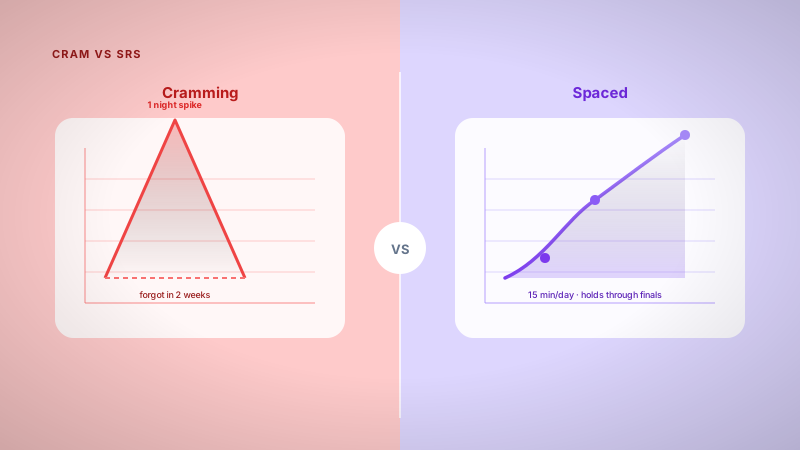
Cramming works for about 72 hours. That's not an insult. It's the actual retention curve.
I used Quizlet cram mode in high school and it was fine. First year at UofT broke that habit when courses started stacking faster than I could relearn old units from scratch.
If your only goal is Friday's quiz and you will never need the material again, cramming is still a rational strategy. Most college classes are not that class. Organic II assumes you remember organic I. Pathophys assumes anatomy. The final is cumulative.
That's where cramming fell apart for me and spaced repetition started making sense.
How to do SRS right: Study routine · Use flashcards effectively · Algorithm pick
What cramming actually does
Cramming floods your short-term memory. You recognize material on the page. Recognition feels like knowing. The exam asks you to produce answers under pressure — and half the stack evaporates.
| Cramming | Spaced repetition | |
|---|---|---|
| Effort before exam | Intense, one or two nights | Steady, 15 min/day for weeks |
| Exam performance | Often good | Often good |
| Retention 2 weeks later | Poor | Strong |
| Cumulative finals | Painful re-learning | Material still there |
| Burnout risk | High | Lower if you cap daily load |
When cramming is fine
- Low-stakes quiz tomorrow on material you won't reuse
- Vocab dump for a language class where you just need passing recognition this week
- One-off certification where the test is the finish line
Gen-ed art history quiz with zero follow-up? I still crammed for one of those. Zero regrets. No need for 200 SRS cards.
When cramming will wreck you
- STEM sequences where every unit builds on the last
- Nursing, pre-med, law — licensing and boards assume long retention
- Finals that cover 14 weeks of material
- Anything you need for a job after graduation (clinical skills, coding patterns, legal rules)
If you crammed orgo I and walked into orgo II three months later, you already know how this story ends.
Fast-paced university programs make this worse. See the calc pacing example in how to use flashcards effectively: when a year of high school content lands in three months, you can't relearn October from scratch in November.
What spaced repetition does differently
Spaced repetition schedules reviews right before you forget. Hard cards tomorrow. Easy cards in two weeks. You spend time where it matters instead of re-reading what you already know.
FSRS is the modern version — fewer reviews for the same retention target compared to older algorithms like SM-2. Nebulearn ships all three if you want to experiment.
"But I don't have time to review every day"
You don't have time not to.
Fifteen minutes daily across four weeks is roughly 7 hours total. One cram session before a cumulative final can easily hit 12–16 hours — and you still re-learn half of it.
Daily small sessions win on total time for any class that lasts more than one exam cycle.
The hybrid approach that worked for me
Pure ideology is dumb. Here's what works:
| Timeline | Strategy |
|---|---|
| Weeks 1–10 | SRS daily on that week's lecture cards |
| 3 days before exam | Extra pass on tagged exam folder |
| Night before | Sleep. Light review of "again" cards only. |
| Exam morning | 10-minute skim of weak tags. Not a full deck. |
The night-before cram is a supplement, not the strategy. Students who only cram skip the first row and wonder why unit 4 feels impossible.
Cramming with flashcards vs cramming with notes
Flipping 400 flashcards at 1am without recall discipline is the same as re-reading notes with extra steps. See flashcard mistakes.
If you're going to cram, at least test yourself — practice problems for STEM, closed-book recall for facts. Passive flipping is theater.
Quizlet and other game-style review
Quizlet's Learn mode, Match, Gravity. All fine for cramming before a low-stakes quiz. I used them in high school for exactly this. Not the same as FSRS scheduling over a whole semester.
University courses that stack week on week need something that schedules recall, not just recognition. Nebulearn vs Quizlet · Quizlet alternatives
My actual semester split
- SRS classes (3–4): Anything cumulative — bio, chem, pharm, law, languages you care about
- Cram classes (1–2): Gen eds, one-and-done topics, low-stakes quizzes
You don't need moral purity. Match the tool to how long the material has to live in your head.
Cramming optimizes for tomorrow. Spaced repetition optimizes for next month.
If your major stacks courses, start with one SRS class — 15 minutes a day on real lecture material.