Language Learning: Memorizing Gender and Articles without the grind
How to use color-coding and visual mnemonics to stop forgetting noun genders in German, French, and Spanish.
Hello there! If you are learning a European language, you have probably hit the "gender wall." You know that the word for table is mesa or Tisch, but you can never quite remember if it is la or el, der or die.
Before we get into the mechanics of fixing this, a little about me. My name is Daniel. I am a third year engineering science student at the University of Toronto, specializing in machine intelligence. I work on Nebulearn, which is a flashcard app built around saving time. I spend a lot of my week thinking about how to get information into a long term queue without it feeling like a second job.
The mistake most people make is treating the noun and the gender as two separate facts. They learn the word first, then try to "attach" the article later. This is why you end up with a high vocabulary score but broken grammar.
To memorize noun gender effectively, you need to bake the gender into the visual identity of the word itself.
Why the article-noun pairing fails in your head
The reason you forget whether a noun is masculine or feminine is that articles like le, la, der, or die are abstract. They do not have a "shape" or a "feeling" in your mind. When you see the word apple, you think of a red fruit. You do not naturally think of the feminine gender.
When you study a flashcard that says "Apple (fem) -> la pomme," your brain prioritizes the "apple" part because it is concrete. The "(fem)" part is just a tiny piece of text that gets ignored during the rush of a study session. To fix this, we have to make the gender impossible to ignore.
This is where visual mnemonics and color-coding come in. Instead of reading that a word is feminine, you should see it.
The color-coding method for flashcards
Color-coding is the fastest way to add a "gender layer" to your memory. If you use the same colors consistently, your brain starts to associate the color with the word before you even read the article.
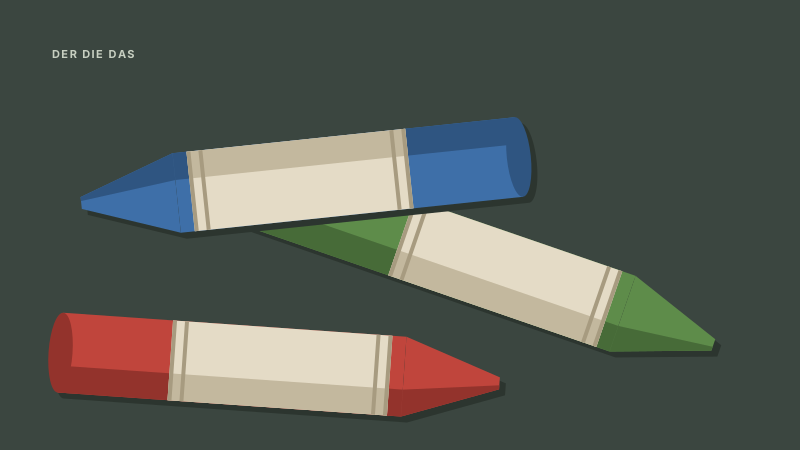
I usually recommend a simple three-color system:
- Blue for masculine nouns.
- Red for feminine nouns.
- Green for neuter nouns (if you are learning German).
When you create your flashcards, do not just type the word in black text. Change the text color of the answer. If you are learning Spanish and you see "Table," the back of the card should show la mesa in bright red.
Over time, you will stop trying to "remember" the rule. You will simply remember the word mesa as a red object in your mind. I work on Nebulearn, and I built the rich text editor specifically so you can color-code your answers without fighting the UI. It allows you to bake these visual cues directly into your SRS queue.
Using visual mnemonics to create "gendered" scenes
If color-coding is the foundation, visual mnemonics are the heavy lifting. This involves associating every masculine noun with one specific "masculine" image and every feminine noun with a "feminine" one.
For example, in German, you might decide that all masculine nouns are "frozen in ice" and all feminine nouns are "on fire."
When you learn the word der Löffel (the spoon), you do not just visualize a spoon. You visualize a spoon stuck inside a giant block of ice. When you learn die Gabel (the fork), you visualize a fork melting in a campfire.
This works because human memory is much better at remembering weird, vivid scenes than it is at remembering grammatical categories. If you can recall the ice, you know the gender is masculine. This is significantly more reliable than trying to remember if there was a tiny "m" written in the corner of your card.
Phonetic endings are the backup plan
While mnemonics are great for irregular words, many languages have "cheat codes" built into the spelling. These are phonetic endings that almost always indicate a specific gender.
In Spanish, words ending in -ción are almost always feminine (la canción, la estación). In German, words ending in -ung are feminine (die Zeitung), while words ending in -ismus are masculine (der Optimismus).
You should not make flashcards just for the rules themselves. Instead, group your cards. If you are adding five new nouns that end in -ung, tag them or put them in the same session. Seeing the pattern repeat five times in a row helps your brain internalize the "sound" of a feminine word.
| Language | Masculine Endings | Feminine Endings |
|---|---|---|
| Spanish | -o, -ma, -or | -a, -ción, -dad |
| French | -age, -ment, -eau | -tion, -té, -ette |
| German | -ant, -ent, -ismus | -ung, -heit, -keit |
After you see enough examples, you will start to develop an "ear" for the gender. You won't need to think about the rule because the "wrong" article will start to sound physically uncomfortable.
Comparison: Where to build your language deck
If you are just starting, you have a few choices for where to put these cards.
Anki is the industry standard for language learning, especially because of the AnKing decks and the massive community shared sets. If you want to download a 5,000-word deck that someone else made and you don't mind the steep learning curve, use Anki. AnkiMobile is about $25 one-time on iOS, but the desktop and Android versions are free. It is the best choice if you want maximum customization and don't mind spending a few hours watching tutorials on how to set up your card templates.
Quizlet is great for a Friday afternoon cram session. If you have a vocab test tomorrow and you just need to see the words 50 times, Quizlet wins. However, their free "Learn" mode is session-scoped. It helps you master a list in one sitting, but it doesn't have a real per-card due calendar for long-term retention. They retired their Long-Term Learning feature a while ago. Their "Plus" tier has a Memory Score, but it is not the same as a true FSRS scheduler.
Nebulearn is where I spend my time. It is built for the student who is currently in a class or a fast-paced program. If your bottleneck is getting words from a PDF or a browser tab into a real spaced repetition queue without the manual data entry, that is what we do.
We use FSRS by default, so your review intervals are mathematically optimized for your memory. Our free tier includes 1,000 saved questions and 40 weekly AI credits, which is plenty for a serious language learner to build a massive vocabulary.
How to structure your study sessions
The biggest mistake is studying too many new words at once. If you add 50 nouns in one day, your mnemonics will start to bleed into each other. You will forget if the spoon was on fire or if the fork was in the ice.
I recommend a 10:1 ratio. For every 10 minutes you spend adding new cards with vivid imagery and color-coding, spend at least 1 minute just "mining" sentences. This prevents the "flashcard-only" trap where you can recognize a word in your app but not in a book. I talk more about this in my breakdown of study apps that save the most time.
Sentence mining is the process of seeing your nouns in the wild. Instead of just "the apple," try to find a sentence like "The red apple falls from the tree." This gives the noun context. If you want to learn more about this, check out our guide on sentence mining vs vocabulary lists. It is often the difference between knowing a word and being able to use it. If you are curious about how the math behind these reviews works, I wrote about how FSRS optimizes your schedule.
If you are already using a different app and want to switch, you can often move your data. We have a guide on how to import Anki decks if you want to bring your current progress over to Nebulearn.
Putting it all together
Memorizing gender does not have to be a grind if you stop treating it like a text-based fact. By using color-coding, you engage your visual memory. By using imagery mnemonics, you engage your spatial memory. By grouping phonetic endings, you engage your auditory memory.
When you use all three, the gender becomes a part of the word's identity. You aren't "remembering" that la mesa is feminine; you are simply seeing a red table in your mind.
If you are tired of the "I know the word but not the article" trap, try building your next deck with these visual cues. It takes an extra five seconds per card to set the color and the image, but it saves you hours of frustrated reviews later when you realize you actually know the grammar.