Why Quizlet 'Learn' feels like it's working (but isn't)
Quizlet Learn mode is great for cramming, but it isn't true spaced repetition. Here is the difference between session-based mastery and a real schedule.
Hello there! If you are hitting the "Learn" button on Quizlet today, you are probably trying to lock in a few dozen terms for a test. It feels productive because the app keeps showing you the same five cards until you stop getting them wrong.
But there is a specific reason why you can "master" a set on a Tuesday and forget half of it by Thursday.
The short answer is that Quizlet Learn is not a spaced repetition system (SRS). It is a session-based trainer. It cares about whether you know the card right now, not whether you will know it in three weeks.
I work on Nebulearn, so I have a clear conflict of interest here. I spent a lot of time looking at how these algorithms differ because I wanted something that combined the speed of a web app with the actual math of a long term scheduler.
What is spaced repetition anyway
Before looking at the buttons in the UI, we have to define what we are actually measuring.
Spaced repetition is a method where the interval between reviews increases every time you get a card right. If you see a card today and get it right, you might see it again in 4 days. If you get it right then, you see it in 10 days, then 25 days, and so on.
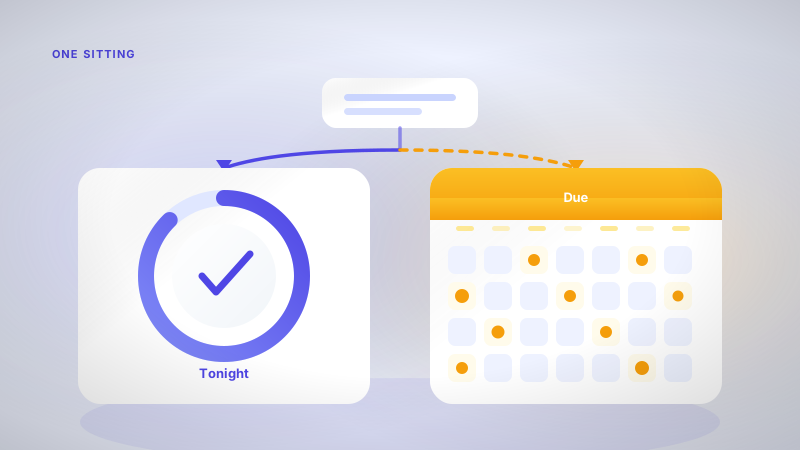
The goal is to show you the card at the exact moment you are about to forget it. This is the most efficient way to move information into your long term memory. To do this, an app needs a "due queue" , a calendar that tracks every single card individually.
Quizlet Learn does something different. It uses a session-based approach.
The session vs the schedule
When you open Learn mode, the app treats your study time as a single "sitting." It wants to get you from 0% to 100% mastery within that specific window.
If you miss a card, the app will show it to you again two or three times in the next ten minutes. This feels great because you are correcting your mistakes immediately. You are building "fluency," which is the ability to recognize something you just saw.
However, seeing the same card three times in ten minutes is not spaced repetition. It is closer to "massed practice" or cramming. Because the intervals are so short, your brain doesn't have to work hard to retrieve the memory. It is still sitting in your short term storage.
A real SRS like Anki or Nebulearn doesn't care about your "mastery" during a single session. It cares about the gap between sessions.
| Feature | Quizlet Learn (Free) | True Spaced Repetition (SRS) |
|---|---|---|
| Primary Unit | The Session | The Individual Card |
| Goal | Finish the set today | Maintain a 90% retention rate |
| Logic | Repeat until correct | Increase interval on success |
| Due Date | None (reset manually) | Calculated per card |
The moment you close the Quizlet tab, the "spacing" logic mostly stops. The app isn't calculating that your "Mitochondria" card is due at 4:00 PM next Tuesday. It just waits for you to start a new session.
Why the Long-Term Learning feature disappeared
It wasn't always this way. Quizlet used to have a specific feature called "Long-Term Learning." It was a separate mode that actually scheduled cards over days and weeks.
Quizlet retired that feature years ago. They moved toward a model focused on "mastery" within the Learn and Test modes. While they introduced a "Memory Score" for Plus subscribers, it still functions differently than a standard SRS. It is a proprietary "spacing" indicator, but it doesn't use open standards like FSRS (Free Spaced Repetition Scheduler).
This change happened because most people use Quizlet to cram for a test on Friday. If you are only studying for one week, a complex long term scheduler is actually annoying. You just want to see the cards you got wrong until you know them.
But if you are in a degree where the material stacks , like medicine, law, or engineering , that "session-only" logic starts to fail you.
Where Anki wins the long game
If you want a true schedule, Anki is the gold standard. It is built entirely around the idea of a due queue.
Anki is free on desktop and Android. If you are on an iPhone, AnkiMobile is about $25 as a one-time purchase. This price helps support the entire ecosystem.
The downside of Anki is the setup time. You have to learn how to manage decks, sync servers, and configure the scheduler. For a lot of students, the "friction" of using Anki is high enough that they stop doing their cards entirely. If you aren't going to stick with the schedule, the algorithm doesn't matter.
This is why many people stay on Quizlet even though Quizlet is not spaced repetition. The UI is just easier to use when you are tired after a lecture.
Finding a middle ground
I built Nebulearn because I was tired of choosing between a "fast" app that didn't have a schedule and a "smart" app that felt like using software from 2005.
I wanted the Quizlet experience , upload a PDF, get cards, start studying , but with a real FSRS scheduler running in the background. In my app, every card has a specific due date. If you get a card right, you won't see it again for days, no matter how many times you hit "Study."
This prevents the "session" trap where you keep reviewing the same easy cards over and over.
If you are already using Anki and it is working for you, keep using it. The time you spend migrating your review history is usually not worth it. But if you are currently using Quizlet Learn and realizing you forget everything the week after the test, it might be time to look at a tool that actually understands the forgetting curve.