The Forgetting Curve Explained: What Ebbinghaus Found and What It Means for You
You forget most of what you learn within days, fast at first and then slower. What the forgetting curve really shows, what it does not, and how to flatten it.
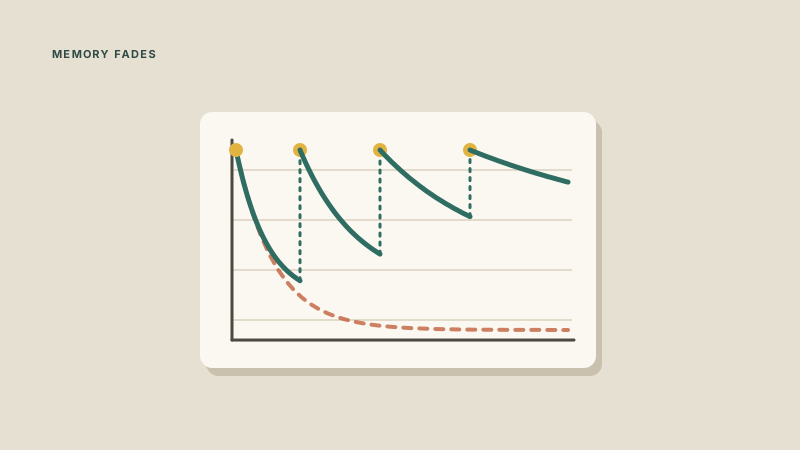
The forgetting curve is the shape your memory of something takes after you learn it: a steep drop in the first hours and days, then a slower and slower decline. It was first measured in the 1880s by Hermann Ebbinghaus, who memorized lists of nonsense syllables and tested himself at different delays. The important part is not the exact numbers, which depend heavily on what you learn and how. The important part is that every time you successfully recall something, the curve that follows is flatter. That one fact is the whole idea behind spaced repetition.
(This explainer is from the Nebulearn blog. Nebulearn makes a flashcard app built around this idea, but the curve applies to any way you study.)
What Ebbinghaus actually did
Hermann Ebbinghaus was a German psychologist, and in 1885 he published a book called Memory: A Contribution to Experimental Psychology. At the time, most people thought memory was too personal and messy to measure. He decided to try anyway, using himself as the only subject.
He wanted to measure memory without the effect of meaning, so he invented around two thousand nonsense syllables, short combinations like "WID" or "ZOF" that do not mean anything. He would learn a list of them until he could recite it perfectly. Then he waited a set amount of time, twenty minutes, an hour, a day, a month, and relearned the same list.
His clever measurement was what he called savings. Instead of only asking "how much do I remember?", he measured how much less time it took to relearn the list the second time. If the first learning took ten minutes and relearning took four, he had saved sixty percent. Even when he could not recall a single syllable, relearning was often faster, which showed that something was still stored.
When he plotted savings against time, he got the curve. A big drop in the first hour or so, a large part gone within a day, and then a long, slow tail. In 2015, Jaap Murre and Joeri Dros repeated the experiment carefully, with one person learning nonsense syllables the way Ebbinghaus did, and got a very similar curve.
What the curve looks like in real life
Here is a version of it you have probably lived. On Monday you sit through a lecture on cell signalling. When it ends, you could explain most of it. On Tuesday evening you open your notes and think, "okay, there was something about receptors... and a cascade... and a second messenger?" By Friday you remember that there was a lecture and that it was about cells. By the exam three weeks later, you look at your notes and it feels almost like new material.
That is the curve. You did not do anything wrong. That is just what memory does with something you learned once and never pulled out again.
| Time since learning | What it tends to feel like |
|---|---|
| Right after | You can explain it, mostly in your own words |
| The next day | The outline is there, the details are fuzzy |
| A few days | You remember the topic, not much of the content |
| A few weeks | Familiar when you see it, but hard to produce from nothing |
| Months | You remember that you once knew it |
The exact percentages you will see quoted online ("you forget 70 percent in 24 hours") come from Ebbinghaus's nonsense syllables, which are about the hardest thing there is to remember. Meaningful material that connects to things you already know is forgotten more slowly. So do not take the numbers literally. Take the shape seriously.
What makes the curve flatter
The curve is not fixed. Several things change how steep it is, and some of them are under your control.
| Factor | Effect on forgetting |
|---|---|
| Meaning | Material that makes sense and connects to what you know fades more slowly than isolated facts |
| How well you learned it the first time | A thing you understood fades more slowly than a thing you only read |
| Retrieval | Each successful recall makes the next curve flatter |
| Spacing | Recalls spread over time flatten the curve more than recalls crammed together |
| Sleep | Sleep after learning helps stabilize memories |
| Interference | Similar material learned around the same time can blur together and speed forgetting |
The retrieval and spacing rows are the big ones. When you pull something out of memory, especially when it takes a bit of effort, the memory becomes more durable. Then it takes longer to fade the next time. That is why the curve after your second review is flatter than after the first, and the one after your third is flatter still. Retrieval strength vs storage strength explains why the effortful recalls matter most.
How spaced repetition uses the curve
If you put the curves after each review side by side, you get a picture that explains spaced repetition in one glance. After the first study session, the curve drops fast, so you need to review soon, maybe the next day. After that review, the curve is flatter, so the next review can wait a few days. Then a week. Then a few weeks. Each review buys you a longer gap.
That is the whole schedule: review each thing right around when you would otherwise start to forget it, and let the gaps grow. Reviewing too early is wasted effort, because the memory is still strong. Reviewing too late means you have to relearn it. What is spaced repetition covers the method from the beginning.
Modern scheduling algorithms try to do this for each card separately. FSRS, which is the default in Nebulearn and available in Anki, models how likely you are to remember each card at any moment, based on your own review history, and schedules the review for when that probability drops to a target, often around 90 percent. In other words, it is trying to estimate your personal forgetting curve for each card. What is FSRS goes into how it works.
What the curve does not tell you
The forgetting curve is one of the most famous ideas in psychology, which means it is also one of the most stretched. A few things to be careful about:
It is not a universal law with fixed numbers. Different material, different people, and different ways of learning give different curves. Ebbinghaus studied one person and meaningless syllables.
Forgotten does not mean gone. Ebbinghaus's savings measure showed that even things you cannot recall can be relearned faster. That is good news. A subject you studied last year and "forgot" will come back much faster than learning it from scratch, as restarting after a long break describes.
Recognizing is not remembering. You can recognize material long after you can no longer produce it. That is why rereading old notes feels reassuring. The curve for recall is steeper than the curve for recognition, and exams usually test recall. More on that in why you can't remember what you read.
It does not mean you should review everything constantly. Reviewing something that is still fresh does little. The value comes from reviewing at the right time, which is usually later than feels comfortable.
Using it without an app
You do not need software to use the forgetting curve. A simple version that works for lecture material:
- Same day or next day: close your notes and write down what you remember from the lecture. Check, fill in the gaps.
- About three days later: test yourself again on the main points, with flashcards or a blank page.
- About a week later: again, faster this time.
- About two to three weeks later: once more, and now it should mostly hold.
That is four short sessions spread over a month, and for most material it will leave you remembering far more at exam time than one long rereading session the week before. The blank sheet method is a good way to do each one.
Where to read more
If you want the original, Ebbinghaus's book is available free online in English translation, and it is surprisingly readable for something from 1885. The Murre and Dros replication is open access too. For a broader and practical view, the book Make It Stick by Peter Brown, Henry Roediger and Mark McDaniel explains the forgetting curve alongside retrieval practice and spacing, with plenty of examples from real classrooms.
Anki, SuperMemo, Nebulearn and other spaced repetition tools are all, in the end, ways to automate what the curve suggests. SuperMemo's creator, Piotr Wozniak, has written a great deal about the history of these ideas. Any of them will do the scheduling for you. The method is what matters.
Forgetting is the default
The forgetting curve says that memory fades fast at first and then slowly, and that every successful recall makes the next fade slower. That is the reason for reviewing soon after learning, for spacing your reviews further and further apart, and for testing yourself instead of rereading. The exact numbers do not matter much. The shape does, and once you know it, you can plan around it.