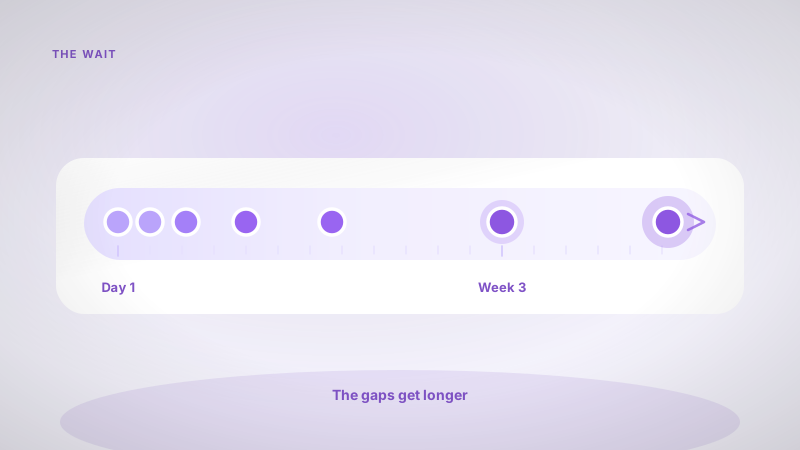
How long until spaced repetition actually works
Spaced repetition is not a magic bullet for tomorrow's exam. Learn the timeline for when the method starts saving you time and how to recognize the shift.
Hello there! If you are looking for a way to pass an exam that starts in six hours, I have bad news. Spaced repetition will not work for you tonight.
My name is Daniel. I am a third year engineering science student at the University of Toronto, specializing in machine intelligence. I also work on Nebulearn, so I have a clear conflict of interest here. I spend a lot of time thinking about how flashcards work, but I still tell people to close their flashcard apps if the final is tomorrow morning.
Spaced repetition takes about two to three weeks of consistent use before you feel the "click." It is a compound interest game. If you try to use it for a single night, you are just doing expensive cramming.
The difference between a session and a schedule
To understand why it takes weeks to work, we have to define what "working" actually means in this context. Most people are used to the Quizlet style of a study session. You open a deck, you go through it until you get 100% correct, and you feel like you know the material.
That is not spaced repetition. That is just successful short term recall.
Spaced repetition is about the due date of a specific card. It does not care if you got the card right three times in a row ten minutes ago. It cares if you can still get it right four days from now. Until those intervals start stretching out, you are just looking at the same information over and over again.
| Phase | Duration | What is happening |
|---|---|---|
| Learning | Days 1–3 | High friction. You are seeing cards daily because they are new. |
| Stability | Days 4–14 | The "due queue" forms. You start seeing cards every 3–5 days. |
| Mastery | Day 21+ | Cards push out to weeks or months. You spend less time per card. |
The system starts working when you stop seeing every card every day. If you have a hundred cards and you are still reviewing all hundred every morning after a week, the algorithm has not had enough data to trust your memory yet.
Why two weeks is the magic number
The first week of any new deck is always the hardest. You are front-loading the effort. You have to see the new cards frequently because the "forgetting curve" is steepest right after you learn something.
By the second or third week, something changes in your daily routine. You open your app and instead of 100 cards, you see 15. Those 15 cards are the only ones the algorithm thinks you are about to forget. This is the moment where the time savings actually kick in.
If you are studying with spaced repetition for a midterm that is three weeks away, you will hit this sweet spot right as the exam arrives. You will spend five minutes a day maintaining your knowledge while everyone else is starting their first eight-hour cram session.
Recognizing the shift in your brain
You will know the method is working when you stop "translating" the answer.
In the first few days, you usually have to think. You see a term, you remember the slide it was on, you remember the professor's voice, and then you find the answer. By week three, the connection is direct. You see the prompt and the answer is just there.
This is the difference between cramming vs spaced repetition. Cramming builds a shaky tower of associations that falls apart the moment the exam ends. Spaced repetition builds a permanent path.
If you use Anki, you might see this reflected in your "Ease" factor or your FSRS weights. If you use a simpler tool like Quizlet, you might not see the data at all because their free tier uses session-scoped mastery rather than a long-term scheduler.
When the method fails to deliver
If you have been doing your cards for a month and it still feels like a massive chore every morning, something is wrong with your cards, not the timeline.
Usually, this happens because the cards are too big. If one flashcard contains a whole paragraph from a textbook, you will never get it "right" consistently enough for the algorithm to push it into the future. You will get stuck in a loop of seeing the same difficult card every day. This is called "ease hell" in the Anki community.
To make the method work faster, you have to make the cards smaller. One idea per card. If a card takes more than five seconds to answer, it is a bad card. Break it into three smaller ones.
I built Nebulearn to help with this specific bottleneck. When you upload a PDF, the AI tries to find those atomic facts so you don't end up with those giant, unmanageable cards that ruin your schedule.