Korean Hangul Flashcards: Learn to Read Korean in About a Week
Hangul has 24 basic letters built on a logical system, so it can be learned in days. How to card the consonants by mouth shape, handle syllable blocks and final consonants, and get to reading speed.
Hangul, the Korean alphabet, is one of the easiest writing systems to learn. It has 14 basic consonants and 10 basic vowels, plus 5 doubled consonants and 11 combined vowels built from the basic ones, for 40 symbols in total. It was designed in the 15th century to be learned quickly, and the consonant shapes even reflect the position of the mouth when you say them. Most learners can read Hangul slowly within a few days and fluently within a few weeks. Flashcards speed this up if you card letters by their logic, then move quickly to whole syllable blocks and real words.
(This guide is from the Nebulearn blog, and Nebulearn makes a flashcard app with text to speech, which helps with sounds.)
Why Hangul is easy
King Sejong and his scholars created Hangul in 1443, and it was proclaimed in 1446, specifically so ordinary people could learn to read. It shows in the design:
| Design feature | What it means for learning |
|---|---|
| Basic consonant shapes depict the mouth | ㄱ (g/k) shows the tongue touching the back of the mouth, ㄴ (n) the tongue touching behind the teeth, ㅁ (m) the closed lips, ㅅ (s) the teeth, ㅇ the throat |
| Stroke added = sound strengthened | ㄱ becomes ㅋ (aspirated k), ㄷ becomes ㅌ (aspirated t), ㅂ becomes ㅍ (aspirated p) |
| Doubled letter = tense sound | ㄱ becomes ㄲ, ㄷ becomes ㄸ, ㅂ becomes ㅃ, ㅅ becomes ㅆ, ㅈ becomes ㅉ |
| Vowels built from three elements | A dot (the sky), a horizontal line (the earth), a vertical line (a person), combined |
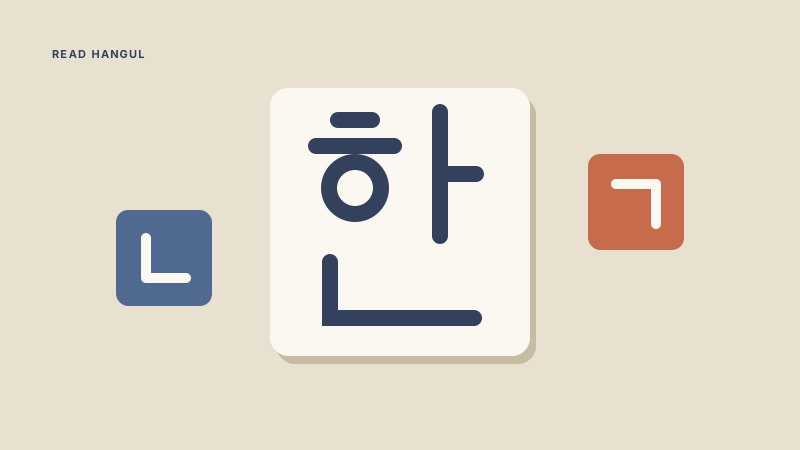
| Letters are grouped into syllable blocks | 한 is one block: ㅎ + ㅏ + ㄴ |
Once you know the pattern, many letters stop being separate things to memorize. Learning ㄱ and the "add a stroke" rule gives you ㅋ almost for free.
Card the letters in families
| Family | Letters | Romanization (approximate) |
|---|---|---|
| Basic consonants | ㄱ ㄴ ㄷ ㄹ ㅁ ㅂ ㅅ ㅇ ㅈ | g/k, n, d/t, r/l, m, b/p, s, silent or ng, j |
| Aspirated (one more stroke) | ㅋ ㅌ ㅍ ㅊ ㅎ | k, t, p, ch, h |
| Tense (doubled) | ㄲ ㄸ ㅃ ㅆ ㅉ | kk, tt, pp, ss, jj |
| Basic vowels | ㅏ ㅓ ㅗ ㅜ ㅡ ㅣ | a, eo, o, u, eu, i |
| Y vowels (one more short stroke) | ㅑ ㅕ ㅛ ㅠ | ya, yeo, yo, yu |
| Combined vowels | ㅐ ㅔ ㅘ ㅝ ㅚ ㅟ ㅢ and others | ae, e, wa, wo, oe, wi, ui |
Card each letter with its sound on the back, and if your app supports it, with audio. Letters that look alike, like ㅓ and ㅗ, or ㅂ and ㅁ, deserve a comparison card that names the difference, the same approach bird and plant identification flashcards uses for look-alike species. Romanization is only an approximation, and several Korean sounds do not map cleanly to English letters, so hearing them matters. Put the family rule on the back too, for example "ㅋ: k (aspirated). ㄱ plus one stroke."
Syllable blocks
Korean is written in blocks, each one syllable. Every block starts with a consonant (ㅇ as a silent placeholder if the syllable starts with a vowel), then a vowel, and optionally a final consonant (called batchim, 받침).
| Block shape | Example | Built from |
|---|---|---|
| Consonant + vertical vowel, side by side | 가 (ga) | ㄱ + ㅏ |
| Consonant + horizontal vowel, stacked | 고 (go) | ㄱ + ㅗ |
| With a final consonant underneath | 감 (gam) | ㄱ + ㅏ + ㅁ |
| Silent initial ㅇ | 아 (a) | ㅇ + ㅏ |
| ㅇ as a final consonant | 강 (gang) | ㄱ + ㅏ + ㅇ, where final ㅇ sounds like "ng" |
Once you know the letters, make cards with whole blocks on the front and their reading on the back. Start with simple blocks, then add ones with final consonants. Keep each card to one block, per the atomic encoding rule.
Final consonants and sound changes
Final consonants are where reading gets harder. Many final consonants reduce to one of seven sounds: ㄱ, ㄴ, ㄷ, ㄹ, ㅁ, ㅂ, ㅇ. For example, final ㅅ, ㅈ, ㅊ, ㅌ and ㅎ are typically pronounced like a final ㄷ (an unreleased t). And when a final consonant is followed by a vowel, it often moves over: 음악 (music) is read eu-mak.
Card these as rules with examples:
Front: How is a final ㅅ pronounced, as in 옷 (clothes)?
Back: Like an unreleased t: "ot."
Front: 한국어 (Korean language): how is it read?
Back: han-gu-geo. The final ㄱ of 국 links into the next syllable.
From letters to reading speed
| Stage | Practice | Goal |
|---|---|---|
| Letters | Single letter cards with audio | Instant recognition, under a second |
| Blocks | Syllable block cards | Read any simple block |
| Words | Common words: 사람 (person), 학교 (school), 감사합니다 (thank you) | Read whole words without spelling out letters |
| Real text | Signs, menus, song lyrics, children's books, subtitles | Reading in context |
The jump from blocks to real text is where most improvement happens. Reading Korean you encounter, even slowly, turns letter knowledge into reading skill. Like Japanese kana, the main skill is speed, which comes from volume. Hiragana and katakana flashcards covers a similar progression for Japanese.
After Hangul: vocabulary
Once you can read, Hangul flashcards turn into vocabulary flashcards. Most learners go to a frequency list of common words next. Spaced repetition for language learning covers the general method, and frequency list vocabulary flashcards covers choosing which words to learn first.
Where other resources are better
Many free resources teach Hangul well, including interactive websites and apps with audio and stroke order, and the Talk To Me In Korean lessons are popular with beginners. Writing each letter by hand a few times helps recognition for many learners, so do not rely only on cards. A Korean speaker or tutor can correct pronunciation, especially the difference between plain, aspirated and tense consonants, which is the hardest part for English speakers.
In Nebulearn, you can set a deck's back language to Korean so cards can be read aloud with your device's text to speech, and FSRS brings back the letters and blocks you hesitate on.
Logic, blocks, then real text
Hangul is designed to be learned fast. Card the letters in families using the stroke and doubling rules, add audio, and switch to syllable blocks by day four. Learn the final consonant rules with examples, then read real Korean as soon as you can, because reading speed comes from volume, not from more letter cards.