The 'Review-First' Rule: Why your new cards are killing your retention
Doing new cards before your daily reviews is a dopamine trap. Learn why the review-first mandate is the only way to maintain a long-term memory queue.
You should always finish your reviews before starting any new cards. If you add twenty new facts to your brain before clearing your due list, you are effectively choosing a feeling of progress over actual retention.
Hello there! My name is Daniel. I'm a third year engineering science student at UofT, specializing in machine intelligence. I also work on Nebulearn, which is a flashcard platform built on the FSRS algorithm. Because I build a study tool, I have a clear conflict of interest here, but the "Review-First" rule is a principle of cognitive science that applies whether you use my app, Anki, or a physical box of cards.
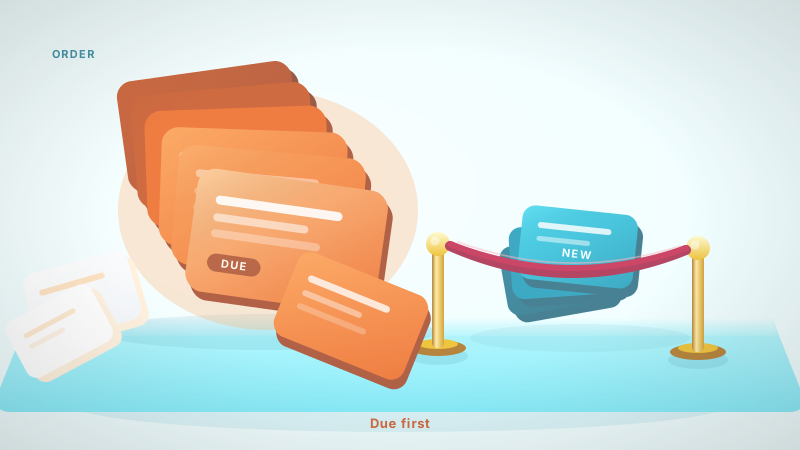
The choice between "New" and "Due" is where most students break their spaced repetition habit. It feels better to learn something fresh than to struggle with something you forgot from Tuesday. But that feeling is a trap.
The dopamine of new information
Learning a new concept provides an immediate hit of satisfaction. You understand the slide, you format the card, and you feel like you have "arrived" at a higher level of knowledge. This is the dopamine of novelty.
Reviews are the opposite. Reviews are often a grind. They represent the work of maintaining what you already claimed to know. When you open your app and see 50 due cards and 20 new cards, the 20 new ones look like a reward. The 50 due ones look like a chore.
If you do the new cards first, you use up your best mental energy on information that has not yet earned its place in your long term memory. By the time you get to the reviews, you are tired. You might skip the last ten, or worse, you might mark them as "Easy" just to get through the pile. This behavior breaks the spaced repetition system because the scheduler assumes you are being honest about your memory.
The sunk cost of old cards
Every card already in your system is an investment. You spent time reading the source material, creating the card, and reviewing it at least once. If you let a review lapse, that investment starts to decay.
Think of it like a garden. If you keep planting new seeds (new cards) but stop watering the plants you put in last week (reviews), the garden will eventually become a graveyard of dead plants. It does not matter how many seeds you have if nothing survives until harvest.
When you prioritize new cards over reviews, you are essentially saying that a fact you might learn today is more valuable than five facts you have already worked to keep. This is rarely true. In a technical degree like engineering or medicine, the foundation from last month is what allows you to understand the lecture this afternoon.
Why the order of operations matters
Spaced repetition relies on the "forgetting curve." The algorithm calculates the exact moment you are about to forget a fact and shows it to you then. This is the most efficient time to study.
If you delay a review because you were busy doing new cards, you are no longer studying at the optimal moment. You are studying after you have already forgotten. This turns a five-second "active recall" session into a two-minute "re-learning" session.
| Activity | Mental State | Goal |
|---|---|---|
| Reviews | High Effort / Recall | Protecting existing knowledge |
| New Cards | High Interest / Encoding | Expanding the knowledge base |
| Cramming | High Stress / Recognition | Short-term survival (Avoid this) |
If you only have fifteen minutes to study, and you spend ten of those on new cards, you have effectively abandoned the cards that were at their most vulnerable state. Over time, this creates a massive backlog that feels impossible to clear. This is why people quit Anki. They don't quit because the app is hard; they quit because their "Due" pile reached 500 and they lost the motivation to catch up.
How different apps handle the queue
The way your software handles this queue determines how much discipline you need to exert.
In Anki, you can change the "New/Review Order" in the deck options. You can set it to "Show after reviews," which is what I recommend. Anki is incredibly powerful, and if you are using it for a massive pre-made deck like AnKing, you should definitely use this setting. AnkiMobile costs about $25 on iOS, but the desktop and Android versions are free, making it the gold standard for long term control.
Quizlet is a bit different. Their free "Learn" mode is mostly session-scoped. They retired their "Long-Term Learning" feature a while ago. While they have a "Memory Score" on their Plus plan, it is not a full FSRS-based due queue. If you use Quizlet, you have to be much more manual about making sure you don't just keep hitting "New" sets while ignoring the old ones.
I work on Nebulearn. In the study screen, new cards wait until today's due count is zero. I did not want the Add button to win just because it feels better.
Managing the friction
If you find that your review pile is so large that you never get to do new cards, the answer is not to do the new cards first. The answer is to stop adding cards for a few days.
This is a signal that you are adding information faster than you can retain it. You might need to ask is 95 percent retention worth it for your specific goals. If you are a casual learner, a lower retention target might be fine. But for a student, the bottleneck is usually the volume of cards.
Try this tomorrow: Don't even look at the "New" count. Open your reviews, finish every single one, and only then allow yourself the "reward" of adding new material. You will find that your stress levels go down because you are no longer "behind" on your past self.