The 'Passive-to-Active' Ladder: Studying when your brain is fried
A tiered protocol for studying while exhausted. Learn how to stay productive without hitting a mental block by matching your tasks to your cognitive energy.
Hello there! If you're reading this, you probably just finished a nine hour day and the thought of opening your textbook makes you want to stare at a wall instead. I know that feeling well.
A litle about me first. My name is Daniel. I'm a third year engineering science student at UofT, specializing in machine intelligence. Between labs and building Nebulearn, I spend a lot of my life in that "fried" state where my brain feels like a browser with too many tabs open.
What I realized early on is that "studying" isn't one single activity. It is a collection of tasks with very different energy costs. When you are exhausted, you shouldn't try to synthesize new complex theories. You should move down the ladder to tasks that keep your momentum alive without breaking your spirit.
I work on Nebulearn, so I think about these workflows constantly. While I built the app to solve these bottlenecks, the protocol below works whether you use Anki, physical cards, or a notebook.
The cognitive load mismatch
Most students fail to study when tired because they try to do the hardest thing first. They open a 50 page PDF and try to "learn" it. This is high load encoding. It requires focus, logic, and the ability to spot what is actually important.
When you are tired, your executive function is the first thing to go. You can still read, you can still recognize patterns, but you cannot easily build new mental models. If you force the high load task, you end up "pseudo-studying" where you read the same paragraph four times and retain zero percent of it.
Instead of quitting, you need to match the task to your current battery level. We can categorize study tasks into three tiers.
| Tier | Task Type | Energy Required | Best For |
|---|---|---|---|
| Tier 3 | New Encoding | High | Morning / Post-nap |
| Tier 2 | Active Reviews | Medium | Afternoon / Early evening |
| Tier 1 | Maintenance | Low | Late night / Exhaustion |
Tier 3: Why you should never make cards after 9 PM
The most dangerous thing you can do when tired is create new flashcards or notes.
When your brain is fried, your "filter" stops working. You start making cards for every single sentence because you don't have the energy to decide what matters. This leads to what I call the "bloated deck" problem. You end up with 50 low quality cards for a single lecture that could have been covered by 10 good ones.
Bad cards are a debt you have to pay back every morning during your reviews. If you make a confusing card at 10 PM on Tuesday, you will spend three minutes trying to decipher it on Wednesday morning.
If it is late and you haven't started your new material, stop. Go to sleep. How to study with no motivation is the same idea: do the smallest honest version, not a hero session at 1 AM.
Tier 2: The "Just Ten" Review Rule
If you aren't fresh enough to make new cards, you might still be fresh enough to review existing ones.
Reviewing is easier than encoding because the prompt is already there. You aren't staring at a blank page; you are reacting to a question. This is the "active recall" phase. Even if you don't feel like doing your whole queue, doing a small batch prevents your flashcard mistakes from piling up into an unmanageable mountain the next day.
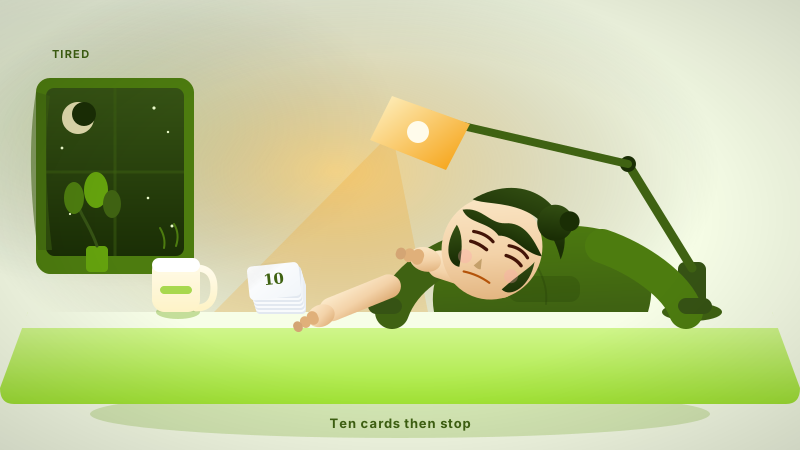
I usually tell myself I will only do ten cards. Usually, once I start, the friction disappears and I do fifty. But if I really am too tired to think, I stop at ten and move to Tier 1. That is a core part of what is spaced repetition: the schedule, not the intensity of a single night.
Tier 1: Maintenance and Card Cleanup
When you reach the point where even basic active recall feels like a chore, you should switch to clerical work. This is the lowest rung of the ladder.
If your brain is too tired to even answer "What is the function of the mitochondria?", you can still perform maintenance tasks that save you massive amounts of time during your high-energy windows. These tasks include:
- Fixing typos in your existing cards.
- Adding images or diagrams to cards you found difficult earlier that day.
- Tagging cards by week or topic.
- Moving cards into different folders.
When I work on Nebulearn, I try to make the interface fast enough that these Tier 1 tasks feel like scrolling a social feed. You are still "studying" because you are interacting with the material, but the cognitive cost is near zero.
Choosing your tool for the protocol
The ladder only works if your software doesn't get in the way. Your choice of app changes how much energy these tiers require, especially when you are trying to move quickly through maintenance tasks.
Anki is the gold standard for long term retention. It is free on desktop and Android, though AnkiMobile for iPhone is about $25. It is powerful, but the UI friction can make Tier 1 tasks feel like a chore. If you have to click through three menus just to fix a typo, you won't do it when you're tired.
Quizlet is great for a quick "session" before a test, but their free "Learn" mode is now session-scoped rather than a true due calendar. Their "Long-Term Learning" feature was retired years ago. If you want real spacing there, you usually have to pay for Plus, and even then, it doesn't use the modern FSRS algorithm.
I built Nebulearn to bridge this gap. FSRS is on by default, and the queue is meant to be light enough that a tired review still counts. Anki still wins if you live in AnKing.